Bolt Grades & Torque for Pole-Line Hardware
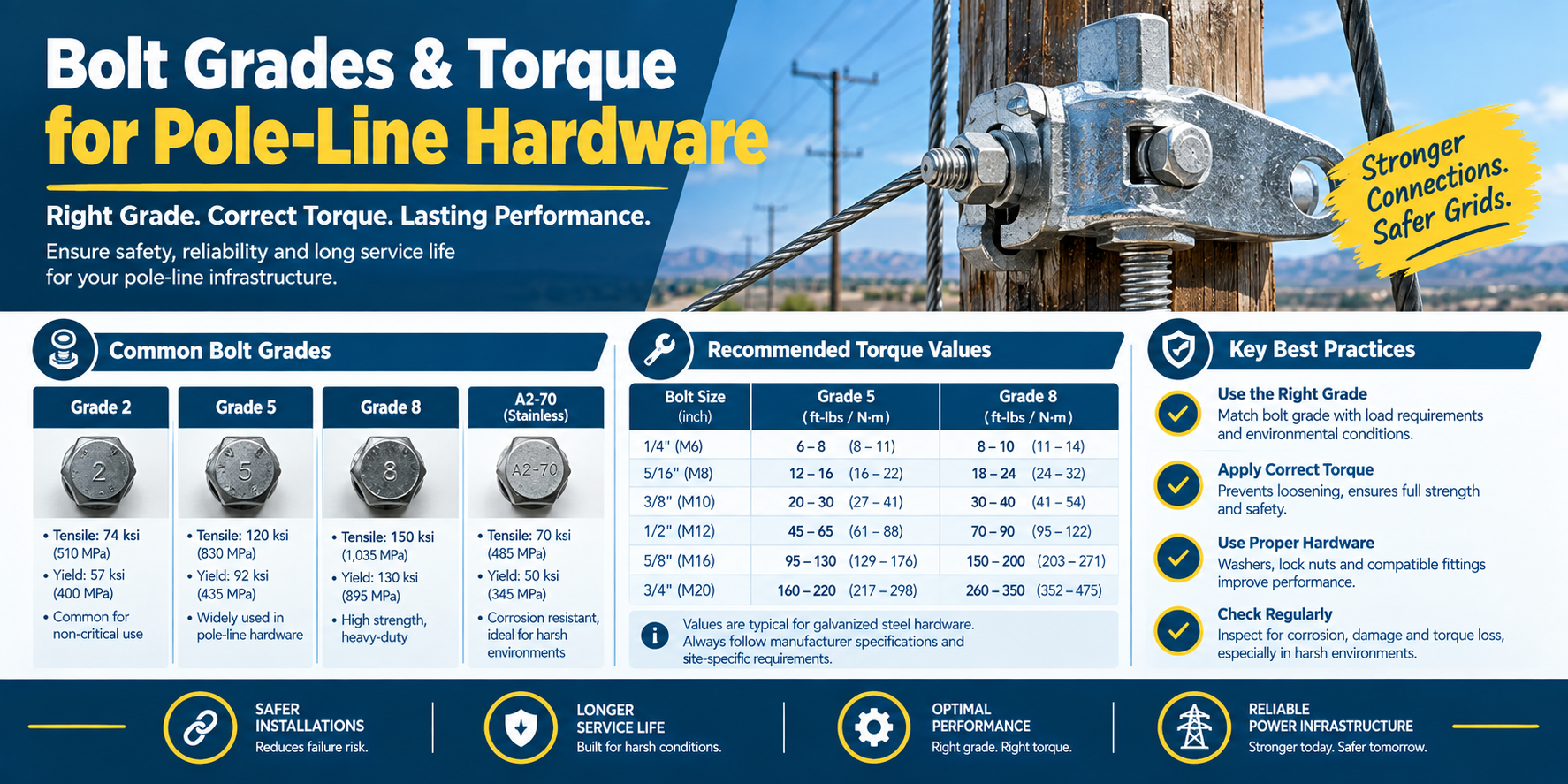
A bolt’s grade (or property class) tells you its strength how much tension and shear it can carry. Different standards mark grades differently (SAE grades, ISO property classes like 8.8/10.9, ASTM designations). Torque is the tightening force applied when installing, and it sets the bolt’s clamping force: under-torqued, a joint can loosen or slip; over-torqued, the bolt can be damaged or fail. For pole-line hardware, use the grade your specification requires, and torque every bolt to the specified value grade and torque together make a reliable, safe joint.
Bolts hold the whole line together, and two things determine whether a bolted joint is reliable: the bolt’s grade (its strength) and the torque it’s tightened to. Getting either wrong risks a loose or failed joint. This guide explains bolt grades and torque for pole-line hardware.
Why Grade and Torque Both Matter
A bolted joint works by clamping parts together with enough force that they act as one and don’t move under load. That clamping force depends on:
- The bolt’s strength (grade) a stronger bolt can be tightened to a higher clamping force without failing.
- The torque applied how hard the bolt is tightened, which creates the clamping force.
A high-grade bolt under-torqued gives a weak joint; a low-grade bolt over-torqued fails. You need the right grade and the right torque together.
Bolt Grades Explained
A bolt’s grade (or property class) is its strength rating mainly its tensile strength and yield strength. Different standards express it differently:
- SAE grades (e.g. Grade 2, 5, 8) common in North America, marked by lines on the bolt head.
- ISO property classes (e.g. 8.8, 10.9, 12.9) the numbers encode the tensile and yield strength; marked on the head.
- ASTM designations (e.g. A307, A325) for structural and specific applications.
The higher the grade/class, the stronger the bolt. For pole-line hardware, the specification (and standard see our bolt-standards guide) tells you which grade to use for each fixing. Don’t substitute a lower grade it may not carry the load. Confirm the grade marking matches the spec.
Torque Explained
Torque is the rotational force applied to tighten the bolt, usually measured in newton-meters (Nm) or foot-pounds (ft-lb). Applying the specified torque:
- Develops the correct clamping force in the joint.
- Keeps the joint tight under load and vibration.
- Stays within the bolt’s safe stress.
Under-torqued → too little clamping force → the joint can loosen, slip, or fatigue. Over-torqued → the bolt is stretched past its safe limit → it can yield, strip, or fail (sometimes later, under load). So torque is applied to a specified value for the bolt size and grade using a torque wrench for critical joints.
Why This Matters for Pole-Line Hardware
Pole-line bolts hold safety-critical assemblies crossarms, guys, terminations that carry conductor loads and line tension:
- A machine bolt or double-arming bolt fixing a crossarm must be the right grade and torqued so the arm doesn’t loosen under load.
- A bolt-type tension clamp or guy clamp develops its holding value only when its bolts are torqued to spec under-torqued, it can slip under the line tension or guy pull.
- A square washer spreads the clamping force so it doesn’t crush the member (especially timber).
So on a line, grade and torque aren’t just fastener details they’re what keeps the assembly holding. Use the specified grade, torque to the specified value, and use the correct washers.
Practical Fastening Tips
- Match the grade to the spec check the head marking against the required grade/class.
- Use a torque wrench for critical joints don’t guess by feel.
- Torque to the specified value from the design or standard for the bolt size and grade.
- Use the right washer to spread the load and protect the member.
- Galvanized finish for outdoor corrosion life (see our HDG-vs-electro-galvanized guide); note that galvanizing can affect torque-tension, so follow the spec for coated bolts.
- Re-check some joints are re-checked after initial loading.
Bolt Grades & Torque: FAQ
What does a bolt grade mean? A bolt’s grade (or property class) is its strength rating mainly its tensile and yield strength. SAE grades (2, 5, 8), ISO property classes (8.8, 10.9, 12.9), and ASTM designations all express strength; higher numbers mean stronger bolts. The grade is marked on the bolt head.
Why is bolt torque important? Torque sets the clamping force that holds a bolted joint together. Under-torqued, the joint can loosen, slip, or fatigue; over-torqued, the bolt can yield or fail. Torquing to the specified value develops the correct clamping force while keeping the bolt within its safe stress.
What happens if a bolt is over-torqued? Over-torquing stretches the bolt past its safe limit, so it can yield, strip its threads, or fail sometimes later under load. It reduces, rather than increases, the joint’s reliability. Always torque to the specified value rather than as tight as possible.
Can I use a lower-grade bolt if it’s the same size? No a lower-grade bolt of the same size is weaker and may not carry the load, even though it fits. Use the grade your specification requires, and check the head marking to confirm. Substituting a lower grade risks joint failure.
How do I know the right torque for a bolt? The torque comes from the design or the applicable standard for the bolt’s size and grade (and finish). Use a torque wrench to apply it for critical joints. Coated bolts (galvanized) can have different torque-tension behavior, so follow the spec for the actual bolt.
Why use a washer with a pole-line bolt? A washer (often a square washer) spreads the clamping force so the nut or head doesn’t crush or pull through the member especially important on timber poles. It protects the member and helps keep the joint tight.
The Bottom Line
A reliable bolted joint needs the right grade (the bolt’s strength, marked on the head to SAE/ISO/ASTM) and the right torque (the tightening force that sets the clamping force). For pole-line hardware, use the specified grade, torque every bolt to its specified value with a torque wrench for critical joints, and use the correct washers so crossarms, clamps, and terminations hold under load.
DAPENG Power (DP Power Fitting) manufactures pole-line fasteners to the grades and standards your project requires machine bolts, double-arming bolts, hex bolts and nuts, eye bolts, square washers, and more, within the pole line hardware range. Tell us your grade, standard, and application, and we’ll supply fasteners to spec.