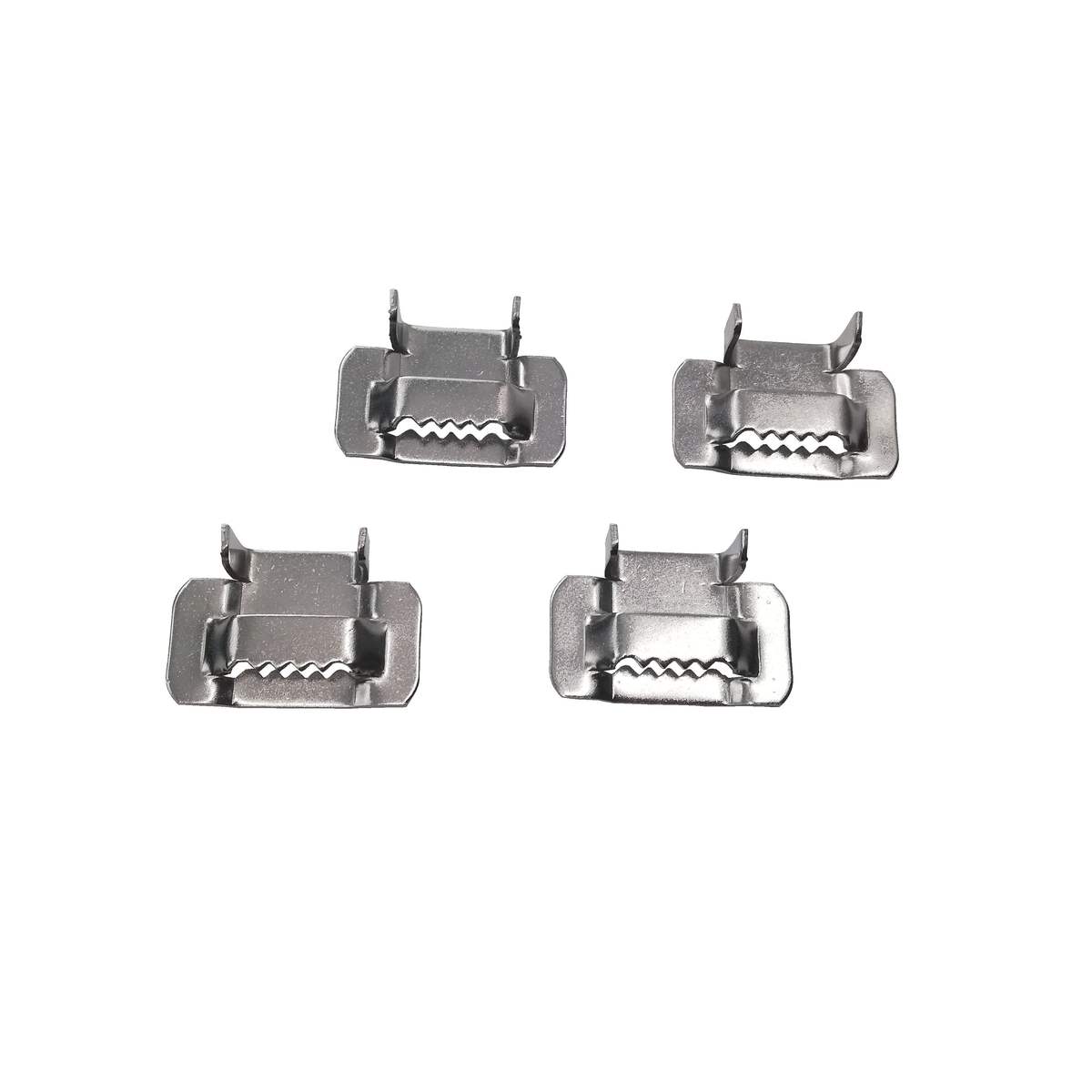
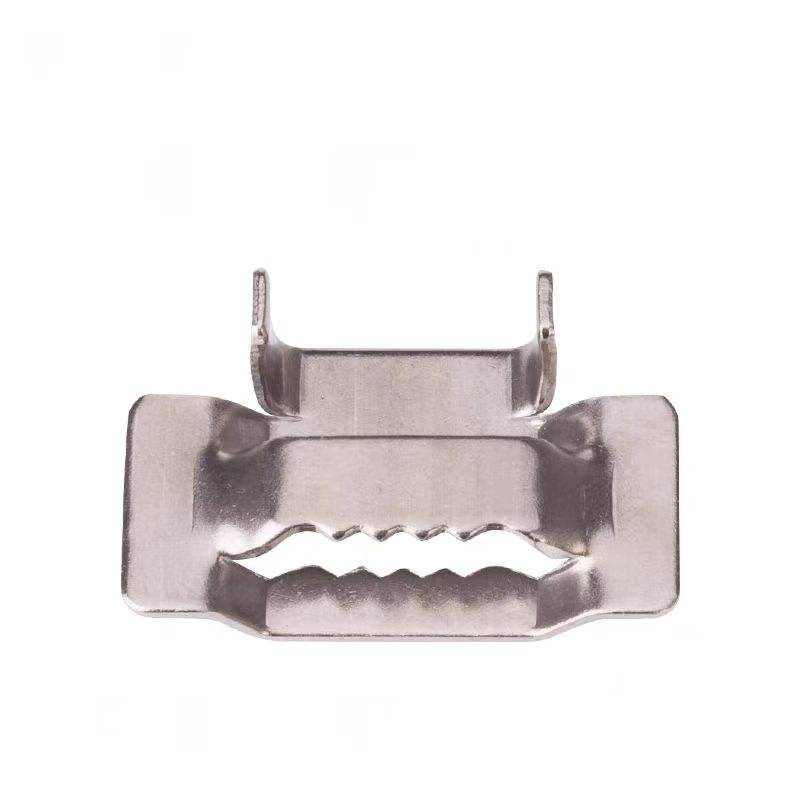
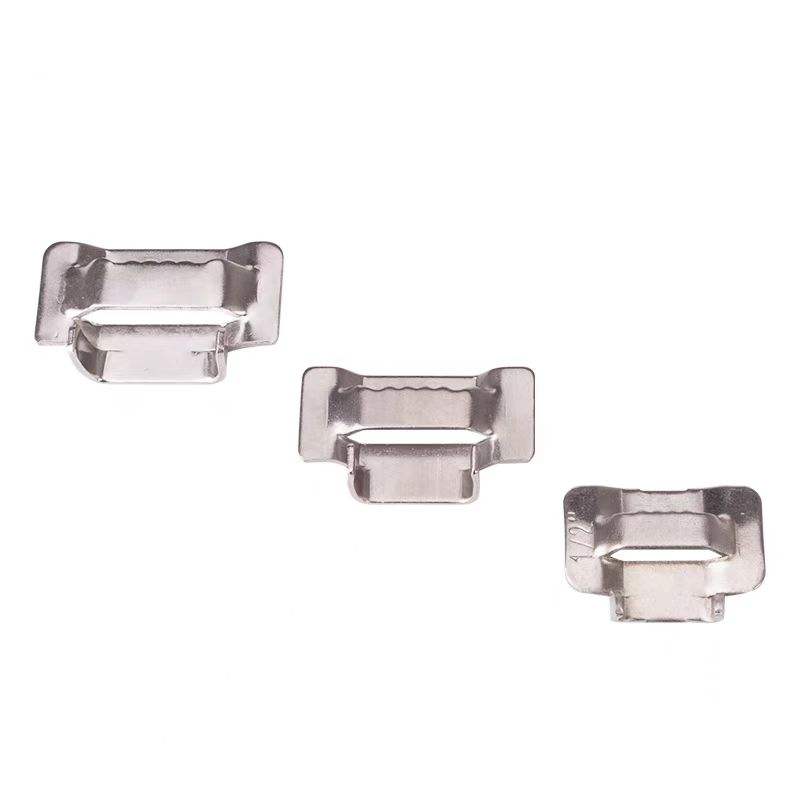
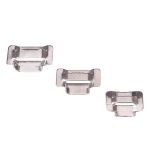
Description
Banded Fixings Don’t Usually Fail at the Strap. They Fail at the Buckle.
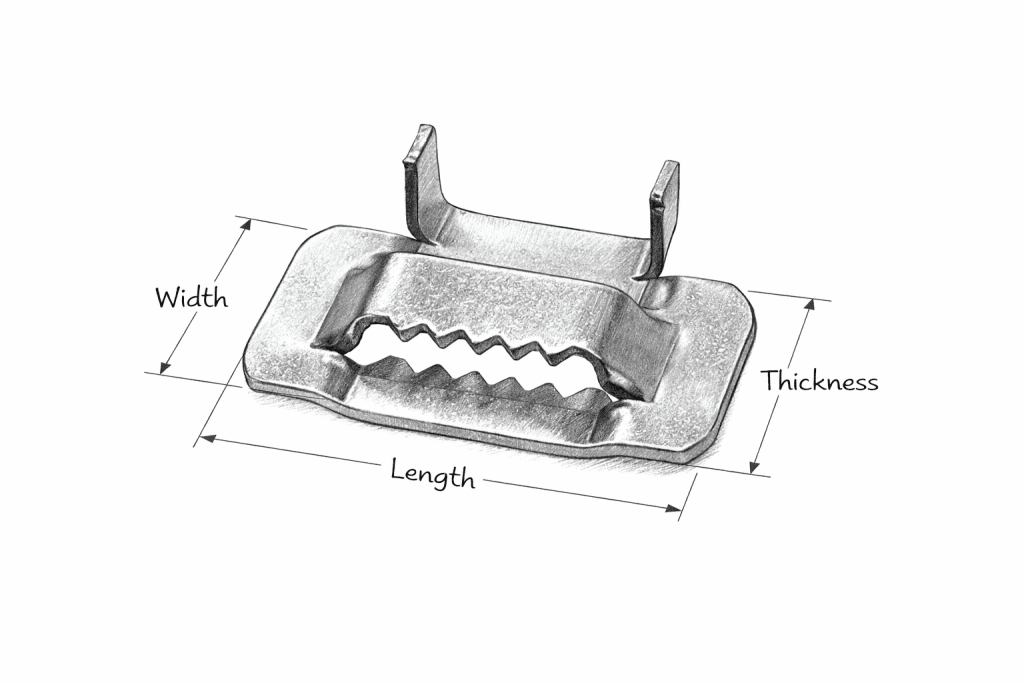
Ask anyone who has replaced pole-mounted hardware after a decade in the weather where the problem was. Rarely the strap itself; the stainless steel banding buckle has a working load far above what a bracket asks of it. The problem is the joint: a buckle that was under-tensioned on installation day, or one width too wide for the strap running through it, or one made thin and soft enough that years of wind loading slowly let the band creep back through.
The result looks the same in each case. A bracket that used to sit tight now moves a little. A junction box hangs slightly askew. And on a windy route, a fixing that was never quite right becomes one that isn’t holding at all.
The buckle is the smallest and cheapest part of a banded installation, and the part that decides whether it lasts. This page covers what to specify so yours does.
How a Banding Buckle Works
The strap wraps the pole and the hardware’s fixing lugs, then passes through the buckle and doubles back on itself. A hand tensioner pulls the loop tight; the buckle holds that tension while the excess strap is sheared off.
The holding mechanism differs by type:
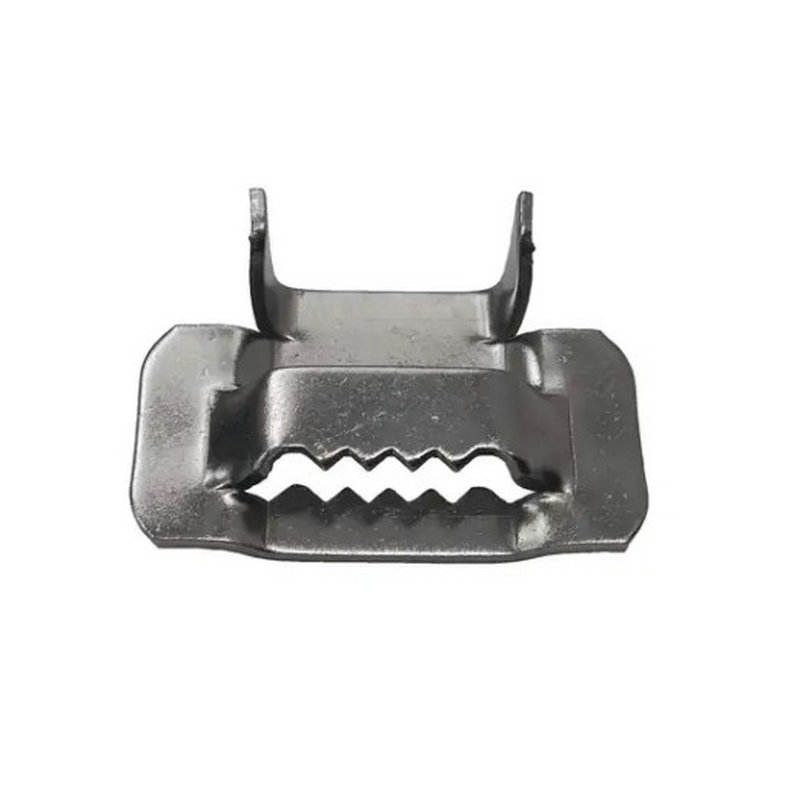
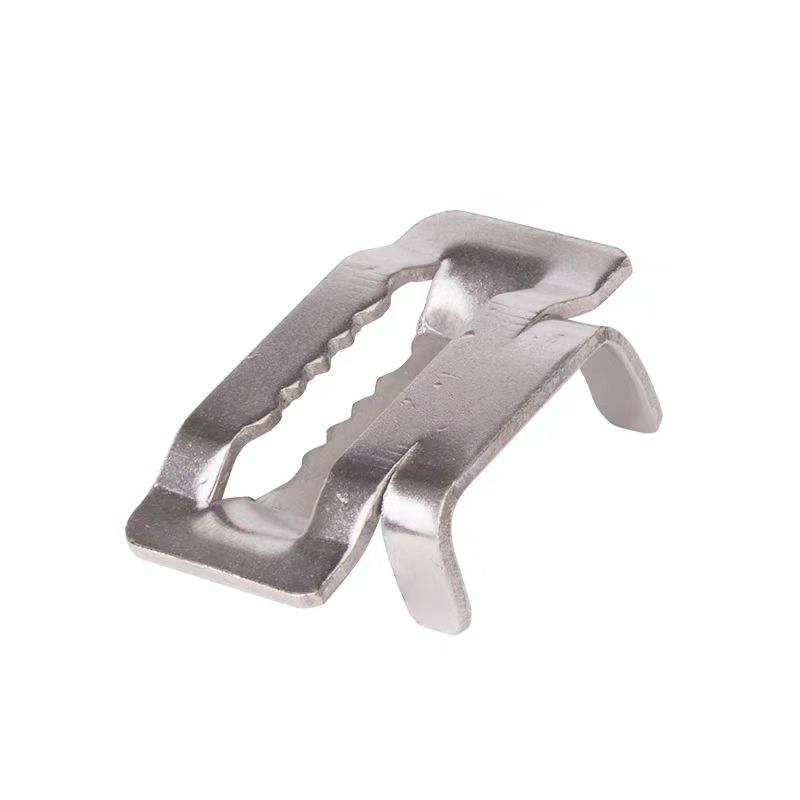
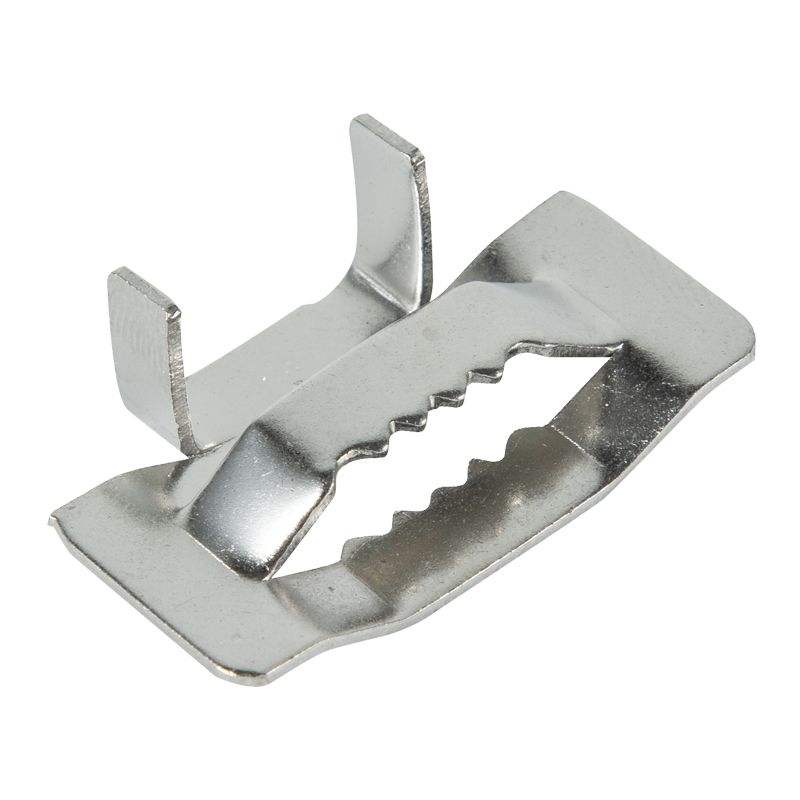
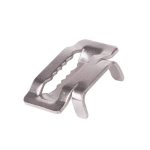
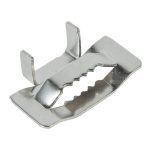
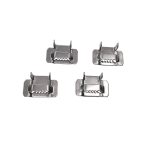
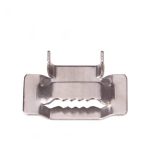
- Locking-ear buckles carry ears that are folded down over the strap during installation, mechanically locking it. Positive, tamper-resistant, and the common choice for permanent utility fixings.
- Open-back buckles hold by friction and the fold-back of the strap through the buckle body, quick to install, well suited to lighter fixings and to applications that may be re-worked.
- Wrap-type buckles suit heavier duty and repeated tensioning where the assembly may be adjusted.
Whichever type, three things determine whether the joint holds for thirty years: correct width, correct grade, and correct tension. The first two are your specification. The third is the tool.
The Two Specification Rules That Prevent Almost Every Banding Failure
Rule 1: The buckle width must match the strap width exactly
A buckle wider than the strap lets the band sit loose and skew inside it, concentrating load on one edge and allowing creep. A buckle narrower than the strap will not accept it at all, which at least fails visibly, on the ground, rather than quietly, in year six.
This sounds obvious and remains the most common wrong-order in the category, because strap and buckles are usually purchased as two separate line items by two different people. Order them together, from one supplier, in matched widths, and if your stores hold multiple widths, insist that cartons are marked by width so a clerk cannot issue a mismatched pair. Ours are.
Rule 2: The buckle grade must match the strap grade
This one is almost never discussed, and it matters more than the first.
If you specify 316 stainless banding strap for a coastal route, correctly, because chlorides demand it, and close it with a 201 buckle, you have bought 316 performance for the band and 201 performance for the joint. The joint is the smaller, more highly stressed, more exposed component. It will corrode first, and when it does, the excellent strap around it is holding nothing.
You have also created a mixed-metal joint at the wettest point of the assembly, which does the corrosion no favors.
So the rule is simple: same grade, strap and buckle. Ask both to be stated on your quotation, from any supplier, including us. Our quotations name the grade on every line, and coils and cartons are marked accordingly.
Why Buyers Choose DAPENG Banding Buckles
- Grade stated on every line: Not “stainless steel”, 201, 304 or 316, named in the quotation, marked on the carton, and backed by material certificates with the shipment.
- Matched to the strap in the same order: Buckles ship with the banding strap they’re intended for, in matching width and grade, so no one has to reconcile two purchase orders at the stores counter.
- Substance where it counts: Buckle thickness and ear geometry specified so the joint holds its tension rather than deforming into slack over years of wind loading.
- Consistent forming, batch to batch: A buckle whose ears fold cleanly on the first attempt is a buckle a crew can install a hundred times a day; one that cracks or springs back is a callback. Dimensional consistency is checked per production batch, with reports supplied.
- Rollout-scale packing: Counted and marked cartons for crew-level stock draws, batched to your programmer calendar, because banding hardware is what a rollout runs out of first.
Use-Case Deep Dive
Which buckle type should I specify for pole-mounted hardware?
For permanent utility fixings: junction boxes, aluminum ADSS supports, down lead clamps running at 1.5-2 m intervals down a structure, terminal brackets and grounding hardware, a positively locking buckle type is the sound choice: the mechanical lock resists the slow loosening that friction-only joints can suffer, and it resists casual interference.
For lighter or temporary fixings: signs, small brackets, hardware likely to be re-positioned, open-back types install faster and are easier to rework.
Send the list of what you’re mounting with the pole types, and the quotation returns buckle types per application rather than one type for everything.
Do I need a special tool, and how many?
Yes, a hand tensioner/cutter, and it is not optional. Hand-tightened banding does not reach the tension the joint’s holding capacity assumes, and locking-ear buckles need the tool to set the ears properly. Buy tools by the crew, not by the order: a rollout with twelve crews and three tools has nine crews improvising.
Tell us the number of crews you are equipping and tool quantities are quoted alongside the consumables.
How many buckles should I order per coil of strap?
More than the arithmetic suggests. Every fixing uses one buckle; some heavy fixings use two straps and two buckles; and crews lose, drop and mis-set them at height at a rate any experienced stores manager will recognize. Building in a sensible allowance costs a fraction of one truck roll to a site where a crew ran out.
Give us the fixing count and we will propose a buckle allowance with the strap quantity rather than leaving you to guess it, and if your programmer has real consumption history, tell us and we’ll use your number instead of ours.
Specifications and What They Mean for You
| Specification | What we supply | What it means for the buyer |
|---|---|---|
| Grades | 201 / 304 / 316 – stated per line, marked per carton | The joint matches the strap; no weak link at the most exposed point |
| Widths | Matched to strap widths | Correct fit; no skew, no creep, no wrong-width returns |
| Types | Locking-ear, open-back, wrap | Positive lock for permanent fixings; quick install for light duty |
| Material thickness | [CONFIRM] | Holds tension over decades instead of deforming into slack |
| Holding load | [CONFIRM per width/grade] | Fixings specified from tested figures |
| Forming quality | Batch dimensional checks, reports supplied | Ears fold cleanly first time, a hundred times a day |
Why so many markers: every number on this page will come from your factory’s own data. We do not publish holding loads or grade claims copied from another supplier’s catalogue, on a fixing that holds a junction box above a public footpath, a borrowed figure is worse than an honest blank.
Straight Answers to Common Buyer Concerns
“It’s the cheapest item on the pole. Does the supplier really matter?” The buckle is where banded fixings fail, so it is the one item on the pole where cheapness is measured in truck rolls rather than in currency. A buckle that costs a few cents more but is the right grade, the right width, and thick enough to hold its tension is the difference between a fixing you install once and one you revisit. Everything about that difference is checkable before you buy: material certificates, batch dimensional reports, samples for your own testing.
“Can we use your buckles with strap we already hold from another supplier?” Width for width, usually yes, but confirm before committing a programmer, because buckle and strap geometries vary between manufacturers at nominally identical widths, and grade may differ too. Send a sample strap and buckle, or clear photographs with a rule in frame, and we’ll confirm compatibility in writing. Mixed-vintage stores are normal; discovering the mismatch at the fortieth pole is avoidable.
“How do we QC hundreds of thousands of pieces?” Batch material certificates stating grade, dimensional and holding-load verification per batch with reports supplied, sampling plans to your QA standard, and third-party pre-shipment inspection (SGS/BV or your nominated agency) welcome at the factory. For programmer orders, take a sample carton first and fold a dozen ears on your own bench, five minutes there tells you more than any assurance in an email.
Complete the Banded Assembly
- Stainless steel banding strap – the other half of the system, width- and grade-matched
- Pole bands – pre-formed bands where a fixed-diameter fitting suits better
- Down lead clamps, junction boxes, aluminum ADSS supports, fiber optic closures – the hardware most often banded to poles
- Strand ground clamps – grounding hardware fixed by banding
- Browse all pole line hardware, ADSS/OPGW fittings and overhead line fittings
Get a Matched Quote Within 24 Hours
Send your strap width and grade (or let us quote both together), the environment, what you’re mounting, and the fixing count. We return a factory-direct quotation with grade named per line, buckles matched to strap, a sensible buckle allowance, and tool quantities per crew, typically within one working day.
After You Order
Material certificates stating grade with every shipment, cartons marked by width and grade so stores cannot issue a mismatched pair, buckles packed alongside their strap, and an engineering contact who answers while the crew is still on the pole, because banding hardware is what a programmer runs short of first, and a supply question shouldn’t cost a day’s connections.