What Is BIL? Insulation Coordination on Overhead Lines
BIL stands for Basic Insulation Level, the standard lightning-impulse voltage that insulation is designed to withstand without flashover or damage. It’s expressed in kV and rates how well insulators and equipment survive surge voltages (mainly lightning). Insulation coordination is the practice of choosing the BIL of each component so that if a surge exceeds the system’s capability, it flashes over at a safe, chosen point (like an insulator or arrester) rather than damaging expensive equipment. In short, BIL is the surge-withstand rating, and insulation coordination arranges those ratings to protect the line intelligently.
BIL and insulation coordination are core high-voltage design concepts that decide how much insulation a line needs and how it behaves under surges. Engineers meet these terms when spec’ing insulators. This guide explains them clearly.
What Is BIL?
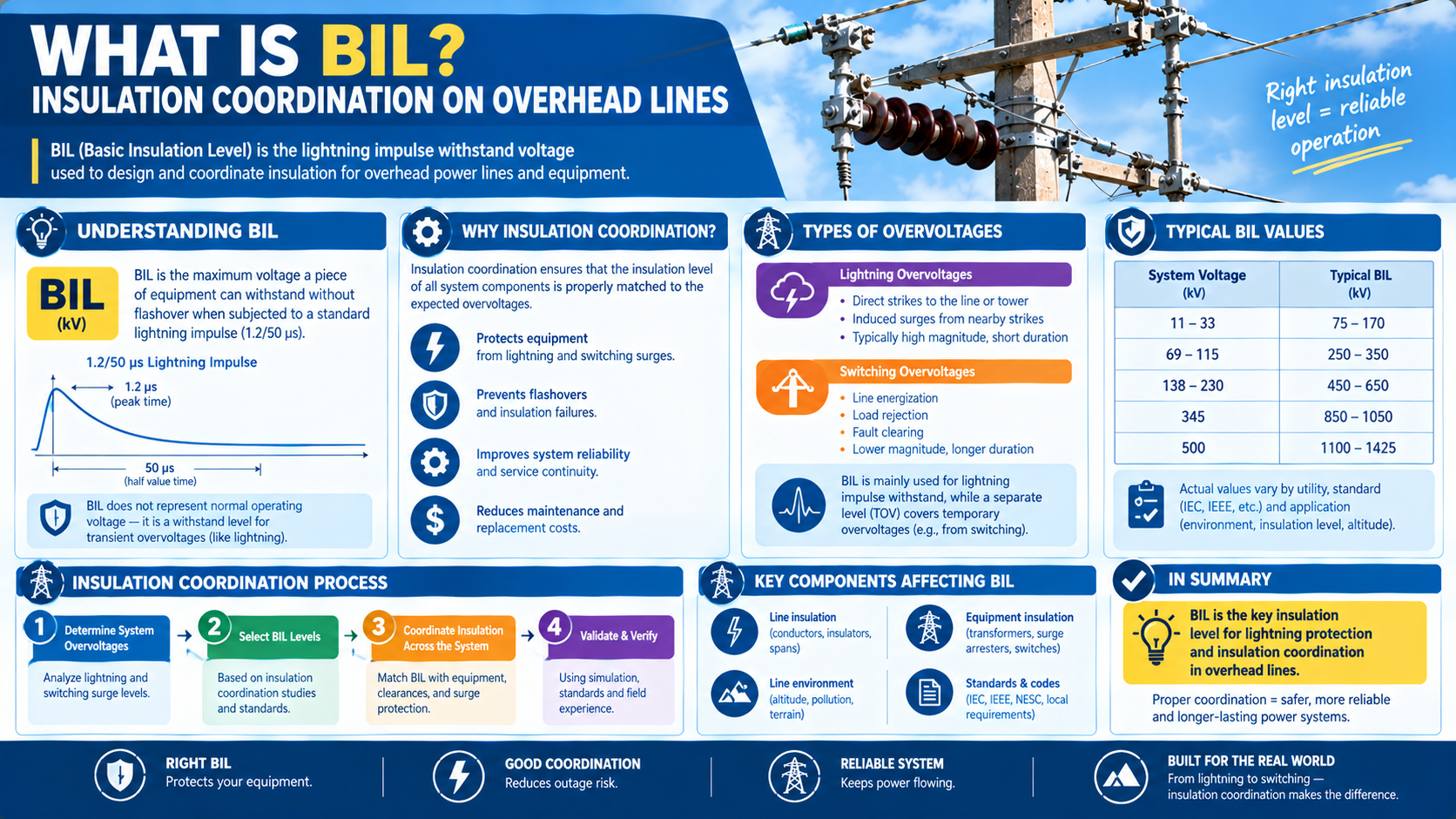
BIL (Basic Insulation Level) is the lightning-impulse withstand voltage the peak surge voltage that a piece of insulation (an insulator, a transformer, a bushing) is designed to withstand without flashing over or being damaged. It’s given in kV, using a standard impulse waveform that represents a lightning surge.
So when an insulator is rated for a certain BIL, it means: “this insulator can survive a lightning-type surge up to this voltage without failing.” BIL is separate from the power-frequency (AC) withstand voltage it specifically rates surge (impulse) performance, which is what lightning produces. (See our insulator-specifications guide for the full rating set.)
Why Surges Need a Withstand Rating
Overhead lines face two kinds of overvoltage:
- Lightning surges fast, very high-voltage transients from strikes.
- Switching surges slower transients from switching operations (important at the highest voltages).
Normal operating voltage is well within the insulation’s capability, but these surges can be many times the operating voltage. BIL rates whether the insulation survives them. Insulation with too low a BIL flashes over or fails under surges; enough BIL rides them through. (See our lightning-protection guide.)
What Is Insulation Coordination?
Insulation coordination is the practice of choosing the BIL of each component across the system so they work together sensibly under surges. The key idea: you can’t make everything infinitely surge-proof, so you arrange the withstand levels so that:
- Expensive, hard-to-replace equipment (transformers, substations) has a higher protective margin.
- Cheaper, self-restoring insulation (line insulators) or surge arresters flash over or operate first, at a lower level, diverting the surge safely.
So if a surge exceeds the system’s capability, it discharges at a chosen, safe point a line insulator flashover (which self-restores) or an arrester operation rather than puncturing a transformer. Insulation coordination is essentially designing where the insulation gives way, so it gives way somewhere harmless.
How BIL Drives Insulator Selection
For the line, BIL is one of the ratings you match when selecting insulators:
- A suspension string‘s BIL increases with the number of discs more discs, higher impulse withstand. So the voltage and required BIL set the string length.
- A pin or post insulator has a BIL rating for its class.
- At high voltages, corona rings manage the field (a related but different issue corona vs surge).
Selecting an insulator means matching its BIL (surge withstand) along with its power-frequency withstand, creepage (pollution), and mechanical rating all four together. (See our insulator-specifications and creepage guides.) The specific BIL values come from the standards and the datasheet for your voltage confirm them for your line.
What Is BIL? FAQ
What does BIL stand for? BIL stands for Basic Insulation Level the standard lightning-impulse voltage (in kV) that insulation is designed to withstand without flashover or damage. It rates how well an insulator or equipment survives surge (lightning) voltages, as distinct from normal power-frequency voltage.
What is the difference between BIL and operating voltage? Operating voltage is the normal AC voltage the line runs at; BIL is the much higher surge (lightning-impulse) voltage the insulation can withstand. Surges can be many times the operating voltage, so BIL rates survival of those transients, not normal operation.
What is insulation coordination? Insulation coordination is choosing the surge-withstand (BIL) levels of components across a system so that, if a surge exceeds capability, it discharges at a safe, chosen point a self-restoring line insulator flashover or a surge arrester rather than damaging expensive equipment like transformers. It arranges where the insulation gives way.
How does BIL affect insulator selection? BIL is one of the ratings you match when selecting insulators. For a suspension string, adding discs raises the BIL, so the voltage and required BIL set the string length. You match the insulator’s BIL along with its power-frequency withstand, creepage, and mechanical rating all four for your line.
Why do transformers have a higher protection margin than line insulators? Because transformers are expensive and hard to replace, while line insulators are cheaper and self-restoring (a flashover clears without permanent damage). Insulation coordination gives equipment a higher protective margin and lets line insulators or arresters give way first, protecting the costly equipment.
Is BIL the same as impulse withstand voltage? Yes BIL (Basic Insulation Level) is the lightning-impulse withstand voltage, the standard surge voltage the insulation withstands. It’s sometimes written as LIWV (Lightning Impulse Withstand Voltage). It rates impulse/surge performance, separate from the power-frequency (AC) withstand rating.
The Bottom Line
BIL (Basic Insulation Level) is the surge-withstand rating of insulation the lightning-impulse voltage it survives without flashover and insulation coordination arranges those ratings across the system so surges discharge at a safe, chosen point rather than damaging equipment. For the line, BIL is one of the four ratings (with power-frequency withstand, creepage, and mechanical strength) you match when selecting insulators.
DAPENG Power (DP Power Fitting) manufactures insulators across the range pin, post, and suspension types and complete strings to IEC/ANSI standards, with BIL and the other ratings confirmed for your line. Tell us your voltage and required BIL, and we’ll specify insulators (and string length) to meet it.