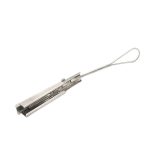
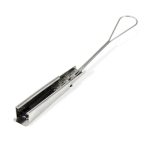
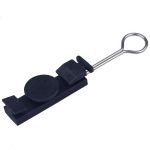
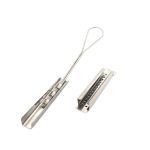
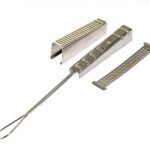
Description
What Holds a Service Drop for Twenty-Five Years Without Crushing the Fiber Inside?
The last span of every telecom network is also its most exposed: the service drop, stretched from pole or strand to a subscriber’s wall, carrying wind load, ice load, thermal cycling, and, buried in that small cable, the glass fiber the customer is paying for. The hardware question sounds simple and isn’t: how do you grip a drop cable hard enough to hold decades of tension, but gently enough never to damage the fiber?
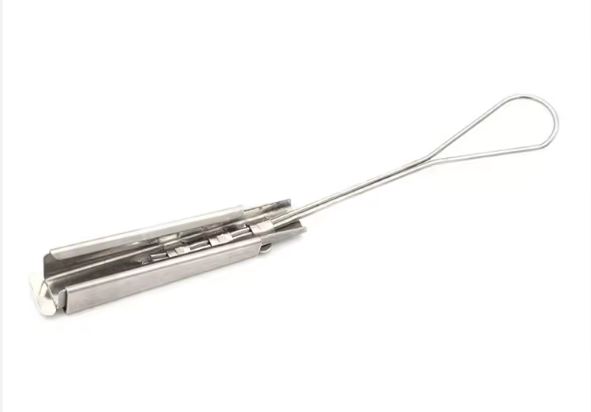
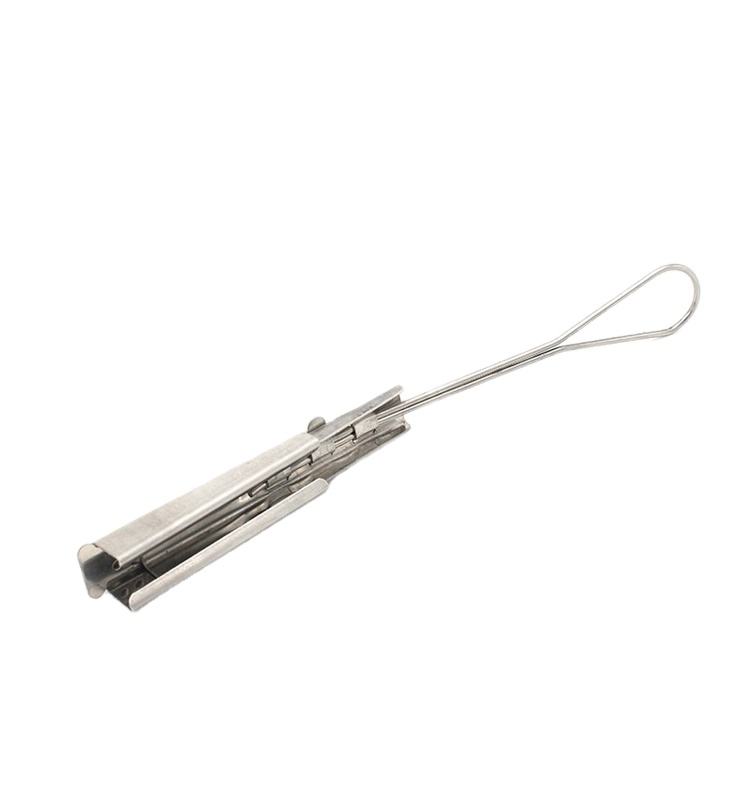
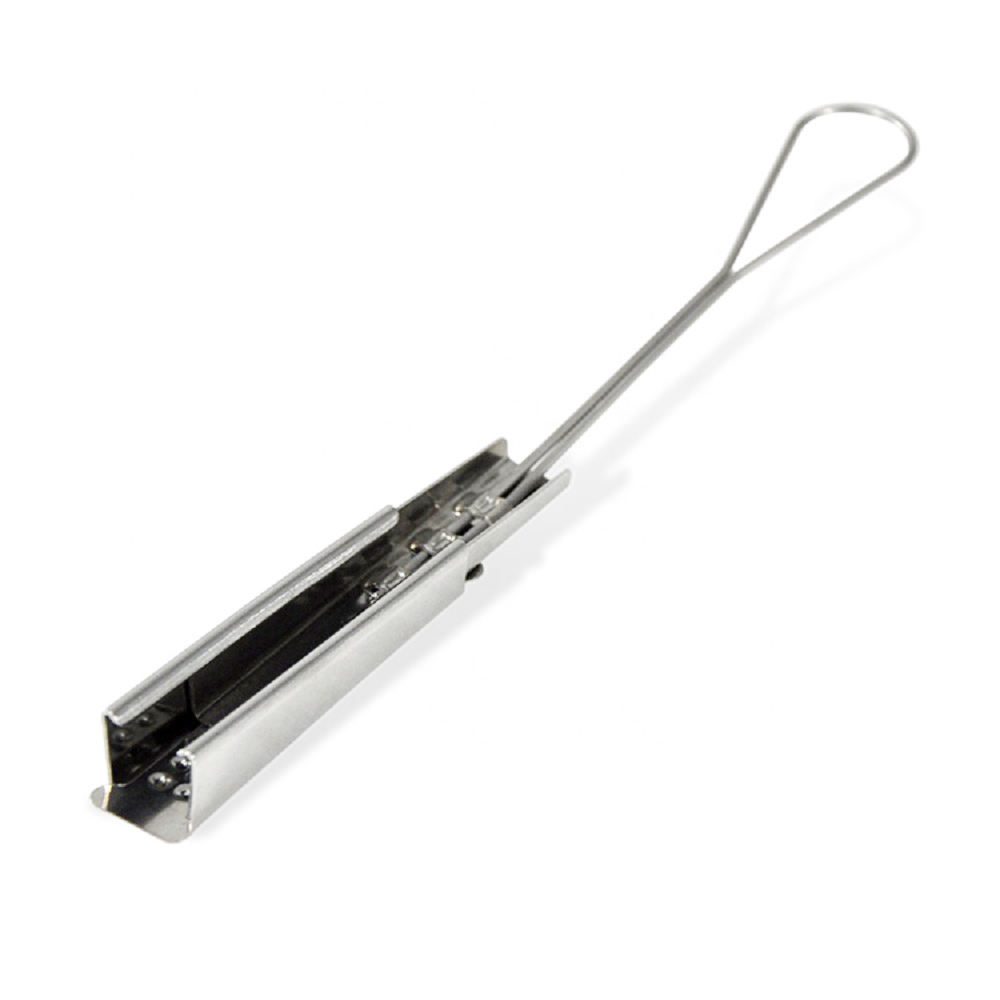
Bolted clamps answer it badly; clamping force is fixed at whatever the installer’s wrist decided, crushing the cable or releasing it. The drop wire clamp answers it with geometry: a wedge mechanism in which the cable’s own tension does the gripping. If your FTTH rollout, telephone plant, or drop-replacement program is specifying anchor hardware for service drops, this is the fitting, and the mechanism below is why it works at the millionth installation exactly as it did at the first.
The Mechanism: Why the Wedge Grip Gets Stronger as the Load Grows
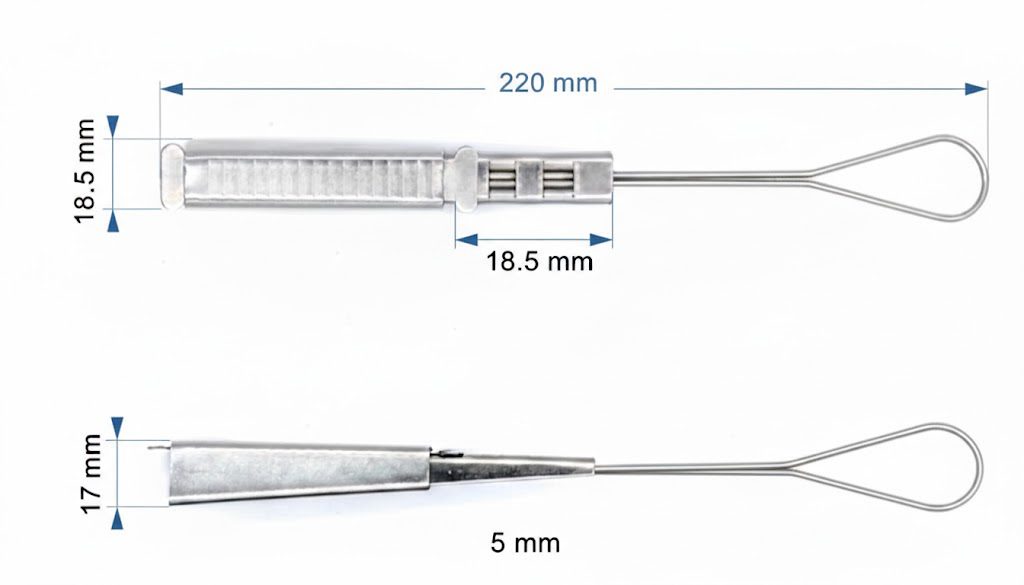
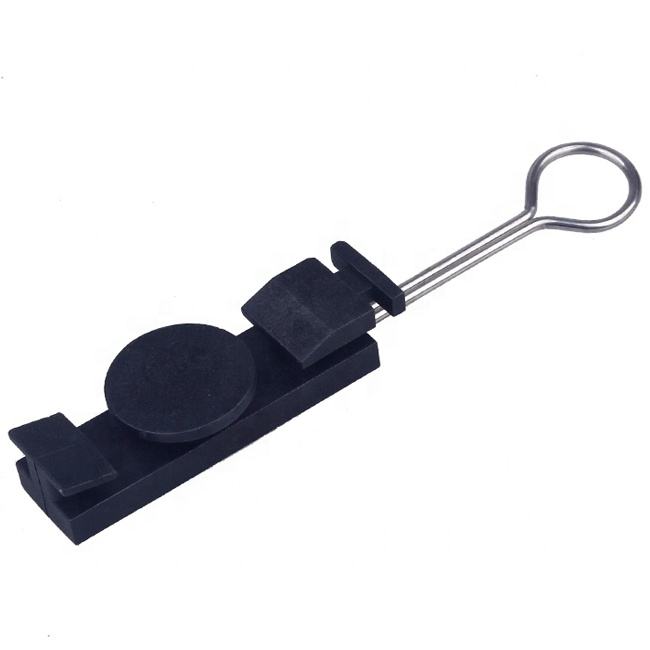
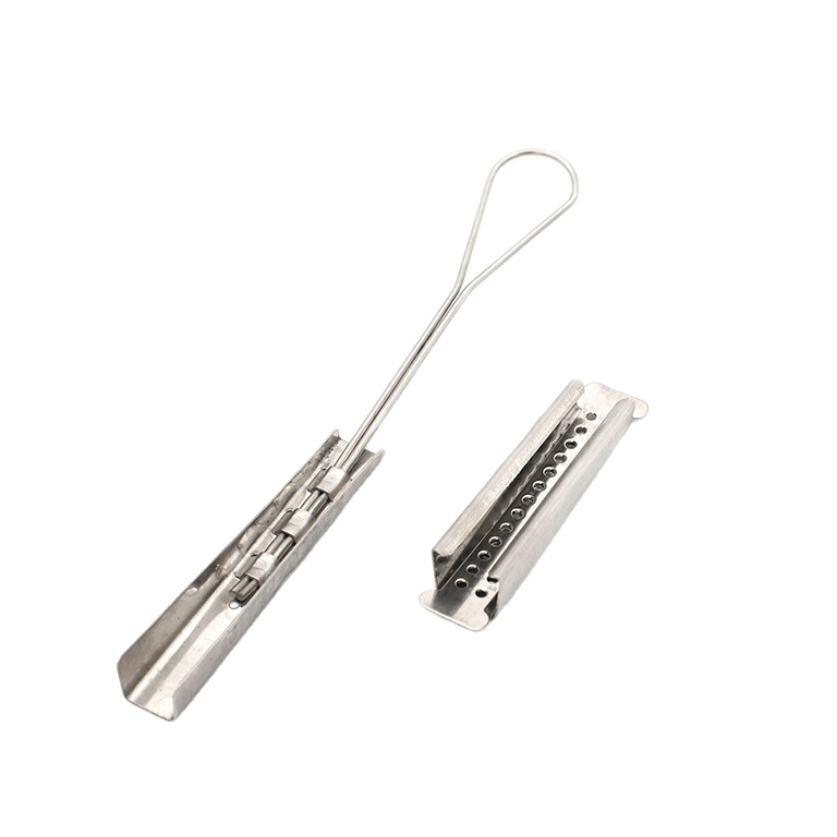
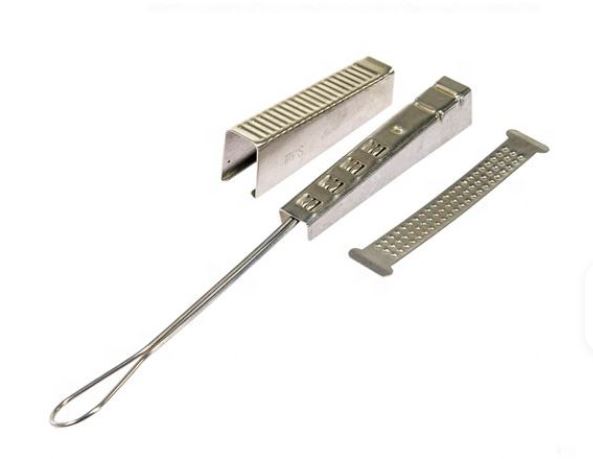
Inside the clamp body, the drop cable lies between shaped wedges (or within a wedge-and-shell channel, depending on pattern). The clamp’s bail, the loop or hook that attaches to the pole hardware, connects to the wedge system, not rigidly to the body. When the cable pulls, it draws the wedges deeper into their tapered channel; the taper converts pull into clamping force, spread across the wedges’ full contact length.
The consequences are exactly what a drop needs:
- More tension → more grip. Wind gusts and ice load tighten the hold instead of testing it.
- Force spread over length, not concentrated at bolts. The fiber inside sees distributed, moderate pressure, never a crush point.
- Installation quality is built into the geometry. There is no torque spec for a tired installer to miss at the fortieth drop of the day: seat the cable, load the wedge, hang the bail. The physics does the rest.
It is the same design philosophy as the shear-head bolt on our insulation piercing connectors: on hardware installed ten thousand times by many hands, correctness must live in the product, not the procedure.
Why Buyers Choose DAPENG Drop Wire Clamps
- Matched to the drop cable you actually run. Flat telephone drops, round FTTH drops, figure-8 self-supporting drops, each takes a wedge profile shaped to it. Send the cable datasheet; the clamp in the carton is the clamp for that cable, confirmed in writing.
- Materials chosen for a no-maintenance life. Stainless steel bodies and bails with engineering-plastic, UV-stabilized wedges for the harshest exposures; economical all-polymer patterns where the load and environment allow. Both live outdoors for decades without a visit.
- Fiber-safe by design. Wedge faces and channel radii sized so minimum bend radius and crush limits of common drop constructions are respected under full working load, the difference between a connected customer and an attenuation ticket.
- Rollout-scale supply and QC. FTTH programs consume these by the ten-thousand: batch load testing with reports, coating/material verification, cartons counted and marked for crew-level stock draws, production batched to your activation calendar.
- Every fitting on the drop path, one factory. The clamp is one of three touchpoints, and we manufacture all three (next section), plus the strand and ABC hardware upstream of them.
The Complete Drop Path: Three Touchpoints, One Kit
1. The pole or strand end. The drop begins at a pole fitting, a hook, a pole band with attachment, or banding straps, or hangs mid-span from a span clamp gripping the messenger strand directly above the premises. A drop wire clamp’s bail loops onto that point and anchors the cable’s first end.
2. The building end. At the subscriber’s wall, a second drop wire clamp anchors the cable to a wall hook or thimble eye bolt, setting the drop’s sag and taking its tension before the cable turns down to the entry point.
3. The network behind it. The fiber the drop carries originates at a fiber optic closure up the line; on powered ABC routes, the electrical service tap beside it is made with an insulation piercing connector. Order the drop program as a kit, clamps, span clamps, hooks, bands, closures, and every touchpoint arrives matched, counted, and documented together.
Use-Case Deep Dive
Which drop wire clamp do I need for FTTH figure-8 drop cable?
A wedge clamp profiled for the figure-8 section, one that seats the messenger portion in the wedge channel while the fiber unit rides unloaded. Specify by the cable’s overall dimensions and messenger size from the datasheet; we confirm the profile match at RFQ. For round FTTH drops, the equivalent round-profile pattern applies. The rule for all of them: the clamp is selected by the cable’s cross-section, not by “fiber drop” in general, two minutes with the datasheet at RFQ versus attenuation calls after energizing the neighborhood.
Can the same clamp anchor the drop at both the pole and the house?
Yes, and that’s the standard practice: one clamp at each end of the span, each bailed to its attachment (pole fitting or wall hook/thimble eye bolt). Order two per drop plus your standard’s spare factor. Where the drop leaves from mid-span rather than the pole, the pole-end clamp hangs from a span clamp on the strand instead, same drop clamp, different upstream attachment.
Stainless-body or all-plastic, how do I choose?
By load, span, and exposure. Stainless-bodied wedge clamps carry the heavier drops, longer spans, coastal and high-UV environments, and any program where “install once, never return” is the specification. All-polymer patterns suit short, light drops in benign environments at lower unit cost. Mixed networks commonly standardize on stainless for spans and polymer for short courtyard drops, tell us the span profile and we’ll propose the split, with both patterns marked distinctly on the cartons.
Specifications and What They Mean for You
| Specification | What we do | What it means for the buyer |
|---|---|---|
| Mechanism | Self-tightening wedge grip; bail-loaded | Grip grows with load; no torque spec to get wrong |
| Cable matching | Profiles for flat, round, and figure-8 drops, confirmed per datasheet | The clamp fits the cable you run, not a generic “drop” |
| Materials | Stainless steel body/bail + UV-stable polymer wedges; all-polymer economy patterns | Decades outdoors, coastal-rated where you need it |
| Fiber safety | Bend radius and crush limits respected at working load | Connected customers, not attenuation tickets |
| Load ratings | Rated per pattern; batch load-tested, [CONFIRM final table from factory data] | Publish real ratings; safety factors on tested numbers |
| Packing | Rollout cartons, counts/markings per PO | Crews draw the right clamp for the right cable, every day |
Straight Answers to Common Buyer Concerns
“These cost cents, why does the supplier matter?” Because the failure costs hundreds: a slipped drop across a driveway is a truck roll, a liability exposure, and a churned customer. The difference between a clamp that holds for twenty-five years and one that creeps loose in five is wedge geometry, material grade, and batch testing, all invisible in a product photo, all verifiable in our test reports and your own sample trial before the program order.
“How do we QC an order of fifty thousand pieces?” By batch and by sample, the same regime as our other rollout hardware: load testing and material verification per production batch with reports supplied, sampling plans per your QA standard, third-party pre-shipment inspection (SGS/BV or your agency) welcome, and trial samples for your own pull-testing before you commit. Fifty units on your test bench beat fifty thousand doubts in your warehouse.
“Our network runs three different drop cables from two eras. Can one supplier cover it?” Yes, that’s a profile-matching exercise, not a problem. Send the datasheets (or sample lengths of the legacy cables); the quotation returns with a clamp pattern per cable, distinctly marked cartons, and a one-page crew card showing which clamp goes on which cable. Mixed plant is normal; mismatched hardware is optional.
Complete the Drop Program
- Span clamps – mid-span attachment on the strand, the drop clamp’s upstream partner
- Thimble eye bolts – the wall-end anchor point
- Pole bands and stainless steel banding straps – pole-end attachments
- Fiber optic closures – where every drop begins
- Browse all ADSS/OPGW fittings for the full aerial fiber range
Get a Rollout-Ready Quote Within 24 Hours
Send your drop cable datasheets, span profile, and connection targets. Our engineers confirm the wedge profile per cable and return a factory-direct quotation, typically within one working day, with the span clamps, hooks, and closures of the same program quoted alongside if you wish.
After You Order
Profile-confirmation sheet before production, batch test reports with every shipment, cartons marked by cable type for error-free issue, and an engineering contact who answers while the crew is still on the ladder, because drop programs are measured in connections per day, and hardware questions can’t cost you an afternoon.