HT vs LT Lines: What’s the Difference?
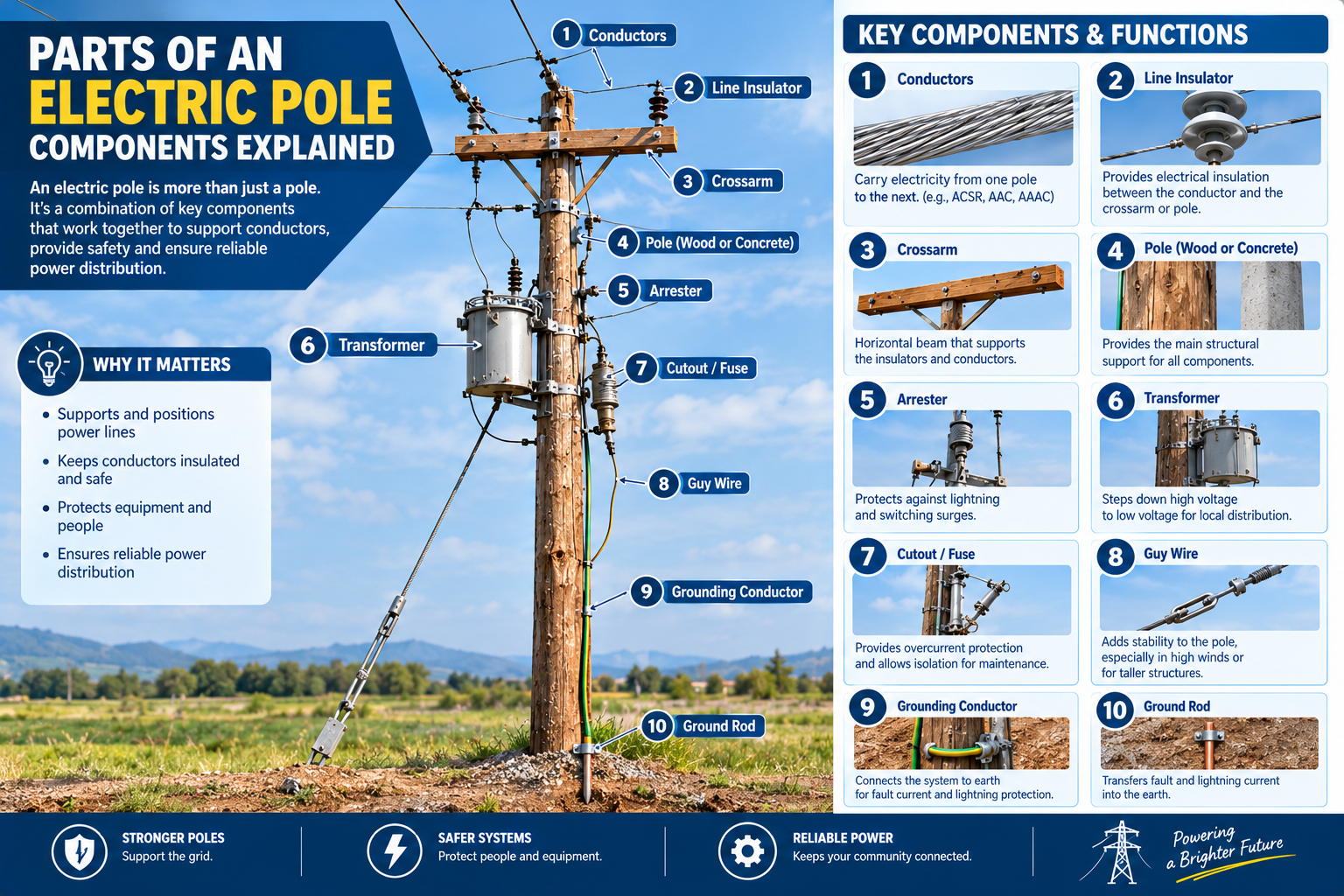
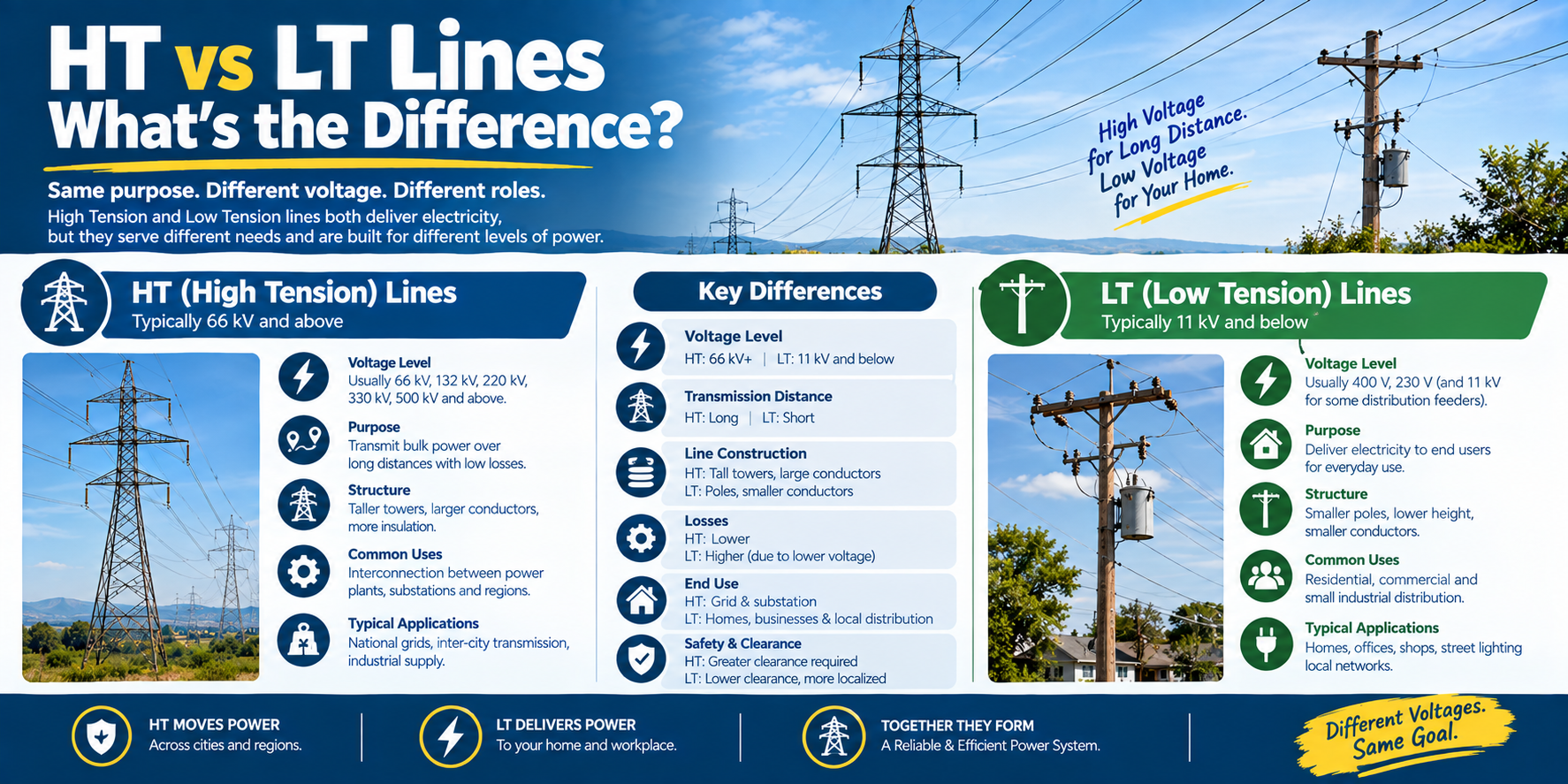
HT (High Tension) lines carry electricity at high voltage; for example, the primary distribution lines at the top of the pole, while LT (Low Tension) lines carry the lower voltage that reaches homes and businesses on the secondary/service side. “Tension” here means voltage, not mechanical tension. HT lines need more insulation (pin/post insulators, wider spacing) and heavier fittings; LT lines use simpler hardware (spool insulators on racks). On a distribution pole, the HT line runs on the crossarm at the top and the LT line below it.
“HT” and “LT” are everyday terms in power distribution across Asia, Africa, and the Middle East, and people often ask exactly what they mean and how they differ. This guide explains HT vs LT lines and the hardware each uses.
What Do HT and LT Mean?
- HT = High Tension “high voltage” An HT line carries electricity at a higher voltage (the primary distribution voltage).
- LT = Low Tension “low voltage.” An LT line carries the lower voltage that supplies end users.
“Tension” here means voltage, not mechanical tension or pulling force a common point of confusion. So an HT line is a high-voltage line and an LT line is a low-voltage line. (The exact voltage bands for HT and LT vary by country and standard.)
Where HT and LT Fit in the Network
Electricity flows from generation through transmission to distribution and then to users. In the distribution network:
- The HT line is the primary distribution line higher voltage, running along the top of the poles between the substation and the distribution transformers.
- A distribution transformer steps the HT voltage down to LT.
- The LT line is the secondary/service line lower voltage, running below the HT line on the pole, carrying power to homes and businesses.
So on a typical distribution pole, you often see the HT line at the top (on the crossarm) and the LT line lower down (on a rack), with a transformer between them.
HT vs LT: The Hardware Difference
Because HT is higher voltage and LT is lower, they use different hardware:
HT line hardware
- Insulators rigid pin or post insulators (more insulation, wider spacing for the higher voltage), on pins.
- Crossarm a steel crossarm holding the conductors out and apart.
- Conductor fittings suspension or strain clamps / dead-end grips to support or terminate the conductor.
- Guys at angles and dead-ends.
LT line hardware
- Insulators small spool insulators for the low-voltage conductors.
- Support a secondary rack (several conductors) or D-bracket (one), holding the spools.
- Simpler and more compact than HT hardware, because the voltage and spacing needs are lower.
The higher the voltage (HT), the more insulation and the heavier the hardware; LT is simpler and more compact. (See our types-of-insulators guide.)
HT vs LT at a Glance
| HT (High Tension) | LT (Low Tension) | |
|---|---|---|
| Meaning | High voltage | Low voltage |
| Position on pole | Top (primary, on crossarm) | Below (secondary/service) |
| Insulators | Pin/post (rigid) | Spool (on racks) |
| Spacing | Wider | Closer |
| Hardware | Heavier | Simpler, compact |
| Supplies | Distribution transformers | Homes and businesses |
A Note on “Tension”
It’s worth repeating: in “HT” and “LT,” tension means voltage (from the older term “tension” for electrical potential), not the mechanical pull in the conductor. The mechanical tension in a conductor (sag and tension) is a separate concept. (See our sag-and-tension guide.) So an HT line is high-voltage, regardless of its mechanical tension.
HT vs LT Lines: FAQ
What is the difference between HT and LT lines? HT (High Tension) lines carry high voltage the primary distribution lines at the top of the pole while LT (Low Tension) lines carry the lower voltage that reaches homes and businesses, on the secondary side. A distribution transformer steps HT down to LT. “Tension” means voltage, not mechanical pull.
What does HT and LT stand for? HT stands for High Tension (high voltage) and LT stands for Low Tension (low voltage). “Tension” is an older term for electrical voltage/potential, so HT and LT simply mean high-voltage and low-voltage lines.
Does “tension” in HT/LT mean mechanical tension? No “tension” here means voltage (electrical potential), not the mechanical pulling force in the conductor. An HT line is a high-voltage line. The mechanical tension in a conductor (which affects sag) is a separate concept entirely.
Which is on top of the pole, HT or LT? The HT (primary, high-voltage) line is usually at the top of the pole, on the crossarm, while the LT (secondary, low-voltage) line runs lower down on a rack. A distribution transformer between them steps the HT voltage down to LT.
What insulators are used on HT and LT lines? HT lines use rigid pin or post insulators (more insulation and wider spacing for the higher voltage); LT lines use small spool insulators on racks or brackets. The higher voltage of the HT line needs more substantial insulation than the LT line.
Why do HT lines need heavier hardware than LT lines? Because HT lines carry a higher voltage, needing more insulation, wider conductor spacing, and stronger fittings, while LT lines carry a lower voltage with simpler, more compact hardware. The hardware scales with the voltage and the loads.
The Bottom Line
HT (High Tension) and LT (Low Tension) lines are high-voltage and low-voltage lines with “tension” meaning voltage, not mechanical pull. The HT line is the primary distribution line at the top of the pole; the LT line is the secondary/service line below it, fed through a transformer. HT uses rigid pin/post insulators and heavier fittings; LT uses spool insulators on racks.
DAPENG Power (DP Power Fitting) manufactures the hardware for both HT and LT lines pin and post insulators, crossarms, and conductor fittings for HT; spool insulators, secondary racks, and D-brackets for LT. Tell us your HT and LT voltages, and we’ll specify the hardware for each.