



Description
The Plate That Shares One Load Across Many Strings
Simple suspension strings hang one insulator string from one attachment. Heavy assemblies can’t work that way. A twin or quad bundle, a V-string, a heavy dead-end carrying two parallel strings these split their load across multiple strings or sub-conductors, and something has to distribute that load cleanly from the single point where the assembly meets the structure.
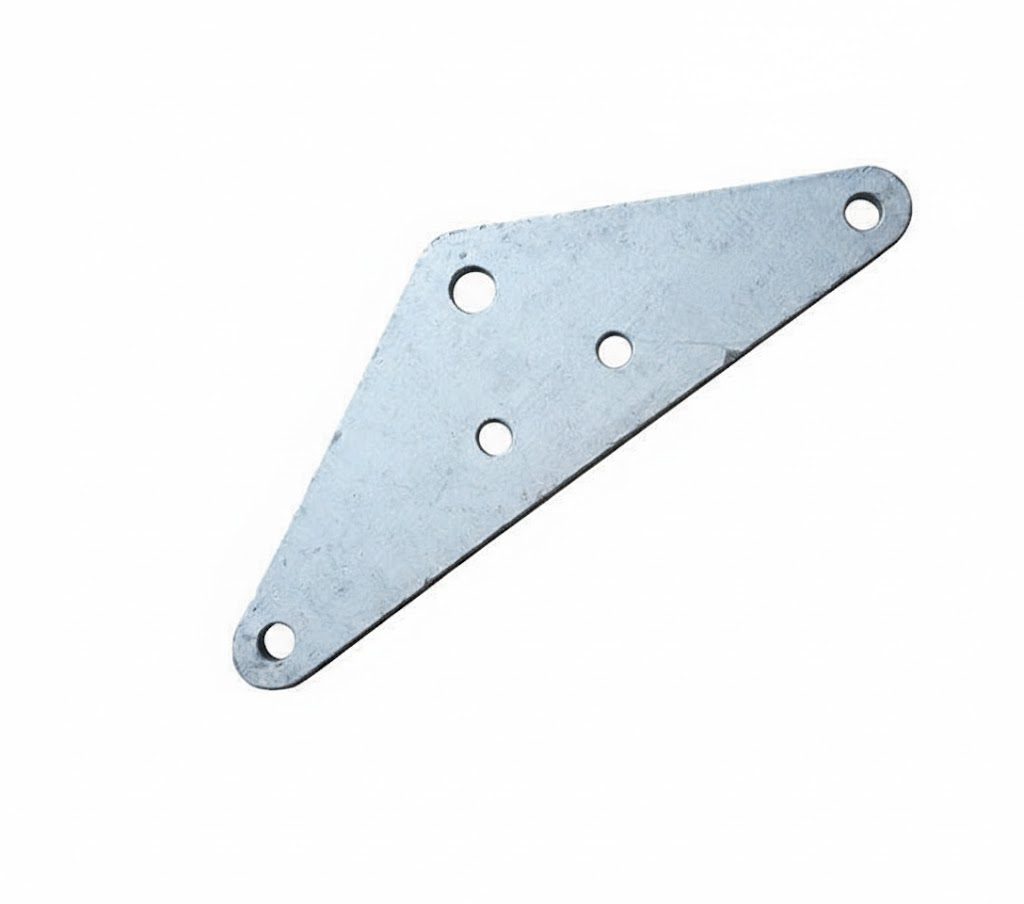
That something is the yoke plate: a forged or plated steel component with a hole pattern that takes the structure attachment on one side and two, three, or more string or clamp connections on the other sharing one load path into several, or gathering several back into one.
It is the load-distribution hub of every heavy assembly, and it’s selected differently from a simple coupling: not by matching a single string’s rating, but by carrying the total load the whole assembly imposes. This page publishes the load classes and explains that selection logic.
Yoke Plate Selection Table
(L-series, hot dip galvanized. Type, rated failure load and weight catalog-verified; hole patterns pending PDF verification see note above.)
| Type | Rated failure load (kN) | Weight (kg) |
|---|---|---|
| L-1040 | 100 | [CONFIRM] |
| L-1640 | 160 | [CONFIRM] |
| L-2140 | 210 | [CONFIRM] |
| L-3050 | 300 | [CONFIRM] |
| L-4050 | 400 | [CONFIRM] |
| L-6050 | 600 | [CONFIRM] |
(Rated failure loads are catalog-verified; confirm the exact type list, weights, and hole-pattern dimensions against the original catalog PDF. Sizes and hole configurations outside the standard range are forged to your drawings.)
Reading the code: the L-designation tracks the load class the leading digits indicate the rated failure load (L-1040 ≈ 100 kN, L-6050 ≈ 600 kN). Select by the total assembly load, not by a single string’s rating see the selection logic below.
How to Select a Yoke Plate: It Carries the Whole Assembly’s Load
This is the point most supplier pages miss. A coupling fitting like a ball eye is sized to the string it sits in. A yoke plate is different: it carries the combined load of every string or sub-conductor it distributes to, plus the way that load is shared between them.
- Start from the total load the assembly imposes at the structure the sum of the conductor tensions or weights the yoke distributes, with your standard’s factor.
- Match the plate’s rated failure load to that total, not to one string. A twin-string assembly where each string is rated 120 kN does not need a 120 kN yoke it needs a yoke rated for the combined load path through the plate.
- Check the hole pattern matches your assembly: the number and position of connection points must take your structure attachment on one side and your strings or clamps on the other, in the geometry your design requires.
- Confirm the coupling fittings that attach to the plate the ball eyes, ball clevises, socket clevises, U shackles mate with the plate’s holes and match its class.
Send the assembly type, the total load, and the strings it feeds, and we return the plate class and hole pattern to suit or forge it to your drawing.
Why Buyers Choose DAPENG Yoke Plates
- Load classes for serious transmission work: The L-series runs to 600 kN, covering heavy dead-ends, quad bundles, and high-voltage V-strings not just distribution-scale assemblies.
- Forged or heavy-plate construction with clean load paths: Material and hole geometry specified so load distributes through the plate without concentrating at a hole edge the plate carries the whole assembly, so its own integrity is non-negotiable.
- Galvanizing you can measure: Hot-dip galvanized to ISO 1461 / ASTM A153 class coatings, checkable with a gauge at goods-in, at a component that carries the assembly’s full load for its whole life.
- Hole patterns to your assembly: Standard patterns for common twin, V, and quad arrangements, or forged to your drawing for non-standard geometries.
- The whole assembly from one factory: Yoke plates ship with the coupling fittings, insulators, suspension and tension clamps, and spacer dampers of the same assembly matched in class, kitted per structure.
Use-Case Deep Dive
When does an assembly need a yoke plate?
Whenever one structure attachment must serve more than one string or sub-conductor:
- Twin (double) suspension or tension strings two parallel strings sharing one attachment, for higher mechanical load or redundancy; the yoke plate splits the load to both.
- V-strings two strings meeting at an angle to fix the conductor’s position against swing; the yoke plate is the apex that ties them and takes the conductor.
- Bundled conductor dead-ends and suspensions where two, four, or more sub-conductors must be gathered to the structure; the yoke plate (sometimes several, in a hierarchy) distributes the bundle’s load.
- Quad and multi-string transmission assemblies the heaviest arrangements, where load classes climb toward the top of the L-series.
A single conductor on a single string doesn’t need a yoke plate a straight coupling chain suffices. The yoke plate earns its place the moment the load path branches.
How does the yoke plate connect to the rest of the string?
Through its hole pattern, to coupling fittings on both sides. On the structure side, a U shackle, ball clevis, or bracket takes the plate to the tower. On the string side, ball eyes or socket clevises connect the plate’s holes to the insulator strings or clamps below. The whole assembly is a matched-class chain, and the yoke plate is the branch point which is why the plate’s holes and the fittings that pin into them must correspond exactly. Send the assembly drawing and we confirm every connection before production.
Can you make a yoke plate to our exact assembly geometry?
Yes, this is core transmission-hardware work. V-string angles, twin-string spacings, and bundled-conductor geometries vary by line design, and the yoke plate is forged or cut to the hole pattern and dimensions your drawing specifies, in the load class your assembly requires, with confirmation drawings before production. A transmission assembly designed to a national standard gets the yoke plate that standard defines, not a nearest-pattern substitute.
Specifications and What They Mean for You
| Specification | What we supply | What it means for the buyer |
|---|---|---|
| Load classes | L-series, 100 to 600 kN | Distribution scale to heavy transmission and quad bundles |
| Function | Splits/gathers load across multiple strings | The assembly’s load distributes cleanly from one attachment |
| Construction | Forged/heavy-plate, clean load paths | Carries the whole assembly without concentrating at a hole |
| Hole pattern | To your assembly geometry | Takes your structure attachment and strings in the right places |
| Coating | HDG to ISO 1461 / ASTM A153 class | Decades carrying the assembly’s full load |
| Verification | Batch load testing, reports supplied | Total-load safety factor on tested figures |
Straight Answers to Common Buyer Concerns
“How do we rate the yoke plate against our assembly?” By total load, not single-string load and we’ll do the arithmetic with you. Send the assembly type, the conductor tensions or weights it carries, the number of strings, and your standard’s safety factor, and we confirm the L-series class and hole pattern that carry the combined load. Rated failure loads are batch-verified with reports supplied, and third-party pre-shipment inspection (SGS/BV or your nominated agency) is welcome on a component that carries the whole assembly, the rating is worth confirming at the factory gate.
“Our V-string / quad geometry is specific to our line. Can you match it?” Yes, hole pattern, plate dimensions, and load class to your drawing, as routine transmission-hardware OEM work. Send the assembly geometry (angles, spacings, the fittings that pin into each hole) and confirmation drawings reach you before production. The yoke plate is the one component where the geometry is the specification, so we build it to yours.
“Can you supply the full assembly, not just the plate?” That’s the intended way. The yoke plate is the hub of a matched-class assembly coupling fittings, insulators, clamps, and (on bundles) spacer dampers and we quote and kit the whole thing per structure so nothing in the load path is mismatched.
Complete the Assembly
- Ball eyes, ball clevises, socket clevises, socket eyes – the coupling fittings that pin into the plate
- U shackles – the structure attachment above the plate
- Insulators and insulator strings – the strings the plate distributes to
- Suspension clamps, strain clamps, bolt type tension clamps, preformed tension clamps – terminal hardware
- Spacer dampers – for the bundled conductors a yoke plate serves
- Browse all overhead line fittings and pole line hardware
Get an Assembly-Matched Quote Within 24 Hours
Send your assembly type (twin, V, quad, bundled dead-end), the total load it carries, the strings it feeds, and the coupling fittings that pin into it or the assembly drawing. Our engineers confirm the L-series class, the hole pattern, and every connection in the chain, then return a factory-direct quotation with the full assembly quoted alongside, typically within one working day.
After You Order
Confirmation drawings before production, batch load-test reports and galvanizing certificates with shipment, plates kitted with their coupling fittings per assembly, and engineering support that stays reachable through stringing because the yoke plate carries the whole assembly, and a question about the load path shouldn’t wait for tomorrow’s email.