How to Install a Guy Anchor: Step-by-Step Guide
To install a guy anchor, first match the anchor type to the soil (drive/plate for most soils, rock for rock, disk for soft-to-medium, screw for turnable soils), set it in line with the guy’s pull at the correct angle and depth, connect the anchor rod so its eye sits at grade, and terminate the guy strand to it. Proof-test or confirm the anchor holds, and make sure every part is rated above the guy’s working tension. Follow your utility’s standard for angle, depth, and capacity.
A guy anchor holds the pole, so installing it right is safety-critical. The two things that most often go wrong are choosing the wrong anchor for the soil and setting it at the wrong angle. This step-by-step guide walks through installing a guy anchor correctly.
Step 1: Match the Anchor to the Soil
The soil decides the anchor this is the first and most important step:
- Most common soils → a drive (plate) anchor, driven and toggled to bear against undisturbed soil.
- Rock / very hard ground → an expanding rock anchor, set in a drilled hole.
- Soft to medium soil → a disk anchor or a dug-in stay plate, bearing against the soil.
- Suitable turn able soils → a screw anchor, turned in by machine without excavation.
Choosing wrong means the anchor drags or pulls out under load. (See our how-to-choose-an-anchor-by-soil guide.) Confirm the anchor’s holding capacity exceeds the guy’s working tension for your soil.
Step 2: Set the Anchor in Line With the Guy’s Pull
The anchor must resist the guy along the line of the guy’s pull so the anchor rod should come out of the ground in line with the guy wire, at the guy’s angle. If the rod and guy aren’t aligned, the anchor is loaded off-axis and holds less. Position the anchor at the correct lead distance from the pole (set by the guy angle and your standard) so the geometry is right.
Step 3: Install the Anchor to Depth
Install by the anchor type:
- Drive anchor: drive the plate to depth, then toggle/rotate it to bear against undisturbed soil. A good drive-anchor system lets you proof-test (load-lock test) the anchor as it sets, confirming it holds.
- Screw anchor: turn the helix in by machine to depth fast, no excavation.
- Rock anchor: drill the hole and set/expand the anchor in the rock.
- Disk anchor / stay plate: excavate, set the disk/plate against undisturbed soil at depth, and backfill (dug-in).
Set the anchor deep enough that the soil column above it develops the required holding capacity.
Step 4: Bring the Rod to Grade
The anchor rod (or stay rod) connects the buried anchor to the surface, with its eye at grade for the guy hardware. For deep-set anchors, extend the rod with a cable extension bolt or coupling so the eye sits at the right height above ground. The rod must be rated above the guy tension it’s in the load path.
Step 5: Terminate the Guy to the Anchor
Terminate the guy wire to the anchor rod’s eye with a preformed guy grip (permanent, full-strength) or a bolted guy clamp (adjustable, re-tension able), often over a thimble to protect the loop. Where the guy runs near energized conductors, include a guy-strain insulator to isolate it. Tension the guy to the design value.
Step 6: Confirm It Holds
Confirm the anchor holds to the required capacity by proof-testing (drive anchors), by the design calculation for the soil, or per your utility’s acceptance procedure. Every part of the assembly anchor, rod, termination, guy must be rated above the guy’s working tension with your safety margin, so the load path from pole to earth is continuous and strong. (See our complete guy/stay assembly guide.)
How to Install a Guy Anchor: FAQ
How do I choose the right guy anchor for the soil? Match the anchor to the ground: drive/plate anchors for most soils, rock anchors for rock, disk anchors or dug-in stay plates for soft-to-medium soil, screw anchors for turn able soils. Choosing wrong means the anchor drags or pulls out. Confirm its holding capacity exceeds the guy tension for your soil.
At what angle should a guy anchor be installed? The anchor rod should come out of the ground in line with the guy wire’s pull, at the guy’s angle, so the anchor is loaded along its axis rather than off-axis. The lead distance from the pole is set by the guy angle and your utility’s standard. Correct alignment is essential for full holding capacity.
How deep should a guy anchor be set? Deep enough that the soil above the anchor develops the required holding capacity which depends on the anchor type and the soil. Screw and drive anchors reach depth by turning/driving; disk anchors and stay plates are dug in. The depth is set by the anchor’s design and the soil; confirm the capacity.
How does the guy connect to the anchor? Through the anchor rod’s eye at grade: the guy wire is terminated to the eye with a preformed guy grip or a bolted guy clamp, often over a thimble. For deep-set anchors, the rod is extended to bring the eye to the surface. Where required, a guy-strain insulator isolates the guy.
How do I know the guy anchor will hold? By confirming its holding capacity for your soil proof-testing (drive anchors), the design calculation, or your utility’s acceptance test and by ensuring every part (anchor, rod, termination, guy) is rated above the guy’s working tension with your safety margin. The load path is only as strong as its weakest link.
Can a guy anchor be installed without digging? Yes drive anchors are driven and screw anchors are turned in by machine, both without a large excavation. Disk anchors and stay plates are dug in. Choose the no-dig types (drive/screw) where excavation is impractical and the soil suits them.
The Bottom Line
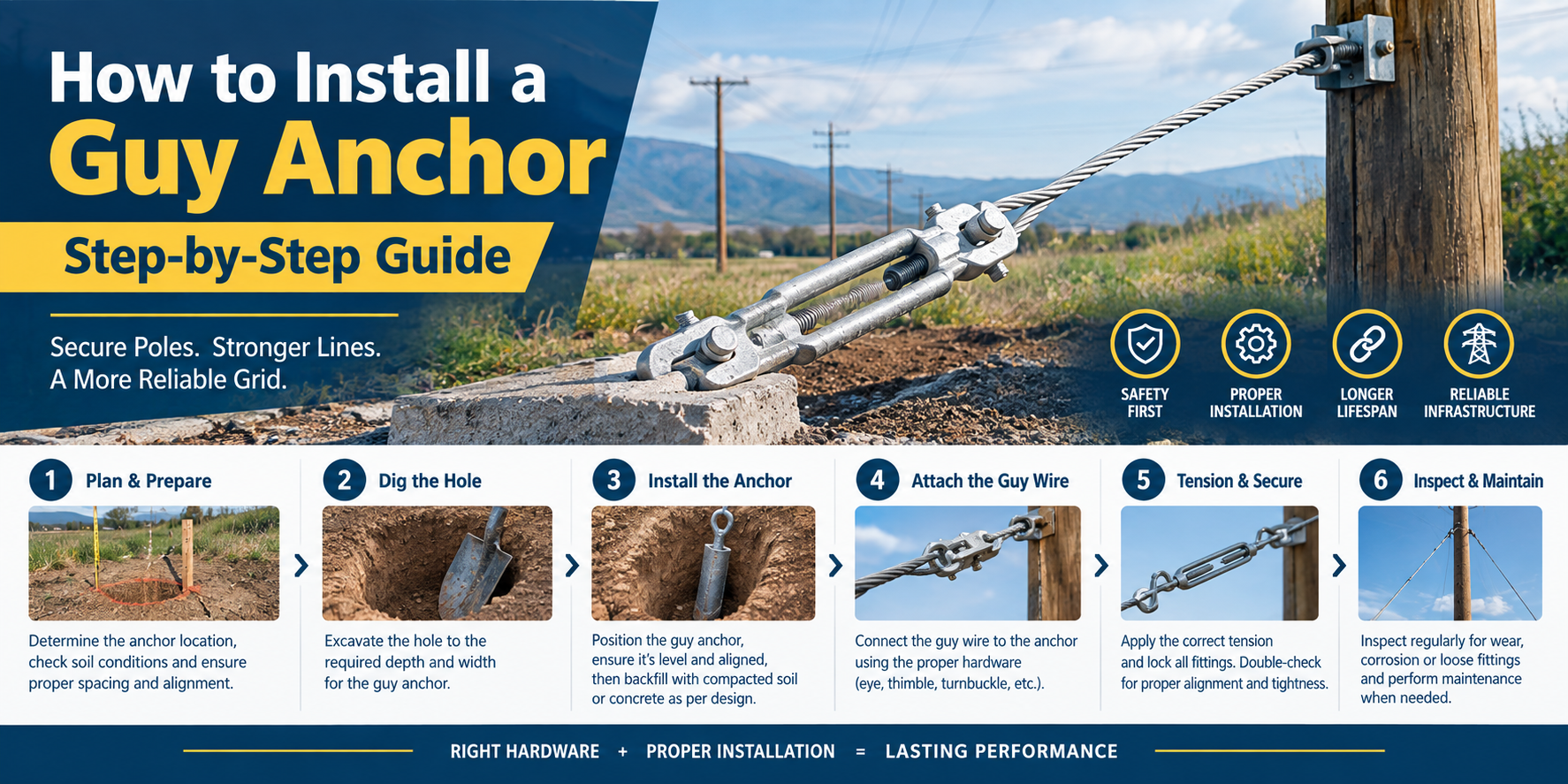
Installing a guy anchor is six steps: match the anchor to the soil, set it in line with the guy’s pull, install it to depth, bring the rod to grade, terminate the guy, and confirm it holds with every part rated above the guy’s working tension. The two biggest mistakes are the wrong anchor for the soil and the wrong angle; get those right and the anchor holds the pole for the life of the line.
DAPENG Power (DP Power Fitting) makes the complete anchor-and-guy set drive, rock, disk, and screw anchors, anchor rods, guy wire, grips and clamps all within the ground-anchor range. Tell us your soil and guy tension, and we’ll specify the anchor and the complete stay.