
Why Do Power Lines Hum or Buzz?
Power lines hum or buzz for two main reasons. First, corona discharge: on high-voltage lines, the intense electric field ionizes the air right at the conductor surface, creating a crackling or hissing sound, especially in damp or foul weather. Second, the magnetic hum: the alternating current (50 or 60 times a second) makes the conductors and equipment vibrate slightly at that frequency, producing a low hum. Corona noise tends to be a crackle or hiss and is worse when wet; the magnetic hum is a steady low tone. Loud or increasing corona noise can signal sharp points or damaged fittings.
That faint buzz or crackle from a power line on a quiet, damp evening is one of the most-noticed and most-searched things about power lines. There are two causes, and knowing them tells you something about the line’s condition. Here’s why.
Cause 1: Corona Discharge (the Crackle/Hiss)
On high-voltage lines, the electric field around the conductor can be intense enough to ionize the air right at the surface a partial electrical discharge called corona. As the air ionizes and discharges, it produces a crackling, hissing, or frying sound, and sometimes a faint bluish glow at night.
Corona noise is:
- Worse in damp or foul weather moisture (fog, rain, dew) lowers the threshold, so lines are noticeably louder when wet.
- Worse at sharp points and rough spots the field concentrates at edges, points, and damaged or dirty fittings, so corona (and its noise) starts there.
- A feature of high voltage low-voltage lines don’t produce significant corona; it’s mainly a high-voltage transmission phenomenon.
Corona is more than just noise it also causes energy loss and radio interference, so engineers work to reduce it. (See our corona-on-overhead-lines guide.)
Cause 2: The Magnetic Hum (the Steady Tone)
The other sound is a low, steady hum caused by the alternating current. AC reverses direction 50 or 60 times a second (50 Hz or 60 Hz, depending on the country), and this creates alternating magnetic forces that make the conductors, and especially transformers and equipment, vibrate slightly at that frequency (and its harmonics). The result is the characteristic mains hum a steady low tone you hear near transformers and substations especially.
This magnetic hum is normal and is tied to the supply frequency. It’s most noticeable around transformers (where the magnetic forces in the core are strong) rather than along the conductors themselves.
Hum vs Buzz: Which Is Which?
| Sound | Cause | When |
|---|---|---|
| Crackle / hiss / frying | Corona discharge | High-voltage lines, worse when wet |
| Steady low hum | Magnetic forces from AC (50/60 Hz) | Near transformers/equipment especially |
So a crackle that gets louder in the rain is corona; a steady low tone is the magnetic hum of the current.
When the Noise Signals a Problem
Some noise is normal, but loud or increasing corona noise can indicate an issue:
- Sharp points or rough spots a damaged conductor, a sharp edge on a fitting, or a loose strand concentrates the field and increases corona.
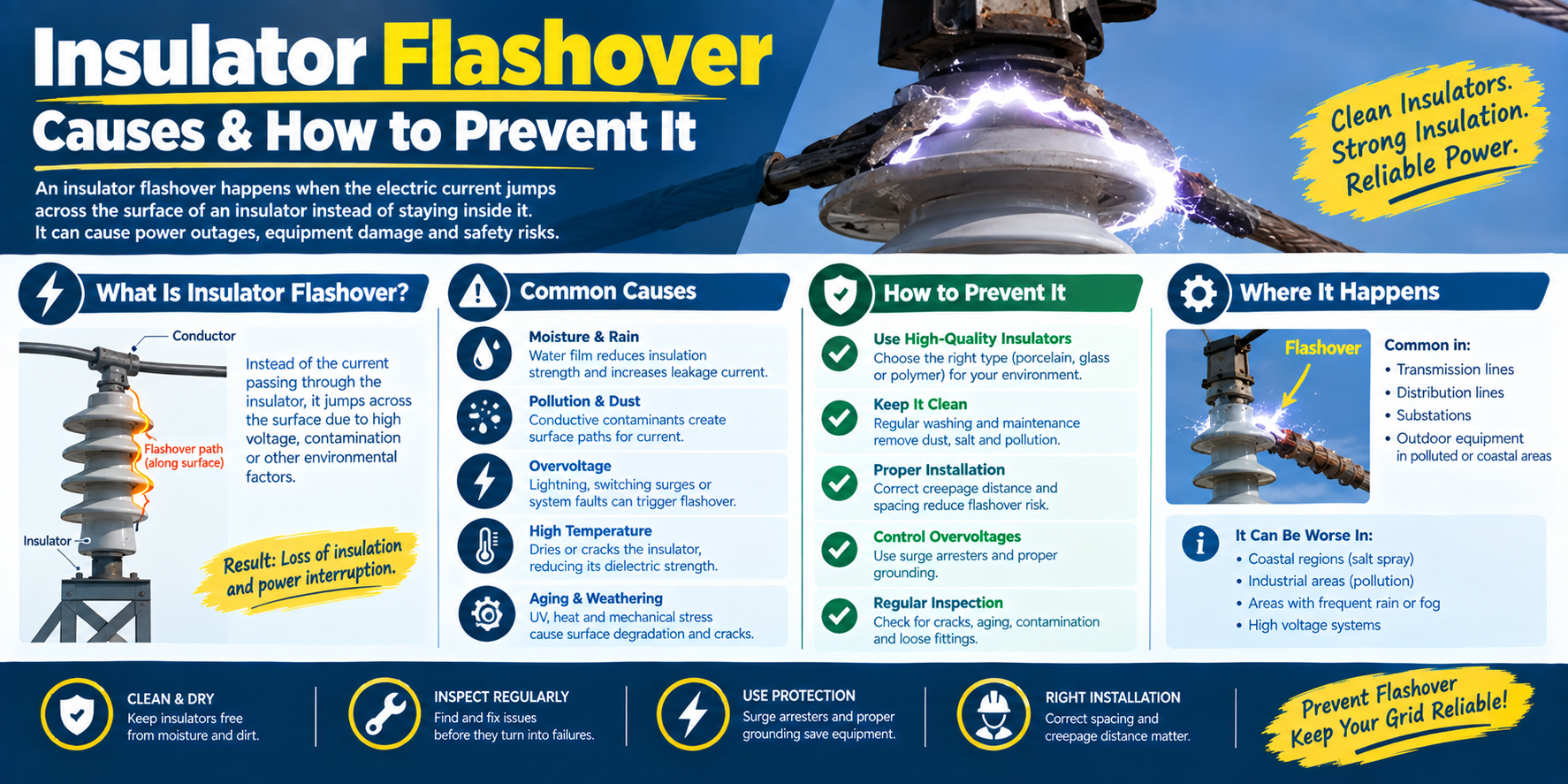
- Dirty or damaged insulators contamination and damage can increase discharge and noise.
- Missing or damaged grading on high-voltage strings, a missing or damaged corona ring lets the field concentrate at the string ends.
So a sudden increase in crackling can be worth investigating. Good design reduces corona noise at the source: smooth fittings, clean insulators, and corona rings that grade the field at high voltage. (See our corona-on-overhead-lines guide.)
How Engineers Reduce the Noise
- Corona rings at high voltage grade the electric field, keeping the peak field below the corona threshold so the discharge (and noise) doesn’t start.
- Smooth, clean fittings avoiding sharp points and rough spots reduces corona.
- Bundled conductors on the highest-voltage lines, bundling makes the conductors behave like a larger-diameter one, lowering the surface field and corona. (See our bundled-conductors guide.)
- Larger conductors a larger diameter lowers the surface field.
Why Do Power Lines Hum: FAQ
Why do power lines hum or buzz? Two reasons: corona discharge (on high-voltage lines, the electric field ionizes the air at the conductor surface, creating a crackle or hiss, worse when wet) and the magnetic hum (the alternating current at 50 or 60 Hz makes the conductors and equipment vibrate slightly, producing a low tone). A crackle is corona; a steady hum is the magnetic effect.
What is the crackling sound from power lines? That’s corona discharge on high-voltage lines, the intense electric field ionizes the air right at the conductor surface, producing a crackling, hissing, or frying sound (and sometimes a faint glow at night). It’s worse in damp or foul weather and at sharp points or damaged fittings.
Why are power lines louder when it’s wet? Because moisture (fog, rain, dew) lowers the threshold for corona discharge, so the air ionizes and crackles more easily. On a damp evening, high-voltage lines produce noticeably more corona noise than in dry conditions. The magnetic hum, by contrast, doesn’t change much with weather.
What is the humming sound from a transformer? That’s the magnetic hum the alternating current at 50 or 60 Hz creates alternating magnetic forces in the transformer’s core that make it vibrate slightly at that frequency, producing the steady low “mains hum.” It’s most noticeable near transformers and substations.
Is it normal for power lines to buzz? Some noise is normal a faint corona crackle on high-voltage lines (especially when wet) and a low magnetic hum near equipment. But loud or increasing corona noise can signal sharp points, damaged conductors or fittings, dirty insulators, or missing grading rings, and may be worth investigating.
How do engineers reduce power line noise? With corona rings that grade the electric field at high voltage, smooth and clean fittings that avoid sharp points, bundled conductors and larger diameters that lower the surface field, and clean insulators. These reduce corona at the source, cutting the crackling noise (and the associated energy loss and interference).
The Bottom Line
Power lines hum or buzz for two reasons: corona discharge (a crackle/hiss from the electric field ionizing the air at the conductor, worse when wet, on high-voltage lines) and the magnetic hum (a steady low tone from the 50/60 Hz alternating current, loudest near transformers). Some noise is normal, but loud corona can signal sharp points or damaged fittings which good design, clean insulators, and corona rings prevent.
DAPENG Power (DP Power Fitting) manufactures the hardware that keeps corona (and its noise) low corona rings that grade the field, smooth conductor fittings, and clean insulators and strings. Tell us your voltage, and we’ll specify hardware designed to minimize corona.