Why Are Overhead Power Lines Not Insulated?
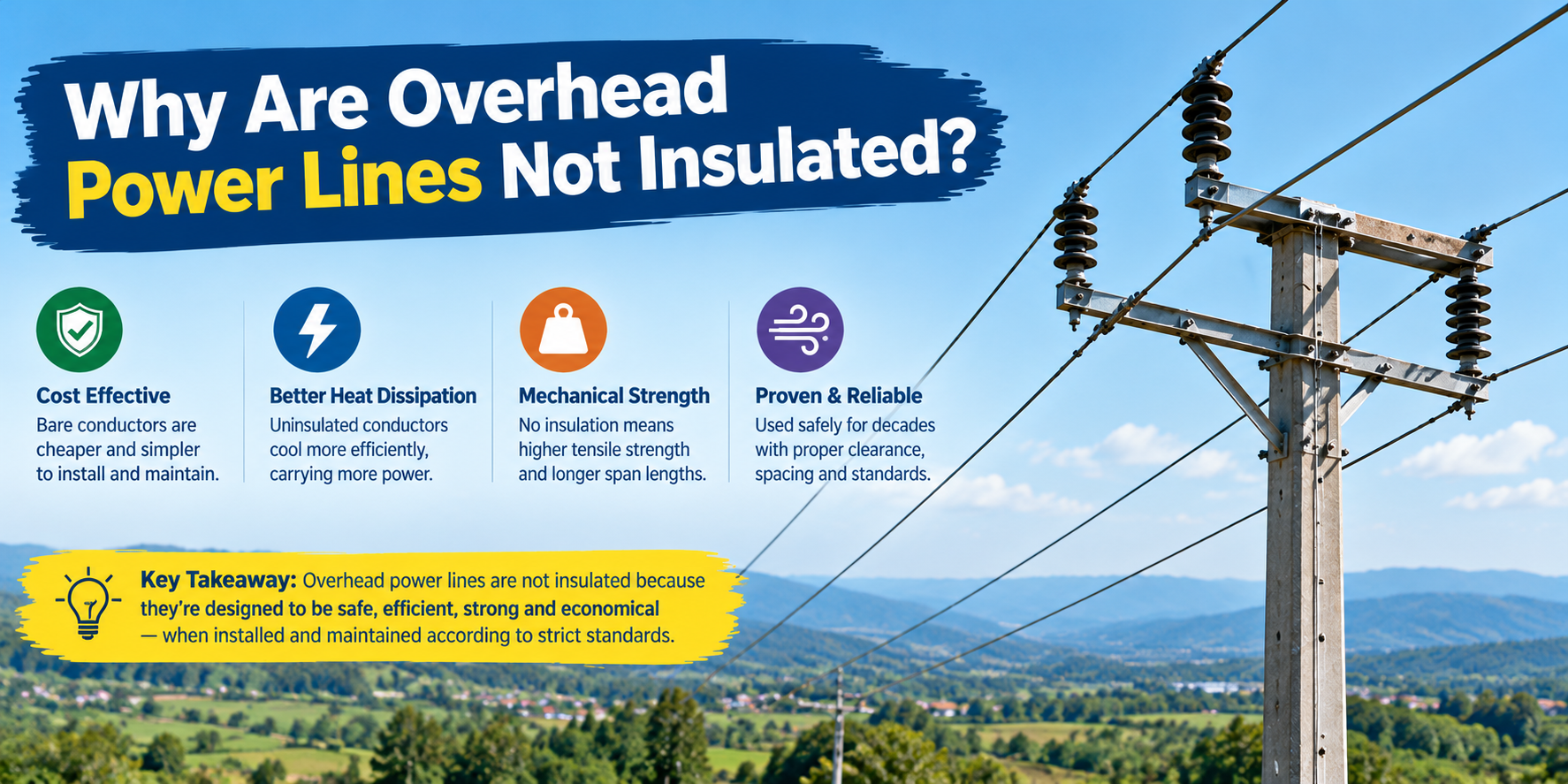
Overhead power lines use bare (uninsulated) conductors because insulating them would be impractical, expensive, and heavy, and unnecessary when air and height do the job. The air around the conductor is itself an excellent insulator, and the conductors are held high up and spaced apart so nothing can touch them. Insulation thick enough for high-voltage transmission would add enormous weight and cost over thousands of kilometers, and would trap heat (reducing current capacity). Instead, the line is “insulated” by air gaps and clearances, with solid insulators used only where the wire must attach to the structure.
Look up at a transmission line, and the conductors are bare metal, with no plastic coating. People often ask why high-voltage lines aren’t insulated like household wires. The answer reveals how overhead lines are designed. Here’s why.
The Short Answer: Air and Height Do the Job
Overhead power lines don’t need insulation around the conductor because they’re insulated by air and distance instead:
- Air is an excellent insulator a gap of air between the conductor and anything else prevents the current from flowing across, as long as the gap is big enough for the voltage.
- The conductors are high up out of reach of people, vehicles, and objects.
- The conductors are spaced apart far enough from each other and the structure that the electricity can’t arc across.
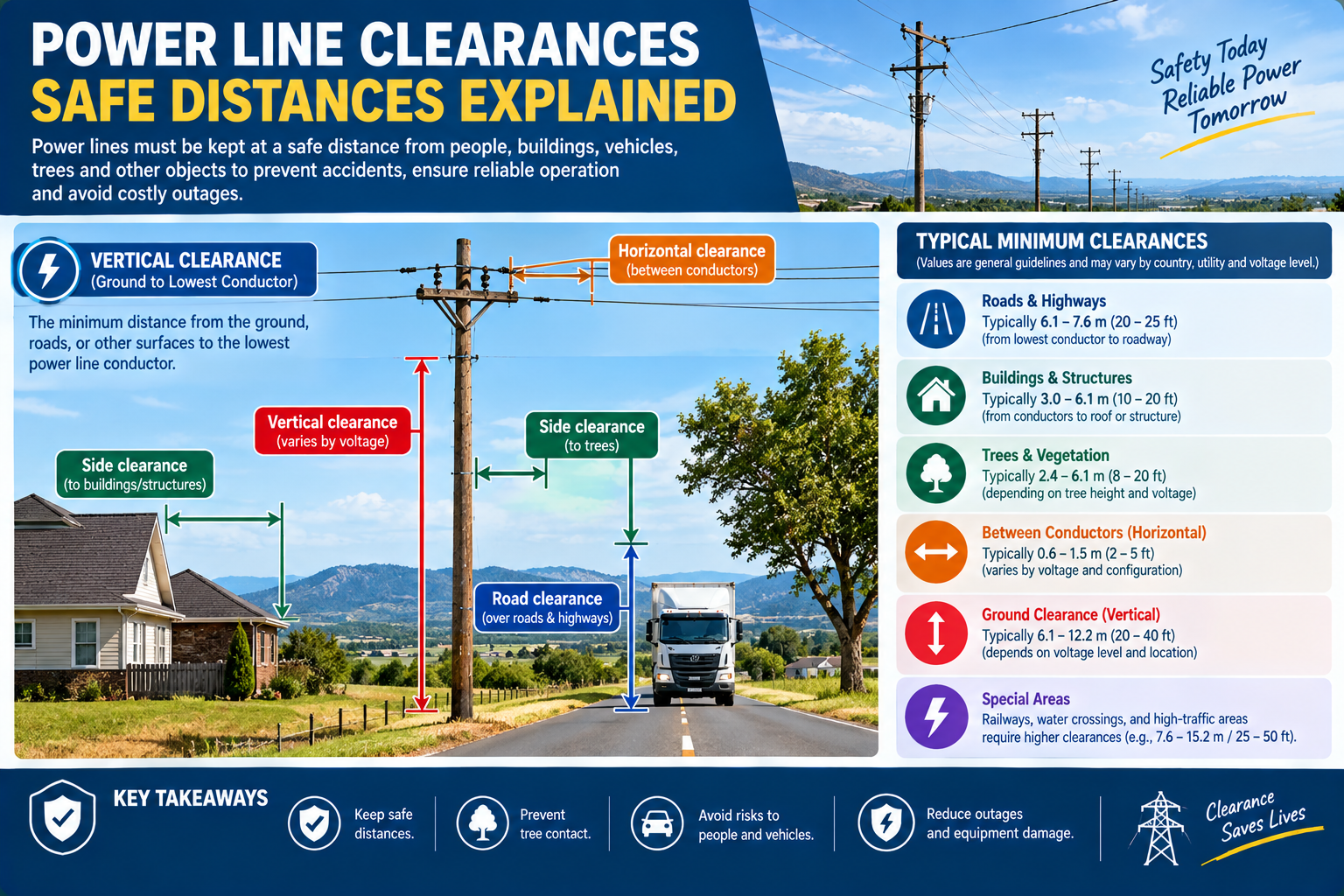
So the line is insulated just by air gaps and clearances rather than a coating. (See our power-line-clearances guide.)
Why Not Just Insulate the Conductor?
Coating a high-voltage conductor with insulation would be a bad idea for several reasons:
1. Enormous weight and cost
The insulation thick enough to contain a high transmission voltage would be very thick and heavy. Over the thousands of kilometers of conductor in a network, the added weight would need far stronger (and more expensive) towers, and the insulation itself would cost enormous amounts. Bare conductors are far lighter and cheaper.
2. Heat reduced capacity
A conductor carrying current gets warm, and it relies on the surrounding air to cool it (letting it carry more current). Wrapping it in insulation would trap the heat, forcing a lower current rating for the same conductor. Bare conductors dissipate heat to the air and carry more current. (This is one reason overhead lines carry more current than buried cables see our overhead-vs-underground guide.)
3. Unnecessary
Because the conductors are high up and spaced apart, nothing touches them, so the insulation isn’t needed for safety in normal operation. The air gap does the job for free.
So for overhead lines, bare conductors insulated by air are lighter, cheaper, cooler, and perfectly safe when installed with proper clearances.
Where Solid Insulation IS Used: Insulators
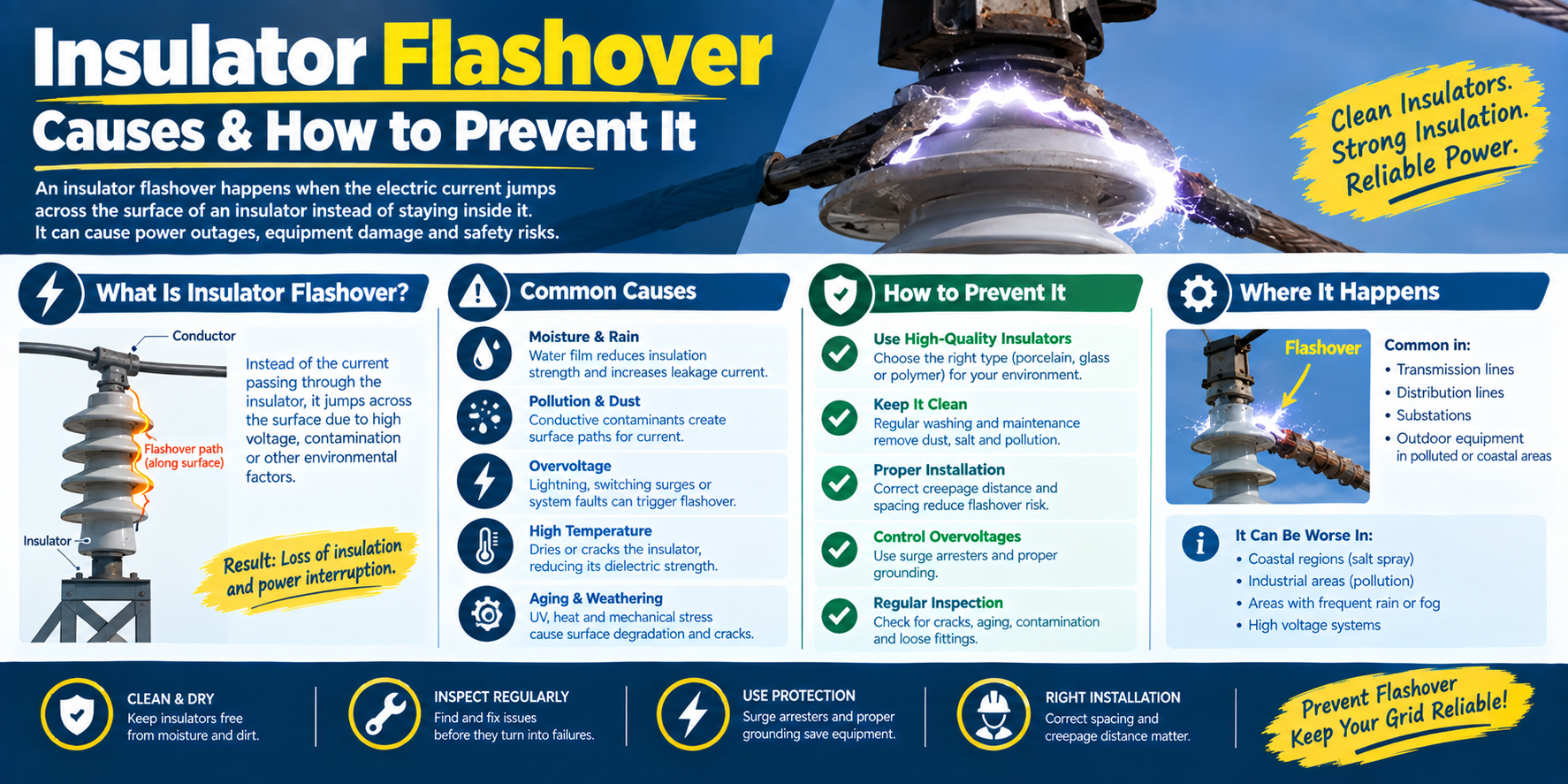
There’s one place the conductor must be held close to the earthed structure where it attaches to the pole or tower. There, air alone isn’t enough, so a solid insulator bridges the gap:
- Insulators (porcelain, glass, or composite) hold the conductor on the structure while isolating it electrically rigid pin and post insulators on distribution, hanging suspension strings on transmission.
- The insulator provides the insulation and the mechanical support exactly where the conductor meets the earthed structure.
So the line uses air to insulate along the span, and solid insulators only at the attachment points. That’s the efficient design: bare conductor through the air, insulators at the structure. (See our types-of-insulators guide.)
What About Covered Conductors?
Some distribution lines do use covered conductors a thin covering (not full insulation) that reduces faults from brief contact (e.g. tree branches). But this is a thin protective covering, not the thick insulation of a cable, and it’s used selectively on distribution, not on high-voltage transmission. For most overhead lines, bare conductors remain the standard.
Why Are Power Lines Not Insulated: FAQ
Why are overhead power lines not insulated? Because they’re insulated by air and distance instead the air around the conductor is an excellent insulator, and the conductors are held high up and spaced apart so nothing touches them. Coating them would add huge weight and cost, and trap heat (reducing capacity), so bare conductors are lighter, cheaper, cooler, and safe with proper clearances.
Is air a good insulator for power lines? Yes a sufficient gap of air between a conductor and anything else prevents the current from arcing across, as long as the gap matches the voltage (higher voltage needs a bigger gap). This is why overhead lines rely on air gaps and clearances rather than a coating around the conductor.
Why would insulating high-voltage lines be impractical? The insulation thick enough to contain a high transmission voltage would be very thick and heavy, adding enormous weight and cost over thousands of kilometers and needing far stronger towers. It would also trap heat, reducing the conductor’s current capacity. Bare conductors avoid all of this.
Where are insulators used if the line is bare? At the points where the conductor attaches to the pole or tower there, a solid insulator (porcelain, glass, or composite) holds the conductor while isolating it from the earthed structure. So the line uses air to insulate along the span and solid insulators only at the attachment points.
Are power lines dangerous because they’re not insulated? They’re safe in normal operation because they’re high up and spaced apart, so nothing touches them but they’re extremely dangerous to touch, which is why you must never approach or contact them. The “insulation” is the air gap and height, which only works at a distance; direct contact is lethal.
Do any overhead lines have covering? Yes some distribution lines use covered conductors with a thin covering that reduces faults from brief contact (like tree branches). But this is a thin protective covering, not the thick insulation of a cable, and it’s used selectively on distribution. High-voltage transmission uses bare conductors.
The Bottom Line
Overhead power lines use bare conductors insulated by air and distance because full insulation would be impractically heavy, expensive, and heat-trapping and unnecessary when the conductors are high up and spaced apart. Solid insulators are used only where the conductor attaches to the structure. That’s the efficient design: air along the span, insulators at the poles.
DAPENG Power (DP Power Fitting) manufactures the insulators that hold bare conductors on the structure pin, post, and suspension types and strings plus the crossarms and conductor fittings that space and support them. Tell us your voltage and line, and we’ll specify the insulators and fittings.