Insulator Flashover: Causes & How to Prevent It
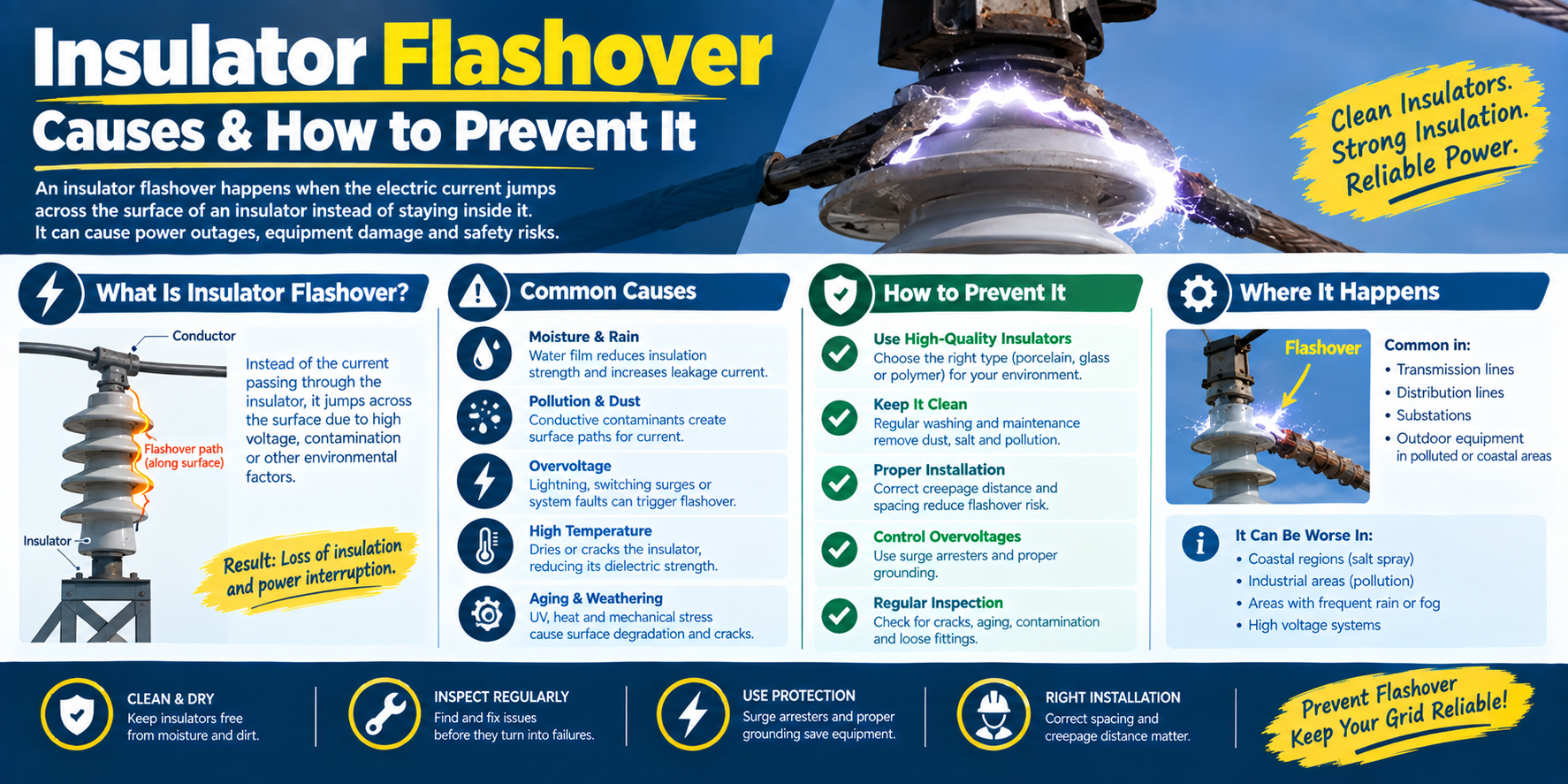
Insulator flashover is an electrical discharge that arcs across the surface (or through the air around) an insulator, from the conductor to the earthed end, bridging the insulation and causing a fault. It’s caused mainly by pollution (a contaminated, wet surface lets current track and arc), lightning and switching surges (overvoltages that exceed the insulator’s withstand), and inadequate insulation for the voltage. Unlike puncture (which permanently damages the insulator), flashover is usually a surface arc that the insulator survives. It’s prevented with enough creepage distance for the pollution, adequate insulation (BIL) for the voltage, grading rings, and clean or hydrophobic designs.
Flashover is one of the main ways an insulator “fails” in service, and understanding its causes is key to preventing line faults. This guide explains insulator flashover and how to prevent it.
What Is Insulator Flashover?
Flashover is an electrical discharge (arc) across or around an insulator from the energized conductor end to the earthed end that bridges the insulation and causes a line fault (a short to earth). The arc travels through the air and along the surface of the insulator, following the shortest path it can break down.
Crucially, flashover is usually an external surface/air arc, so the insulator itself typically survives (it continues to work once the arc clears), unlike puncture see below. But the flashover causes a fault on the line, which protective devices must clear.
Flashover vs Puncture
These two insulator failures are often confused:
- Flashover an arc across the surface or through the air around the insulator. External. The insulator usually survives and keeps working after the arc clears.
- Puncture a discharge through the solid body of the insulator (through the porcelain/glass). Internal. It permanently damages the insulator.
Insulators are designed with a safety factor (the ratio of puncture strength to flashover voltage) so that if anything gives way, it flashes over externally rather than punctures internally because a flashover is recoverable, a puncture is not.
What Causes Flashover
1. Pollution (the most common cause)
A clean, dry insulator is an excellent insulator. But when the surface gets contaminated (salt, dust, industrial deposits) and then wet (dew, fog, light rain), the pollution layer becomes conductive, and current tracks along the surface. This heats and dries bands, which arc, and the arcing can cascade into a full pollution flashover across the insulator. This is the leading cause of flashover in service, especially in coastal, industrial, and desert environments. (See our creepage-and-pollution guide.)
2. Lightning surges
A lightning strike or a nearby strike induces a huge, fast overvoltage that can exceed the insulator’s lightning-impulse withstand (BIL) and flash over. (See our BIL and lightning-protection guides.)
3. Switching surges
Switching operations create slower transient overvoltages that, at the highest voltages especially, can cause flashover if the insulation isn’t adequate.
4. Inadequate insulation
If the insulator has too little creepage for the pollution, or too few discs / too short for the voltage, it can flash over under normal or mildly abnormal conditions. This is a design/selection error.
How to Prevent Flashover
Enough creepage for the pollution
Match the insulator’s creepage distance to the pollution level more creepage (higher creepage class, more discs, anti-fog profiles) for coastal, industrial, and desert environments, so the surface current can’t bridge the insulator. (See our creepage-and-pollution guide.)
Adequate insulation (BIL) for the voltage
Choose an insulator with enough electrical withstand (power-frequency and lightning-impulse / BIL) for the system voltage, with margin for a suspension string, enough discs. (See our insulator-specifications and BIL guides.)
Grading rings at high voltage
At high voltages, corona rings grade the electric field at the string ends, reducing the stress that contributes to discharge.
Clean or hydrophobic designs
Use anti-fog / open-profile insulators that shed pollution and are easier to clean, or composite (silicone) insulators whose hydrophobic surface resists the wetting that drives pollution flashover. Periodic cleaning (or live washing) is used in heavily polluted areas.
Good design and maintenance
Select the right insulator type and rating for the voltage and environment, keep the insulators clean, and inspect for damage a cracked or contaminated insulator is more likely to flash over.
Insulator Flashover: FAQ
What is insulator flashover? Insulator flashover is an electrical arc across the surface or through the air around an insulator, from the conductor to the earthed end, bridging the insulation and causing a line fault. It’s usually an external arc that the insulator survives, unlike puncture, which permanently damages the insulator internally.
What is the difference between flashover and puncture? Flashover is an external arc across the surface or air around the insulator the insulator usually survives. Puncture is a discharge through the solid body of the insulator, permanently damaging it. Insulators are designed to flash over externally (recoverable) rather than puncture internally (destroyed).
What causes insulator flashover? Mainly pollution (a contaminated, wet surface lets current track and arc the most common cause), lightning surges (overvoltages exceeding the insulator’s withstand), switching surges, and inadequate insulation (too little creepage for the pollution or too short for the voltage). Pollution flashover dominates in coastal, industrial, and desert areas.
What is pollution flashover? Pollution flashover happens when an insulator’s surface is contaminated (salt, dust, industrial deposits) and then wetted (fog, dew, light rain), making the pollution layer conductive so current tracks along the surface, arcs, and cascades into a full flashover. It’s the leading cause of flashover in service.
How do you prevent insulator flashover? Provide enough creepage distance for the pollution level (higher creepage class, more discs, anti-fog or composite insulators), adequate insulation (BIL) for the voltage, grading rings at high voltage, and clean or hydrophobic designs plus cleaning in heavily polluted areas. Correct insulator selection for the environment is key.
Does flashover damage the insulator? Usually not permanently flashover is typically an external surface/air arc that the insulator survives and continues working after the arc clears (though it causes a line fault that must be cleared). Puncture, by contrast, permanently damages the insulator. Insulators are designed to flash over rather than puncture.
The Bottom Line
Insulator flashover is an external arc across an insulator that causes a line fault caused mainly by pollution (a wet, contaminated surface), lightning and switching surges, and inadequate insulation. It’s prevented with enough creepage for the pollution, adequate BIL for the voltage, grading rings, and clean or hydrophobic designs. Unlike puncture, flashover usually doesn’t destroy the insulator but correct selection for the environment prevents it.
DAPENG Power (DP Power Fitting) manufactures insulators and strings selected to prevent flashover pin, post, and suspension types and strings with the right creepage and BIL for your voltage and pollution, plus corona rings for high-voltage grading. Tell us your voltage and pollution level, and we’ll specify insulators sized to resist flashover.