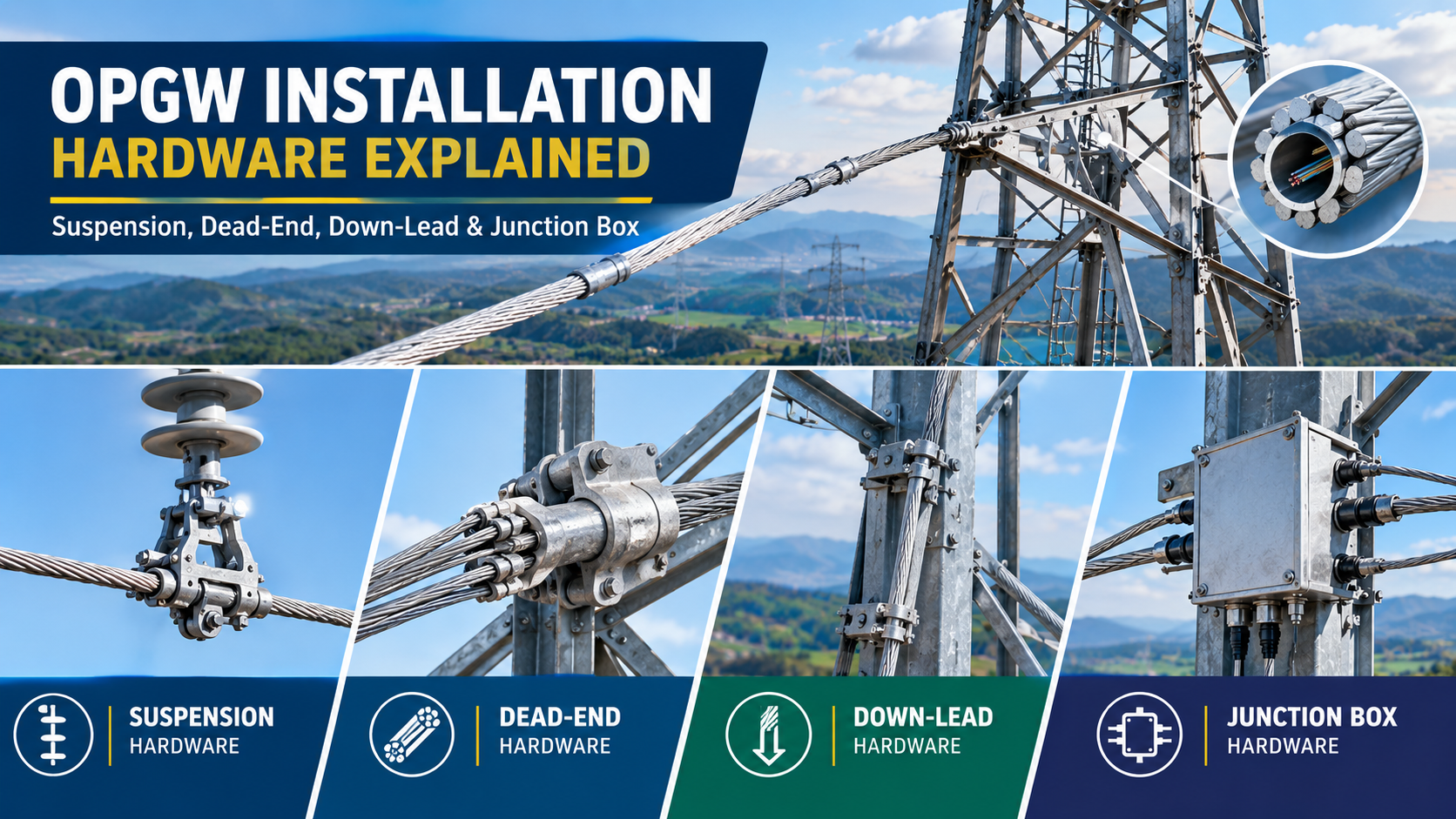
OPGW Installation Hardware Explained: Suspension, Dead-End, Down-Lead & Junction Box
OPGW (Optical Ground Wire) is a metallic shield wire with fibers inside, installed at the top of a transmission tower. Its hardware coordinates with the tower’s earthing and holds the cable through the route: suspension assemblies support it at tangent towers, tension/dead-end assemblies terminate it at angle and dead-end towers, down-lead clamps guide the cable down the tower to the splice, and a junction box/splice closure protects the fiber joint. Because OPGW is metallic and earthed, its fittings are bonded to the structure. Every fitting is sized to the OPGW’s diameter and tension.
If you’ve decided on OPGW (see our ADSS-vs-OPGW guide), the next question is the hardware because OPGW needs its own coordinated set of fittings, different from ADSS. This guide walks through what an OPGW route needs and what each fitting does.
OPGW in Brief
OPGW is a dual-purpose cable: a conventional earth/shield wire (aluminum and steel strands) at the top of the tower, with optical fibers protected in a metal tube inside. It gives a transmission line lightning protection and a fiber-optic communications path in one cable, in the shield-wire position. Because it’s metallic and lives on the earthed structure, all its hardware coordinates with the tower’s bonding an important difference from all-dielectric ADSS.
The hardware falls into four groups: supporting, terminating, routing down the tower, and splicing.
1. Suspension Assemblies Supporting at Tangent Towers
At tangent (straight-run) towers, the OPGW is supported (not terminated) by a suspension assembly that holds the cable in the shield-wire position while allowing the line to move. The suspension clamp cradles the cable without damaging it, sized to the OPGW diameter. On lines with vibration exposure, vibration protection is added at these supports (OPGW, like any taut cable, is subject to aeolian vibration). These are part of the ADSS/OPGW fittings range and related to conductor suspension clamps.
2. Tension / Dead-End Assemblies Terminating at Angle & Dead-End Towers
At angle and dead-end towers, the OPGW must be terminated held against the full cable tension. A preformed tension clamp (dead-end) grips the OPGW and takes the tension into the tower, without crushing the cable or the fibers inside. Preformed dead-ends are widely used on OPGW because their distributed grip protects the cable. The termination attaches to the tower’s dead-end attachment point.
3. Down-Lead Clamps Routing the Cable Down the Tower
At the towers where the fiber is spliced (and periodically along the route), the OPGW must run down the tower from the top to the splice enclosure. A down-lead clamp pins the cable to the tower steel at intervals as it descends, so it’s held neatly against the structure and doesn’t slap against the steel in the wind (which would fatigue the cable). Down-lead clamps route and secure the descent.
4. Junction Box / Splice Closure Protecting the Fiber Joint
Where fiber sections are joined, the splice must be protected from weather and mechanical damage. An ADSS/OPGW metal junction box (or splice closure) houses and seals the fiber splice, mounted on the tower at the base of the down-lead. It protects the optical joint for the life of the route.
The Earthing Difference
Because OPGW is metallic and part of the shield-wire/earthing system, its hardware coordinates with the tower’s bonding the cable is earthed to the structure. This is the fundamental difference from ADSS, which is all-dielectric and needs no earthing (and uses different fittings dielectric-friendly clamps, aluminum supports, and light spiral dampers). Don’t mix the two hardware families: OPGW fittings assume a metallic, earthed cable; ADSS fittings assume a dielectric one. (See our ADSS-vs-OPGW guide for the cable-level comparison.)
Specifying an OPGW Hardware Kit
To specify the hardware, your supplier needs:
- The OPGW cable diameter and construction.
- The tension for the tension/dead-end assemblies.
- The tower types along the route tangent (suspension), angle/dead-end (tension), and splice towers (down-lead + junction box).
- The vibration exposure for damping at supports.
- The earthing requirements bonding to the structure.
With those, the whole route can be supplied as a coordinated kit, marked by tower type, so each structure gets the right assembly. All are part of the ADSS/OPGW fittings range.
OPGW Installation Hardware: FAQ
What hardware does an OPGW line need? Suspension assemblies to support the cable at tangent towers, tension/dead-end assemblies to terminate it at angle and dead-end towers, down-lead clamps to route it down the tower to the splice, and a junction box/splice closure to protect the fiber joint all coordinated with the tower’s earthing because OPGW is metallic.
What is a down-lead clamp for? A down-lead clamp pins the OPGW to the tower steel at intervals as it runs down from the top to the splice enclosure, holding it neatly against the structure so it doesn’t slap against the steel in the wind (which would fatigue the cable). It routes and secures the cable’s descent.
How is OPGW terminated at a dead-end tower? With a tension/dead-end assembly commonly a preformed tension clamp that grips the OPGW and takes the full cable tension into the tower without crushing the cable or the fibers inside. Preformed dead-ends are favored for their distributed, cable-protecting grip.
Does OPGW hardware need to be earthed? Yes OPGW is a metallic shield wire and part of the earthing system, so its hardware coordinates with the tower’s bonding and the cable is earthed to the structure. This is a key difference from all-dielectric ADSS, which needs no earthing.
Can I use ADSS fittings on OPGW? No ADSS fittings assume an all-dielectric cable strung below the conductors, while OPGW fittings assume a metallic, earthed cable at the top of the tower. The grip, sizing, and earthing assumptions differ. Specify the hardware family to the cable.
What protects the fiber splice on an OPGW route? A junction box or splice closure houses and seals the fiber splice, mounted on the tower at the base of the down-lead, protecting the optical joint from weather and mechanical damage for the life of the route.
The Bottom Line
An OPGW route needs a coordinated hardware set: suspension at tangent towers, tension/dead-end at angle and dead-end towers, down-lead clamps to route the cable down to the splice, and a junction box to protect the fiber joint all bonded to the tower’s earthing, because OPGW is metallic. Specify the kit by cable, tension, tower types, and earthing, and keep it separate from ADSS hardware.
DAPENG Power (DP Power Fitting) manufactures the OPGW hardware range suspension and tension/dead-end assemblies, down-lead clamps, and metal junction boxes all within the ADSS/OPGW fittings range. Tell us your OPGW cable, tension, tower types, and route, and we’ll specify a coordinated hardware kit by structure.