What Is Aeolian Vibration? Protecting Overhead Conductors
Aeolian vibration is the small, high-frequency, wind-induced oscillation of an overhead conductor caused by vortices shedding off the cable in steady wind. Unchecked, it causes fatigue cracking in conductor strands and fittings, especially at supports, and is a leading cause of premature line failure. It’s controlled with a toolkit: vibration dampers (spiral for light cables, Stockbridge for heavier conductors) to absorb the energy, armor rods to reinforce the conductor at the support, and armor-grip suspension for severe duty. Match the protection to the conductor and the exposure.
You rarely see it, but on almost every exposed overhead line, wind quietly works the conductor back and forth thousands of times an hour. Over years, that fatigues the metal and fails the line. This guide explains what aeolian vibration is, why it matters, and the full set of tools used to protect against it.
What Causes Aeolian Vibration?
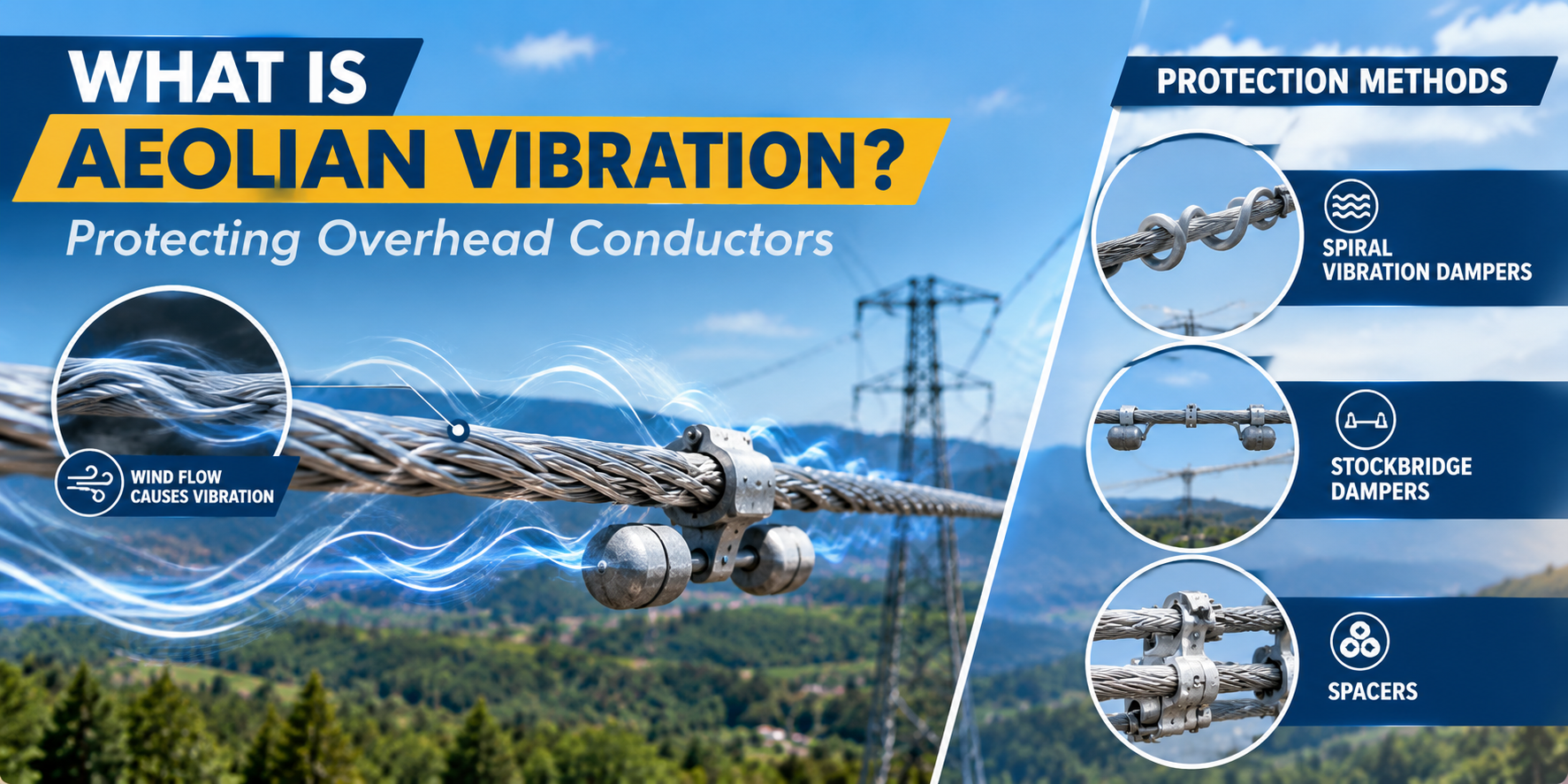
When steady, low-to-moderate wind flows across a taut conductor, it sheds tiny vortices alternately from the top and bottom of the cable. Each vortex gives the conductor a small push, and at certain wind speeds these pushes synchronize with the conductor’s natural frequency, setting up a standing wave of small-amplitude, high-frequency oscillation the conductor vibrates up and down rapidly, though the movement is small enough to be hard to see.
It’s called aeolian (after Aeolus, keeper of the winds) because steady wind is the driver. It’s distinct from the large, dramatic motions of galloping (which is a different, low-frequency phenomenon). Aeolian vibration is small, constant, and over time destructive.
Why It Matters: Fatigue
The danger isn’t any single oscillation it’s the accumulation. The conductor flexes millions of times, and metal that flexes repeatedly eventually fatigues and cracks. The damage concentrates where the conductor is held rigidly at the suspension clamps and supports because that’s where the flexing conductor meets a fixed point and the bending stress is highest. Fittings can fatigue too. Left uncontrolled on an exposed line, aeolian vibration is a genuine cause of premature conductor and fitting failure.
The Protection Toolkit
Controlling aeolian vibration uses two complementary strategies: reduce the vibration energy (dampers) and reinforce where fatigue concentrates (armor rods / armor-grip suspension).
Vibration dampers absorb the energy
A damper absorbs or disrupts the oscillation so the fatigue never accumulates:
- Spiral vibration damper a lightweight clip-on spiral for light cables (ADSS, OPGW, small conductors). Economical and tool-free.
- Stockbridge vibration damper a tuned-mass device (weights on a messenger) for larger conductors and higher vibration energy.
Choose by the cable (see our spiral-vs-Stockbridge guide). Dampers are placed near the supports where vibration concentrates; quantity and placement depend on span, tension, and terrain.
Armor rods reinforce at the support
Armor rods wrap the conductor at the suspension clamp, spreading the clamping load and adding stiffness that resists the bending fatigue exactly where it’s worst at the support. They work alongside dampers: the damper reduces the vibration, the armor rods protect the conductor where it’s held.
Armor-grip suspension for severe duty
Armor-grip suspension supports the conductor through an elastomer-cushioned grip (often incorporating armor rods), for severe vibration duty where a plain clamp plus armor rods isn’t enough. It cushions and supports the conductor at the structure.
How Much Protection Do I Need?
The level of protection depends on the exposure span length, conductor tension, and terrain:
- Long, high-tension spans in open, windy terrain generate the most vibration and need the most protection (dampers plus armor rods, possibly armor-grip suspension).
- Shorter or sheltered spans need less.
- Bundled conductors use spacer-dampers, which maintain sub-conductor spacing and damp vibration together.
Damper quantity and placement are an engineering calculation give your supplier the span, tension, conductor, and terrain and they’ll advise. Under-protection leaves the conductor exposed to fatigue; the right protection extends the line’s life.
What Is Aeolian Vibration? FAQ
What is aeolian vibration? Aeolian vibration is the small, high-frequency oscillation of an overhead conductor caused by vortices shedding off the cable in steady wind. It’s small and hard to see but constant, and over time it fatigues the conductor and fittings a leading cause of premature line failure.
Why is aeolian vibration a problem? Because the conductor flexes millions of times, and repeated flexing fatigues the metal until it cracks especially at the rigid supports where bending stress is highest. Uncontrolled, it fails conductors and fittings before their time.
How do you prevent aeolian vibration damage? With a combination of vibration dampers (spiral for light cables, Stockbridge for heavier conductors) that absorb the energy, and armor rods (or armor-grip suspension for severe duty) that reinforce the conductor at the support. Match the protection to the conductor and the exposure.
What is the difference between a spiral and a Stockbridge damper? A spiral damper is lightweight and clips on, for light cables like ADSS/OPGW and small conductors. A Stockbridge damper uses a tuned mass to absorb higher energy on larger conductors. Choose by the cable. (See our spiral-vs-Stockbridge guide.)
Do armor rods stop vibration? Armor rods don’t reduce the vibration energy in the span dampers do that but they reinforce the conductor at the support, spreading the clamp load and resisting the bending fatigue where it concentrates. They’re used together with dampers on lines with a vibration problem.
How many dampers does a span need? It depends on the span length, tension, conductor, and terrain it’s an engineering calculation, not a fixed number. Dampers go near the supports; longer spans may need them at both ends or more. Give your supplier the span details for a recommendation.
The Bottom Line
Aeolian vibration is the steady, wind-driven oscillation that quietly fatigues overhead conductors and fittings, especially at supports. Control it with a matched toolkit: dampers (spiral or Stockbridge, by cable) to absorb the energy, armor rods to reinforce at the support, and armor-grip suspension for severe duty scaled to the span, tension, and terrain.
DAPENG Power (DP Power Fitting) makes the full vibration-protection range spiral and Stockbridge dampers, armor rods, armor-grip suspension, and spacer-dampers for bundles, all within the overhead line fittings range. Tell us your conductor, span, tension, and terrain, and we’ll recommend the protection and quantity.