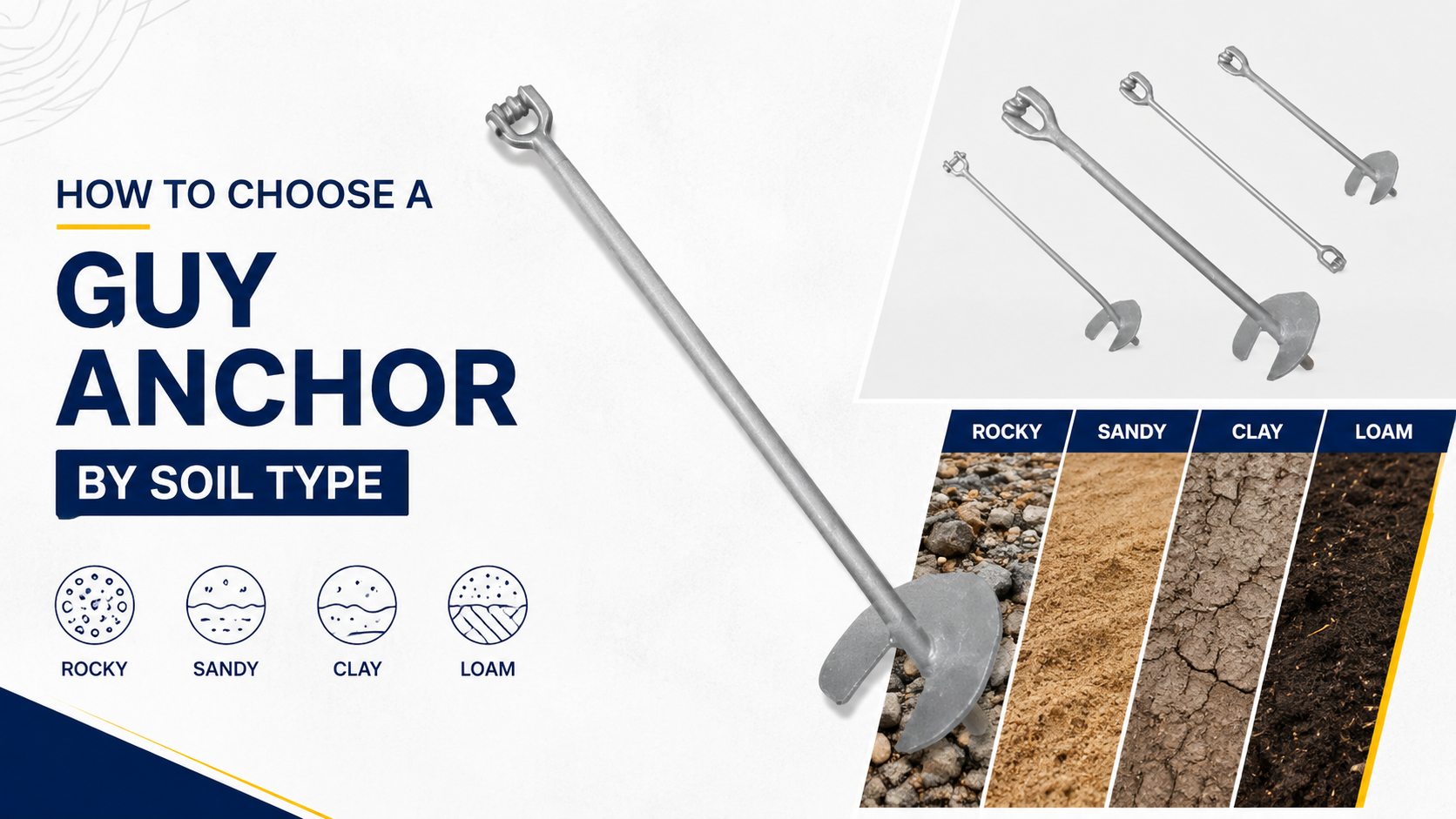
How to Choose a Guy Anchor by Soil Type
The guy anchor follows the ground. In most soils, a driven plate (“drive”) anchor works well. In rock or very hard ground, use an expanding rock anchor. In soft to medium soil, a disk anchor bears effectively. In suitable turnable soils, a screw anchor installs fast without excavation. Match the anchor’s hold mechanism to your soil, and size its holding capacity above the guy’s working tension.
A guy holds the pole, but the guy is only as good as what it’s anchored to. Put the wrong anchor in the wrong ground, and it drags or pulls out under load. This guide gives you the soil-based framework utilities use to pick the right anchor and explains why the ground, not the guy, decides.
Why Soil Decides the Anchor
A guy anchor resists the guy’s pull by mobilizing the soil around it by bearing against it, gripping rock, or bearing on a disk. So the anchor’s holding capacity depends as much on the ground as on the anchor itself: the same anchor holds more in strong soil and less in weak soil, and some anchors simply can’t be installed in some ground (you can’t screw into rock, or drive a plate into solid stone). That’s why anchor selection starts with the soil, then confirms the capacity.
The Four Main Guy Anchor Types
Drive (plate) anchor most soils
A drive anchor (driven plate anchor) is a plate driven into the ground on a rod; once at depth, it rotates/toggles to bear against the undisturbed soil above it. Drive anchors work in a wide range of common soils and install without a large excavation. A good drive-anchor system also lets you proof-test the anchor as it’s set (a load-lock test), confirming its hold. For most soils, the drive anchor is the versatile default.
Expanding rock anchor rock / very hard ground
An expanding rock anchor is set into a drilled hole in rock and expands to grip the rock walls. Where the ground is rock or very hard, this is the anchor a plate can’t be driven and a screw can’t be turned into solid rock, but a rock anchor grips it directly.
Disk anchor soft to medium soil
A disk anchor is a bearing disk on a rod that resists the guy’s pull by bearing area against the soil. In soft to medium soils, where a larger bearing area develops the needed hold, the disk anchor performs well. It’s a manufactured bearing anchor, related to the traditional plate-and-rod approach.
Screw anchor suitable turn able soils
A screw anchor has a helix that is turned (screwed) into the soil, pulling the anchor down and then bearing against undisturbed ground. In soils it can turn into, it installs fast, by machine, without excavation a quick, low-labor anchor. It’s not for rock (a screw can’t penetrate it) and very soft ground may hold less.
Guy Anchor by Soil Type: Quick Reference
| Soil / ground | Recommended anchor | Why |
|---|---|---|
| Most common soils | Drive (plate) anchor | Versatile, driven, proof-testable |
| Rock / very hard ground | Expanding rock anchor | Grips drilled rock; others can’t install |
| Soft to medium soil | Disk anchor | Bearing area develops the hold |
| Suitable turn able soils | Screw anchor | Fast, machine-turned, no excavation |
The Selection Framework
1. Identify the soil
Rock? Firm/average soil? Soft ground? A soil investigation or local knowledge tells you which category you’re in. This is the first and most important step.
2. Match the anchor to the soil
Use the table above. If you’re between categories or the site varies, tell your supplier the soil description and they’ll advise and in mixed ground you may use different anchors on different structures.
3. Size the holding capacity to the guy
Whatever anchor type, its holding capacity must exceed the guy’s working tension with your standard’s safety margin, in that soil. The same anchor has different capacity in different soils, so capacity is confirmed for your ground, not assumed. This is a datasheet figure to confirm never estimate a safety-critical holding capacity.
4. Complete the connection
The anchor connects to the guy through an anchor rod (extended with a coupling for deep sets), and the guy terminates to it with a grip or clamp. Specify the anchor with its rod and the guy hardware as one stay.
What About Dug-In Plate Anchors?
A traditional option is a stay plate on a stay rod a bearing plate dug into an excavation and backfilled. It works by the same bearing principle as a disk anchor but is assembled on site from a plate and rod rather than supplied as a complete manufactured unit. It’s economical where excavation is easy and a dug-in plate suits the ground.
Choosing a Guy Anchor: FAQ
How do I choose a guy anchor? Start with the soil: drive (plate) anchors for most soils, expanding rock anchors for rock, disk anchors for soft-to-medium soil, and screw anchors for suitable turntable soils. Then size the anchor’s holding capacity above the guy’s working tension for that specific ground.
What anchor do I use in rock? An expanding rock anchor, set into a drilled hole and expanded to grip the rock. Drive and screw anchors can’t install in rock, so the rock anchor is the correct choice for hard ground.
What is the best anchor for soft soil? A disk anchor generally performs well in soft to medium soil because its bearing area develops the hold. Very soft ground may need a larger bearing area or a different approach confirm the capacity for your soil.
What is a screw anchor and when should I use it? A screw anchor has a helix turned into the soil, installing fast by machine without excavation. Use it in soils it can turn into; it’s not for rock, and very soft ground may hold less. It’s valued for quick, low-labor installation.
How much holding capacity does a guy anchor need? Enough to exceed the guy’s working tension with your standard’s safety margin, in your specific soil. Because the same anchor holds differently in different soils, the capacity is confirmed for your ground on the datasheet never estimated.
Can I use the same anchor across a whole line? Only if the soil is consistent. Where the ground varies along a route, different structures may need different anchors. Match each to its local soil, or ask your supplier to specify by structure.
The Bottom Line
The guy anchor follows the ground: drive anchors for most soils, rock anchors for rock, disk anchors for soft-to-medium soil, screw anchors for suitable turn able soils with the holding capacity always sized above the guy tension for that specific soil. Get the soil right and the rest follows.
DAPENG Power (DP Power Fitting) makes the full ground-anchor range, drive/plate, rock, disk, and screw anchors, plus the anchor rods, stay plates, and guy hardware that complete the stay. Send us your soil conditions and guy tension, and we’ll recommend the anchor and confirm its holding capacity.