How to Choose the Right Crossarm: Steel Types & Selection
First choose the material steel crossarms are stronger, longer-lasting, fire-resistant, and dimensionally consistent compared with wood, which is why most modern lines specify steel. Then choose the type by the structure and clearance: a standard straight crossarm (symmetric, conductors both sides) for open structures, a V-type crossarm for heavier-duty self-braced configurations, and an alley arm (offset, single-side) where one side must stay clear of an obstruction. Match the crossarm to the conductors, spacing, and load, and mount it with the right pole hardware.
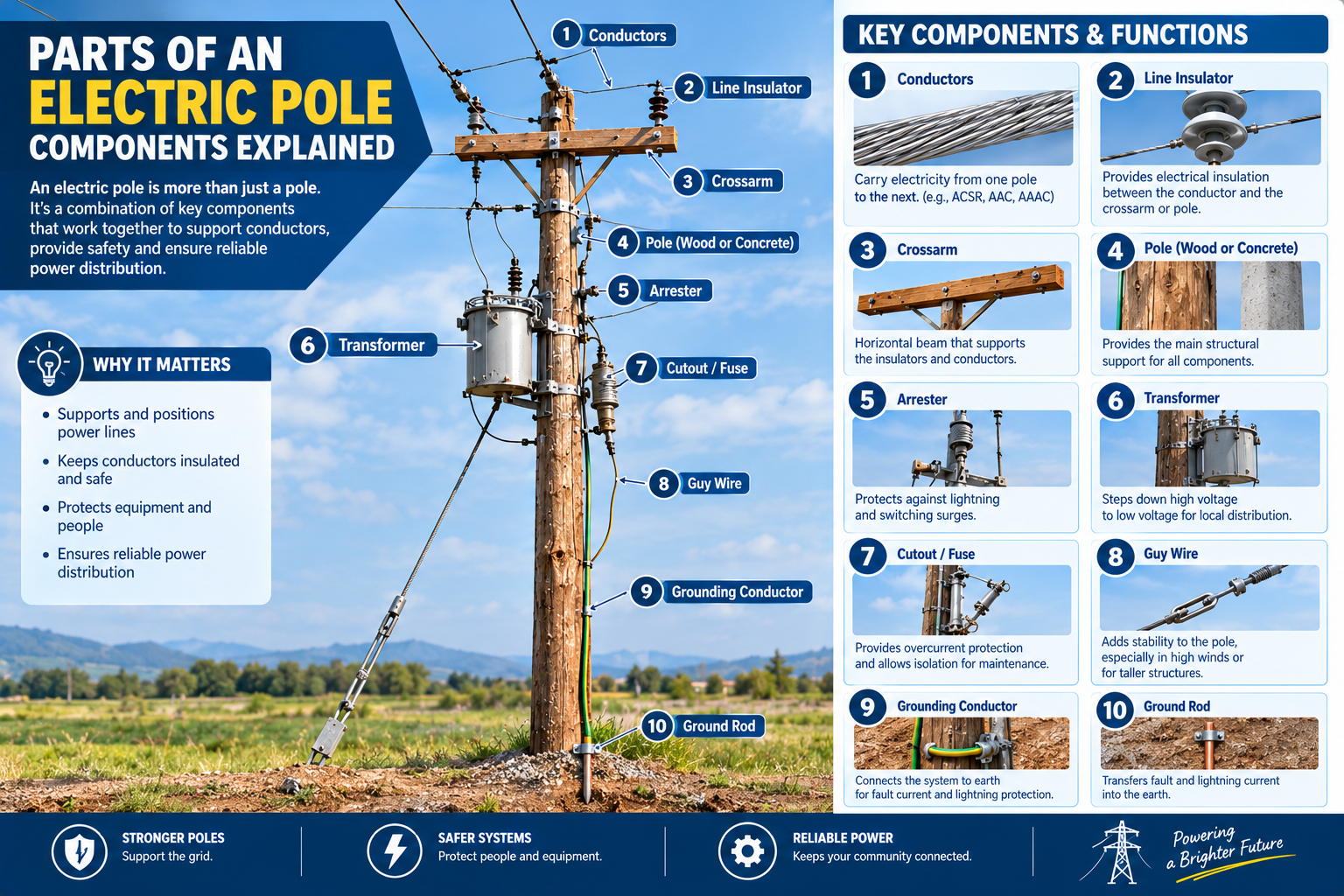
The crossarm carries the insulators and conductors and takes their load into the pole so choosing the right one matters for the whole structure. This guide covers the two decisions: steel vs wood, and which steel crossarm type for your situation.
Steel vs Wood Crossarms
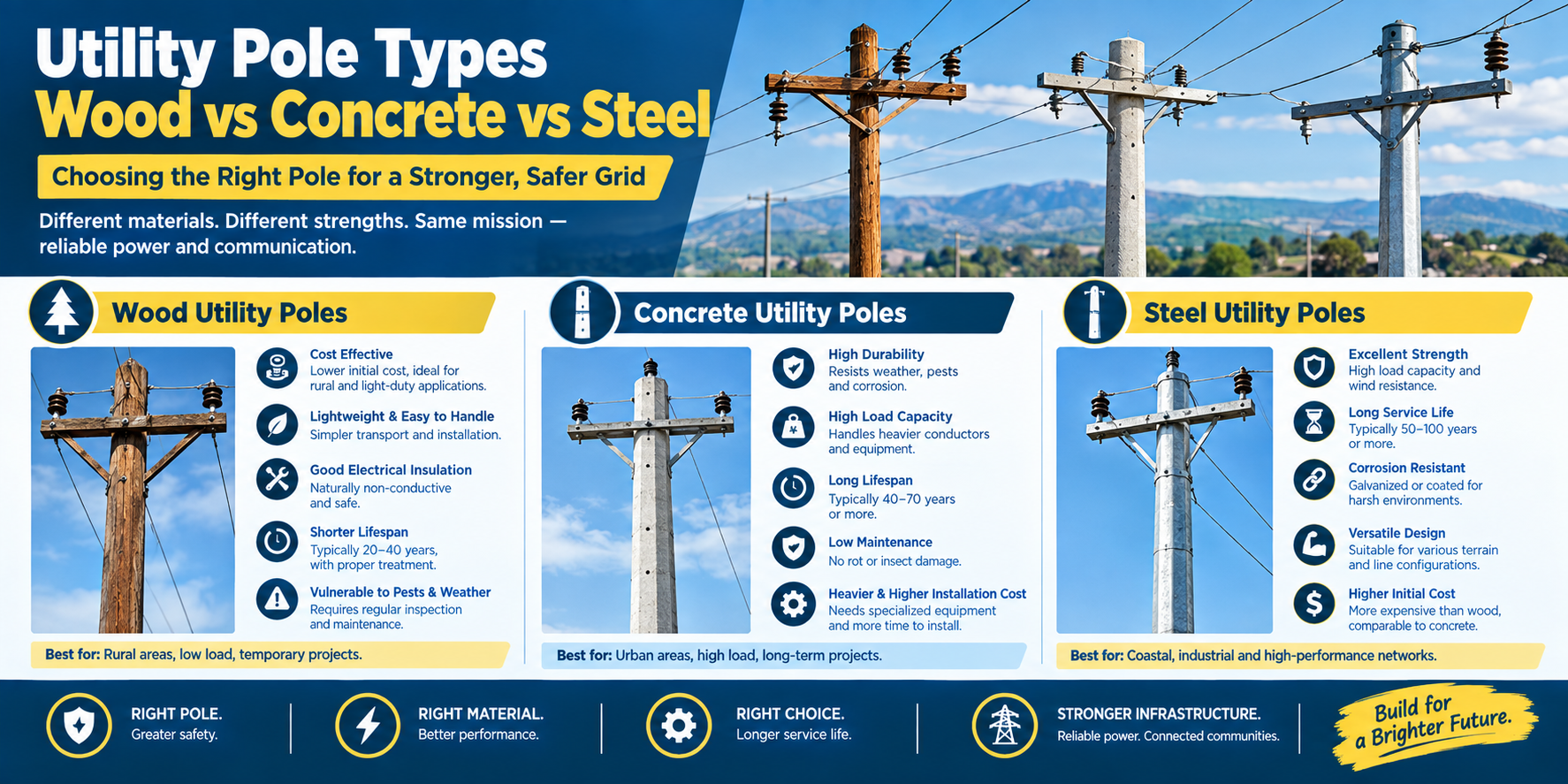
Wood crossarms have a long history, but steel has become the modern standard for good reasons:
Steel crossarm advantages:
- Strength steel carries higher loads for its size and doesn’t split or check like wood.
- Longevity hot-dip galvanized steel resists rot, insects, and weathering that degrade wood over time.
- Fire resistance steel doesn’t burn, a real advantage in fire-prone areas.
- Dimensional consistency every steel crossarm is identical, drilled to a precise pattern, unlike variable timber.
- Lower lifecycle cost longer life and less maintenance often outweigh a higher purchase price.
Where wood still appears: legacy systems, certain aesthetic or heritage requirements, and some utilities’ standards. But for new and rebuilt lines, steel crossarms are usually the specification.
Which Steel Crossarm Type?
Once you’ve chosen steel, the type depends on the structure, the clearance, and the duty:
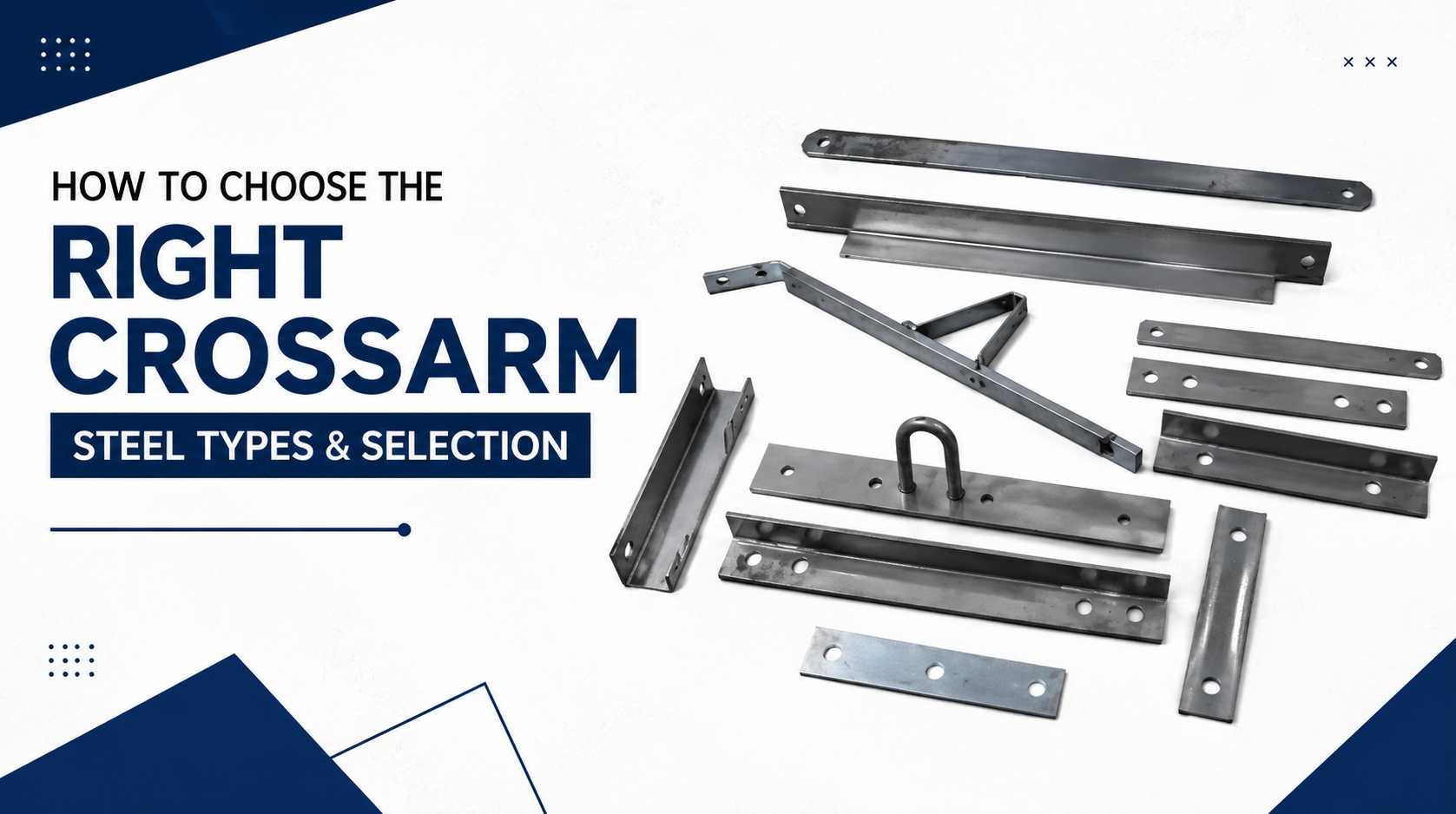
Standard straight crossarm (symmetric)
The common crossarm: a straight steel arm carrying conductors on both sides of the pole, mounted symmetrically. DAPENG makes these as the electrical cross arm (EC series) and power pole cross arm (SA series) standard drilled arms sized to the conductors and spacing. Use these on open structures where a symmetric arm fits.
V-type crossarm
A V-type crossarm is a self-braced arm configured in a V, giving greater rigidity and load capacity for heavier-duty configurations. Use it where a standard arm needs more strength or a braced geometry.
Alley arm (offset, single-side)
An alley arm is an offset crossarm that carries the conductors out to one side only, with an integral brace. Use it where a symmetric arm won’t fit where one side of the pole would overhang an alley, a road edge, a property line, or a building. It’s a clearance solution, not just a smaller arm.
Crossarm Type Selector
| Situation | Crossarm | Why |
|---|---|---|
| Open structure, conductors both sides | Standard straight (EC/SA) | Symmetric, simple, economical |
| Heavier duty / needs rigidity | V-type | Self-braced, higher capacity |
| One side must stay clear (alley/road/property line) | Alley arm | Offset single-side with brace |
The Selection Framework
1. Material: steel (usually)
For strength, longevity, fire resistance, and consistency, steel is the modern default. Choose wood only where a legacy system or specific standard requires it.
2. Type: by structure and clearance
- Symmetric, open structure → standard straight crossarm (EC/SA).
- Heavier duty / rigidity → V-type.
- Restricted clearance on one side → alley arm.
3. Size: to the conductors, spacing, and load
The crossarm’s length, section, and drilling are set by the number of conductors, the phase spacing your voltage requires, and the mechanical load (conductor tension, wind, ice). Give these to your supplier and the arm is sized and drilled to fit. Load ratings are datasheet figures to confirm for your line.
4. Mounting and bracing
The crossarm mounts to the pole commonly via a pole band and bolts and symmetric arms are supported by a flat crossarm brace. The pole band must fit the pole diameter at the mounting height (poles taper), and the brace triangulates the arm. Specify the crossarm with its mounting and bracing as a set.
What Goes on the Crossarm?
The crossarm carries the insulators pin or post insulators on pins which carry the conductors. So the crossarm choice coordinates with the insulator choice and the pole structure: the arm sets the spacing, the insulators do the insulating, the pole band mounts it all.
Choosing a Crossarm: FAQ
Are steel crossarms better than wood? For most modern lines, yes steel is stronger, longer-lasting, fire-resistant, and dimensionally consistent, with lower lifecycle cost. Wood still appears in legacy systems and where a standard or heritage requirement calls for it, but steel is the usual specification for new and rebuilt lines.
What is the difference between a standard crossarm and an alley arm? A standard crossarm is symmetric, carrying conductors on both sides of the pole. An alley arm is offset, carrying conductors to one side only with an integral brace used where one side must stay clear of an alley, road, property line, or building. The alley arm is a clearance solution.
When do I need a V-type crossarm? When you need greater rigidity or load capacity than a standard straight arm the V-type is self-braced for heavier-duty configurations. For ordinary symmetric structures, a standard straight crossarm is simpler and more economical.
How do I size a crossarm? By the number of conductors, the phase spacing your voltage requires, and the mechanical load (tension, wind, ice). These set the length, section, and drilling. Give your supplier the conductors, spacing, and load, and confirm the load rating on the datasheet.
How is a crossarm mounted to the pole? Commonly via a pole band clamped around the pole (sized to the pole diameter at the mounting height, since poles taper) and bolts, with a flat brace supporting a symmetric arm. Specify the crossarm with its mounting and bracing together.
What insulators go on a crossarm? Usually pin or post insulators on pins, which carry the conductors. The crossarm sets the phase spacing; the insulators do the insulating. Coordinate the crossarm and insulator choice for your voltage.
The Bottom Line
Choosing a crossarm is two decisions: material usually steel, for strength, longevity, fire resistance, and consistency and type a standard straight arm for symmetric structures, a V-type for heavier duty, or an alley arm where one side must stay clear. Size it to the conductors, spacing, and load, and mount it with the right pole band, bolts, and brace.
DAPENG Power (DP Power Fitting) manufactures the full steel crossarm range, electrical (EC), power-pole (SA), V-type, and alley arms with the pole bands, braces, bolts, and insulator hardware to complete the structure. Tell us your conductors, spacing, load, and clearance, and we’ll recommend and size the crossarm.