Armor Rods vs Line Guards: Conductor Protection Explained
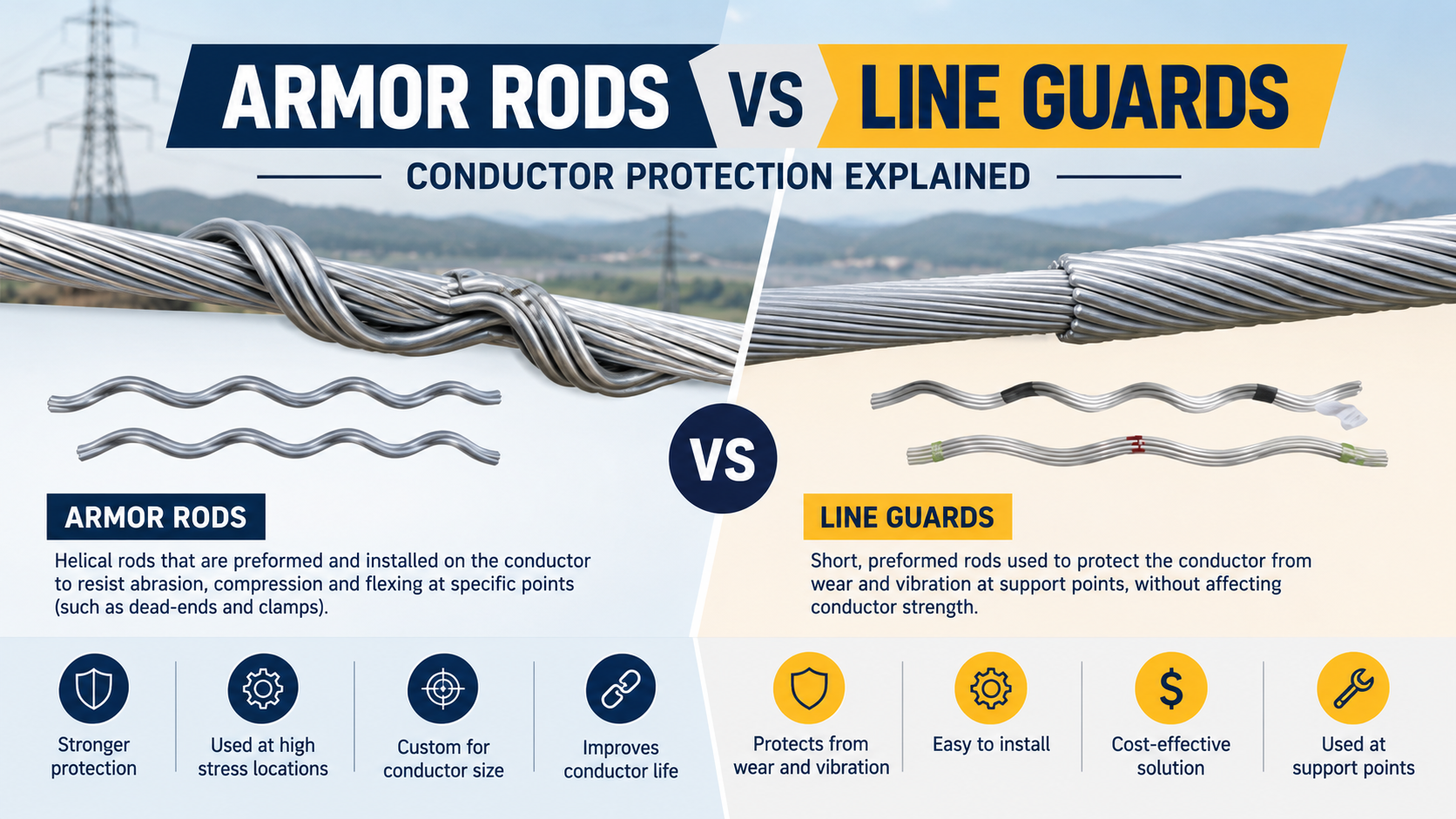
Both are preformed helical rods wrapped around a conductor, but they serve different purposes. Armor rods reinforce the conductor at a support (suspension) point, spreading the clamping load and adding stiffness to resist vibration fatigue where the conductor is held. Line guards are a helical wrap that protects the conductor surface from contact, chafing, and abrasion, for example, where conductors could rub, or at points of mechanical contact. Use armor rods for vibration/fatigue reinforcement at supports; use line guards for general contact/abrasion protection.
Two preformed products look similar: helical rods wrapped on a conductor, and they are easy to confuse. But they solve different problems, and using the wrong one leaves the conductor unprotected where it matters most. This guide draws the distinction clearly.
What Are Armor Rods?
Armor rods are a set of preformed helical rods wrapped around the conductor at a suspension support, under and around the suspension clamp. They do two things:
- Spread the clamping load over a longer length of conductor, so the clamp doesn’t concentrate stress on a short section.
- Add stiffness at the support, which resists the bending fatigue caused by aeolian vibration where the conductor is held rigidly.
The support is exactly where vibration-induced fatigue concentrates the conductor flexes against a fixed clamp so reinforcing it with armor rods extends the conductor’s fatigue life. Armor rods are a vibration/fatigue measure at the support, working alongside dampers (which reduce the vibration) and the suspension clamp (which holds the conductor).
What Are Line Guards?
Line guards are a preformed helical wrap applied to the conductor to protect its surface from contact, chafing, and abrasion. Where a conductor could rub against something, or where mechanical contact would wear the strands, the line guard takes that wear on itself, protecting the conductor underneath.
Line guards are a surface-protection measure they guard the conductor from physical contact and abrasion, rather than reinforcing it against vibration at a support. That’s the core difference.
Armor Rods vs Line Guards: Comparison
| Armor Rods | Line Guards | |
|---|---|---|
| Form | Preformed helical rods | Preformed helical wrap |
| Primary job | Reinforce at the support | Protect the surface |
| Protects against | Vibration fatigue, clamp stress | Contact, chafing, abrasion |
| Where used | At suspension clamps | Where contact/abrasion occurs |
| Works with | Suspension clamp, dampers | General conductor runs / contact points |
How Do I Choose?
Use armor rods when…
- You’re at a suspension (support) point and want to protect the conductor from vibration fatigue and clamp stress.
- You want to spread the clamping load and stiffen the conductor where it’s held.
Use line guards when…
- The conductor needs protection from physical contact, chafing, or abrasion.
- There’s a point where the conductor could rub or be mechanically worn.
Sometimes you use both for different reasons
On a line with a vibration problem, armor rods reinforce the supports; where conductors face contact/abrasion, line guards protect the surface. They’re not substitutes each addresses a different threat to the conductor.
Where They Fit in Conductor Protection
Conductor protection at and around supports involves several complementary products:
- Armor rods – reinforce at the support against vibration fatigue.
- Armor grip suspension – a suspension unit that cushions and supports the conductor with an elastomer insert, for severe vibration duty.
- Dampers – reduce the vibration itself (spiral or Stockbridge).
- Line guards – protect the surface from contact/abrasion.
All are part of the preformed line family. Specify them by the threat: vibration fatigue at supports → armor rods (or armor grip suspension for severe duty) plus dampers; contact/abrasion → line guards.
Armor Rods vs Line Guards: FAQ
What is the difference between armor rods and line guards? Armor rods reinforce the conductor at a suspension support spreading the clamp load and resisting vibration fatigue. Line guards are a helical wrap that protects the conductor surface from contact, chafing, and abrasion. Armor rods = reinforcement at supports; line guards = surface protection.
What do armor rods do? Armor rods wrap the conductor at the suspension clamp, spreading the clamping load over a longer length and adding stiffness that resists the bending fatigue caused by aeolian vibration where the conductor is held. They extend conductor fatigue life at supports.
When do I need line guards? When the conductor needs protection from physical contact, chafing, or abrasion anywhere it could rub or be mechanically worn. The line guard takes the wear on itself, protecting the conductor strands underneath.
Do armor rods replace a vibration damper? No they’re complementary. Dampers reduce the vibration energy in the span; armor rods reinforce the conductor at the support where fatigue concentrates. On a line with a vibration problem, you often use both.
Can I use armor rods for abrasion protection? Armor rods are designed for support reinforcement against vibration fatigue, not general surface abrasion for contact/abrasion, line guards are the right product. Use each for its intended job.
What is armor grip suspension? Armor grip suspension is a suspension unit that supports the conductor through an elastomer-cushioned grip (often with armor rods), used for severe vibration duty. It’s a step beyond a plain suspension clamp plus armor rods where vibration is a serious concern.
The Bottom Line
Armor rods and line guards are both preformed helical products, but they protect the conductor in different ways: armor rods reinforce at the support against vibration fatigue and clamp stress; line guards protect the surface from contact and abrasion. Choose by the threat and use both where the conductor faces both.
DAPENG Power (DP Power Fitting) makes the full conductor-protection range armor rods, line guards, armor grip suspension, and the suspension clamps and dampers they work with, all part of the preformed line family. Tell us your conductor and the threat vibration or abrasion and we’ll recommend the right protection.