Ball-and-Socket vs Clevis-and-Tongue: Insulator String Couplings Explained
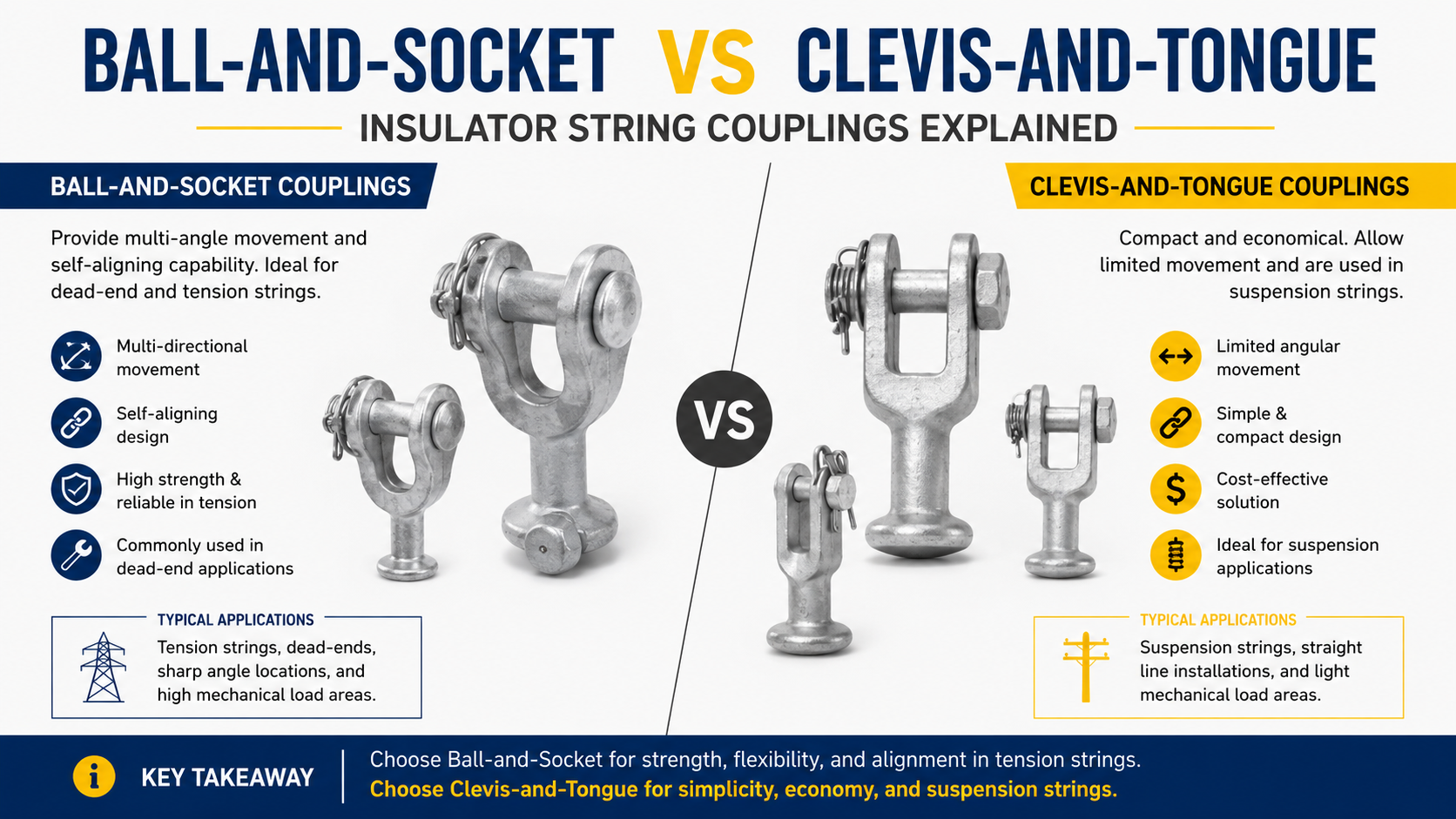
Insulator strings are built from links that connect in one of two coupling systems. In ball-and-socket coupling, a ball on one fitting seats into a socket on the next (secured by a split pin/W-clip), the common system for suspension strings. In clevis-and-tongue coupling, a flat tongue fits between the jaws of a clevis and is held by a pin. Both join the discs and end fittings into a string; the whole string must use one matched coupling system and size (designated by IEC 60120), so every link mates with the next.
An insulator string looks simple, but it’s an assembly of links that all have to connect. Get the coupling system or size wrong and the fittings don’t mate. This guide explains the two coupling systems, the sizing that makes them fit, and how the string hardware goes together.
Why Couplings Matter
A suspension or tension insulator string is a chain: structure → end fitting → insulator discs → end fitting → conductor clamp. Every joint in that chain is a coupling, and every coupling must mate with its neighbor. Two things must match at each joint: the coupling system (ball-and-socket or clevis-and-tongue) and the coupling size. If either is wrong, the fittings won’t connect, which is why strings are specified as a coordinated set in one system and size.
Ball-and-Socket Coupling
In ball-and-socket coupling, one fitting ends in a ball and the mating fitting has a socket that the ball seats into, secured by a split pin or W-clip (security clip). It’s a compact, articulating joint that allows the string to swing ideal for suspension strings.
Typical ball-and-socket fittings include the ball eye and ball clevis (ball on one end, eye or clevis on the other) and the socket eye and socket clevis (socket on one end). You use these to transition between the ball-and-socket discs and the eye/clevis hardware of the structure and conductor end.
Clevis-and-Tongue Coupling
In clevis-and-tongue coupling, one fitting ends in a clevis (a U-shaped jaw) and the mating fitting has a flat tongue that fits between the jaws, held by a clevis pin and cotter. It’s a robust, bolted-style joint common where a pinned mechanical connection is preferred.
Clevis-and-tongue and ball-and-socket are the two standard families; a given string uses one or the other, and the end fittings are chosen to transition to the structure and conductor hardware accordingly.
The Sizing That Makes Them Fit: IEC 60120
Coupling size is standardized. Under IEC 60120, ball-and-socket couplings are designated by a size number (for example, the common 16, 20, 24, 28 mm ball/pin sizes), and every fitting in the string must share the same designation so the ball fits the socket. This designation is the practical language of string hardware: specify the coupling size, and every link ball eye, disc, socket clevis, yoke plate is ordered to match.
The mechanical strength of the coupling (the failing load it must hold) is a separate rating that scales with the size and must meet the string’s mechanical duty a datasheet figure to confirm for your line.
How the String Goes Together
A typical suspension string, top to bottom:
- Structure attachment – a u-shackle or bracket connects to the tower.
- Top end fitting – a ball eye or socket clevis transitions to the discs.
- Insulator discs – the suspension insulators, coupled ball-to-socket, as many as the voltage needs.
- Bottom end fitting – transitions to the conductor clamp.
- Conductor clamp – a suspension clamp (tangent) or strain clamp (dead-end) holds the conductor.
For twin or multi-conductor strings, a yoke plate distributes the load across multiple legs. On high voltages, a corona ring grades the field at the string ends. Every coupling in this chain shares one system and size.
Ball-and-Socket vs Clevis-and-Tongue: FAQ
What is the difference between ball-and-socket and clevis-and-tongue couplings? Ball-and-socket coupling seats a ball into a socket, secured by a split pin, compact and articulating, common on suspension strings. Clevis-and-tongue coupling fits a flat tongue between clevis jaws, held by a pin a robust pinned joint. Both join string hardware; a string uses one system throughout.
What is IEC 60120? IEC 60120 is the standard that designates ball-and-socket coupling dimensions by size (e.g. 16, 20, 24, 28 mm). It ensures fittings from different sources mate correctly. Specify the coupling size and every link in the string is ordered to match.
Can I mix coupling systems in one string? No a string uses one coupling system and size throughout, with end fittings (ball eye, socket clevis, etc.) transitioning to the structure and conductor hardware. Mixing systems or sizes means the fittings won’t mate.
What is a ball eye vs a socket clevis? A ball eye has a ball on one end (to seat into a socket) and an eye on the other. A socket clevis has a socket on one end (to receive a ball) and a clevis on the other. They’re transition fittings that connect the ball-and-socket discs to eye/clevis structure and conductor hardware.
What holds a ball-and-socket coupling together? A split pin or W-clip (security clip) locks the ball in the socket so it can’t disengage under load or vibration, while still allowing the joint to articulate. Correct security-clip installation is essential.
How do I choose the coupling size? By the string’s mechanical duty and your standard the coupling size (IEC designation) is chosen so its rated strength meets the load, and every fitting shares that size. Tell your supplier the string’s voltage and mechanical load and they’ll specify the coupling.
The Bottom Line
Insulator strings connect through one of two coupling systems ball-and-socket (compact, articulating, common on suspension) or clevis-and-tongue (robust pinned joint) and every link in a string must share one system and size (IEC 60120) so the fittings mate. Specify the coupling, and the whole string is ordered to match.
DAPENG Power (DP Power Fitting) manufactures the full string-coupling range ball eye, ball clevis, socket eye, socket clevis, u-shackles, yoke plates, and corona rings with the suspension insulators and strings they connect. Tell us your voltage, string type, and mechanical load, and we’ll specify a matched coupling system and size.