ACSR vs AAC vs AAAC: Overhead Conductor Types Explained
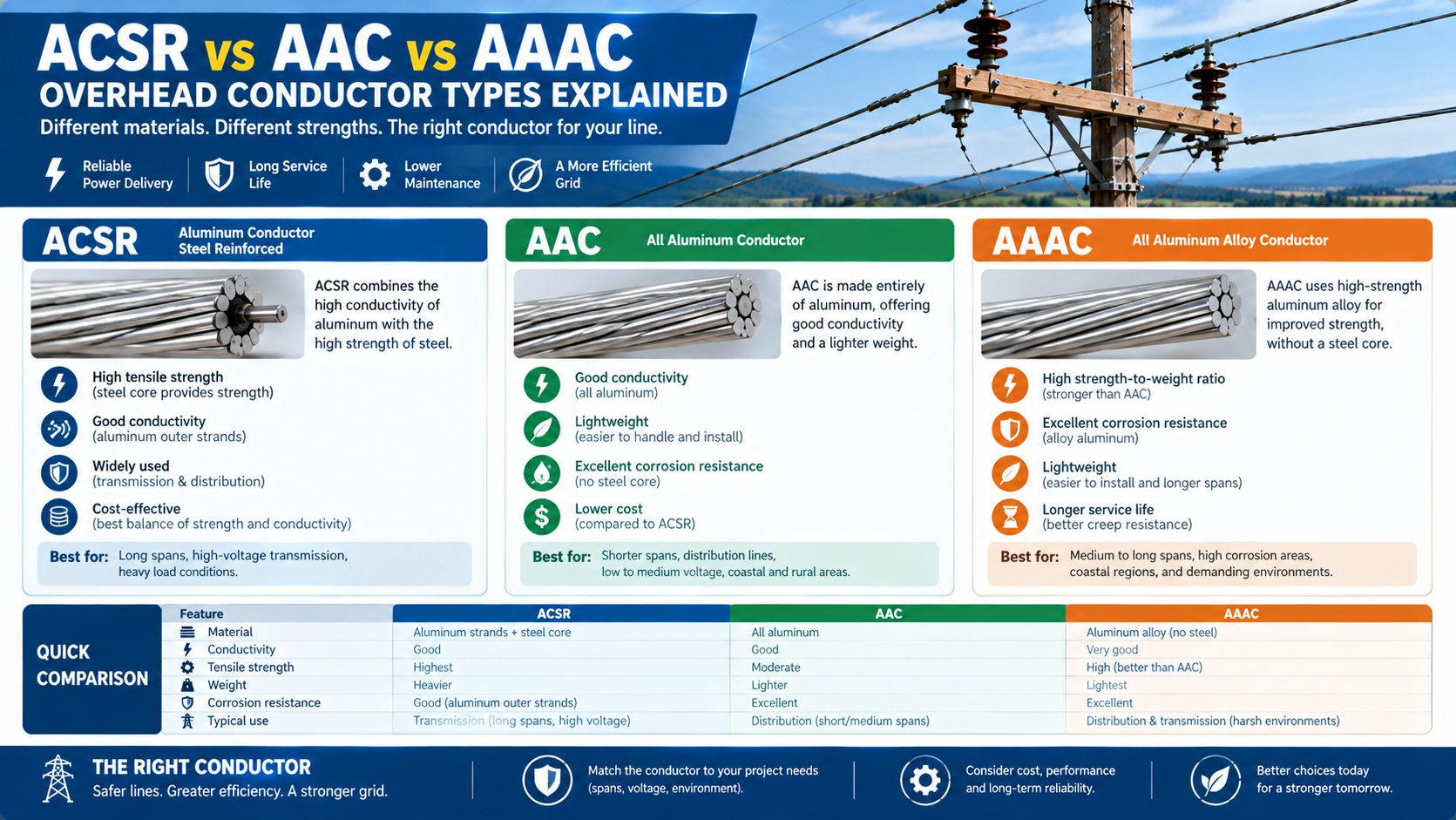
ACSR (Aluminum Conductor Steel Reinforced) has aluminum strands around a steel core, giving high strength for long spans and transmission. AAC (All Aluminum Conductor) is pure aluminum, with high conductivity but lower strength, for short spans and urban distribution. AAAC (All Aluminum Alloy Conductor) uses an aluminum alloy for a better strength-to-weight ratio and corrosion resistance than AAC, without a steel core. Choose ACSR for strength/long spans, AAC for conductivity/short spans, and AAAC for a balance with good corrosion resistance and match the fittings to whichever you use.
The conductor you choose affects the whole line spans, structures, and the fittings that hold it. ACSR, AAC, and AAAC are the three most common overhead conductor types, and each suits different situations. This guide explains the difference and how the hardware matches.
Why Conductor Type Matters
An overhead conductor has to do two things: carry current (conductivity) and hold itself up across the span (mechanical strength). Aluminum conducts well and is light, but on its own it isn’t very strong. The three conductor types are different answers to that strength-vs-conductivity trade-off and the answer affects the span length, the tension, and the fittings.
ACSR – Aluminum Conductor Steel Reinforced
ACSR has aluminum strands wrapped around a steel core. The aluminum carries the current; the steel core carries the mechanical load:
- High strength the steel core lets ACSR span long distances at high tension.
- Good current capacity the aluminum provides the conductivity.
- Widely used for transmission and long-span distribution.
The trade-off is weight and the dissimilar-metal (aluminum/steel) construction. ACSR is the workhorse where strength and long spans matter.
AAC – All Aluminum Conductor
AAC is made entirely of pure aluminum strands:
- High conductivity pure aluminum conducts very well for its weight.
- Lower strength without a steel core, it can’t span as far at high tension.
- Good corrosion resistance no dissimilar metals.
- Used for short spans and urban distribution, where spans are short and conductivity matters.
AAC suits dense, short-span networks where its conductivity is an advantage and its lower strength isn’t a limitation.
AAAC – All Aluminum Alloy Conductor
AAAC is made of an aluminum alloy (not pure aluminum, not steel-reinforced):
- Better strength-to-weight than AAC the alloy is stronger than pure aluminum.
- Good corrosion resistance all one alloy, no steel core, so it resists corrosion well (useful in coastal/aggressive environments).
- A balance more span capability than AAC, lighter and more corrosion-resistant than ACSR.
- Used where a balance of strength, weight, and corrosion resistance is wanted.
AAAC is often chosen as a corrosion-resistant alternative to ACSR or a stronger alternative to AAC.
ACSR vs AAC vs AAAC at a Glance
| ACSR | AAC | AAAC | |
|---|---|---|---|
| Construction | Aluminum + steel core | Pure aluminum | Aluminum alloy |
| Strength | High | Low | Medium-high |
| Conductivity | Good | High | Good |
| Corrosion resistance | Lower (bimetallic) | Good | Good |
| Best for | Transmission, long spans | Urban, short spans | Balance, coastal |
Matching the Fittings to the Conductor
Whatever conductor you choose, the fittings must match its size and type this is where DAPENG Power comes in. We manufacture the fittings, sized and specified to your conductor:
- Suspension clamps and dead-end grips / strain clamps sized to the conductor diameter and rated for its tension.
- Armor rods and vibration dampers matched to the conductor.
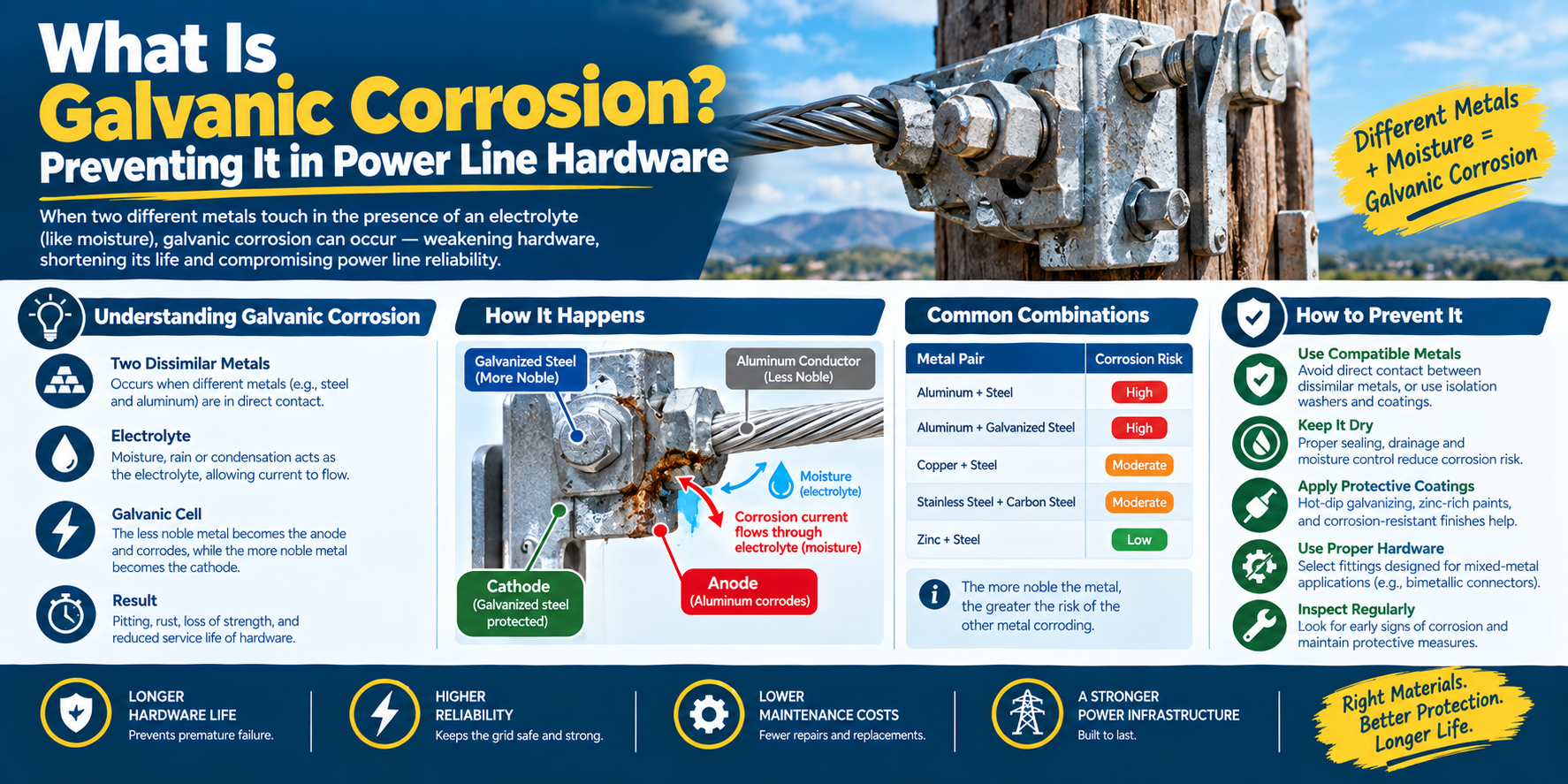
- Parallel-groove clamps and connectors and for ACSR joined to copper or dissimilar metals, a bimetallic connector to avoid galvanic corrosion.
- Preformed fittings made for the specific conductor construction (the grip is sized to the conductor).
A fitting made for the wrong conductor size or type won’t grip correctly so specify the conductor (ACSR/AAC/AAAC, size, strands) and the fittings are matched to it. All are part of the overhead line fittings range.
ACSR vs AAC vs AAAC: FAQ
What is the difference between ACSR, AAC, and AAAC? ACSR is aluminum strands around a steel core (high strength, for transmission and long spans). AAC is pure aluminum (high conductivity, lower strength, for short urban spans). AAAC is aluminum alloy (a balance of strength, light weight, and corrosion resistance). Each suits a different strength-vs-conductivity need.
Which conductor is strongest? ACSR is generally the strongest of the three, because its steel core carries the mechanical load, letting it span long distances at high tension. AAAC is next (a stronger alloy than pure aluminum), and AAC is the least strong but the most conductive for its weight.
Which conductor is best for coastal or corrosive environments? AAAC is often preferred in coastal or corrosive environments because it’s a single aluminum alloy with good corrosion resistance and no steel core to corrode. ACSR’s bimetallic construction can be more vulnerable to corrosion at the aluminum/steel interface.
When is AAC used? AAC (all aluminum) is used for short spans and urban distribution, where spans are short enough that its lower strength isn’t a limitation and its high conductivity for its weight is an advantage. It’s common in dense distribution networks.
Do ACSR, AAC, and AAAC use different fittings? The fittings must be sized to the conductor’s diameter and construction, so a fitting is specified to the specific conductor. The fitting families are the same (suspension clamps, dead-ends, armor rods), but each is sized and rated to the conductor it holds. A grip made for the wrong conductor won’t grip correctly.
How do I connect ACSR to copper? Use a bimetallic connector designed for the aluminum-to-copper junction, to avoid the galvanic corrosion that a direct connection would cause. This applies whenever dissimilar metals meet match the connector to the metals for a lasting joint.
The Bottom Line
ACSR, AAC, and AAAC are the three main overhead conductor types, differing in the strength-vs-conductivity trade-off: ACSR (steel-cored, strong, for transmission and long spans), AAC (pure aluminum, conductive, for short urban spans), and AAAC (alloy, balanced, corrosion-resistant). Choose by your span, strength, and environment and match the fittings to whichever conductor you use.
DAPENG Power (DP Power Fitting) manufactures the fittings for all overhead conductors suspension clamps, dead-end grips, strain clamps, armor rods, dampers, and connectors sized to your ACSR, AAC, or AAAC conductor, within the overhead line fittings range. Tell us your conductor type and size, and we’ll match the fittings.