Types of Earthing Explained: Pipe, Plate & Rod Earthing
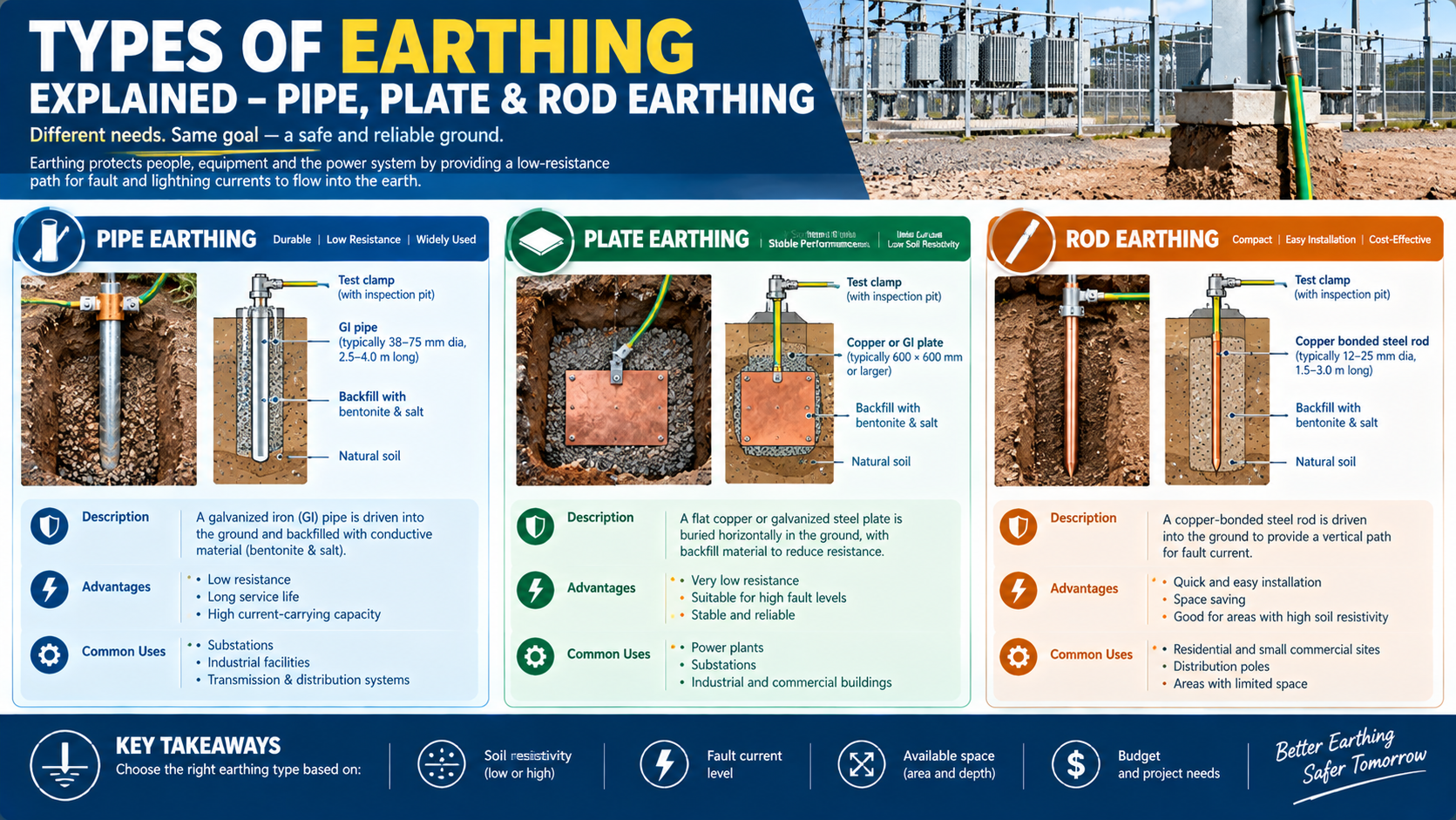
The main types of earthing are pipe earthing (a GI pipe buried vertically), plate earthing (a copper or GI plate buried in a pit), rod earthing (a driven rod electrode), strip/wire earthing (a horizontal conductor in a trench), and mat/grid earthing (an interconnected network for substations). Each provides a low-resistance path to earth for fault and lightning current; the choice depends on the soil, the space available, and the required earth resistance. Rod and plate earthing are the most common for general use.
Earthing (grounding) gives fault and lightning current a safe path into the ground, protecting people and equipment. But there are several earthing methods, each suited to different conditions. This guide explains the main types of earthing and when to use each.
Why Earthing Type Matters
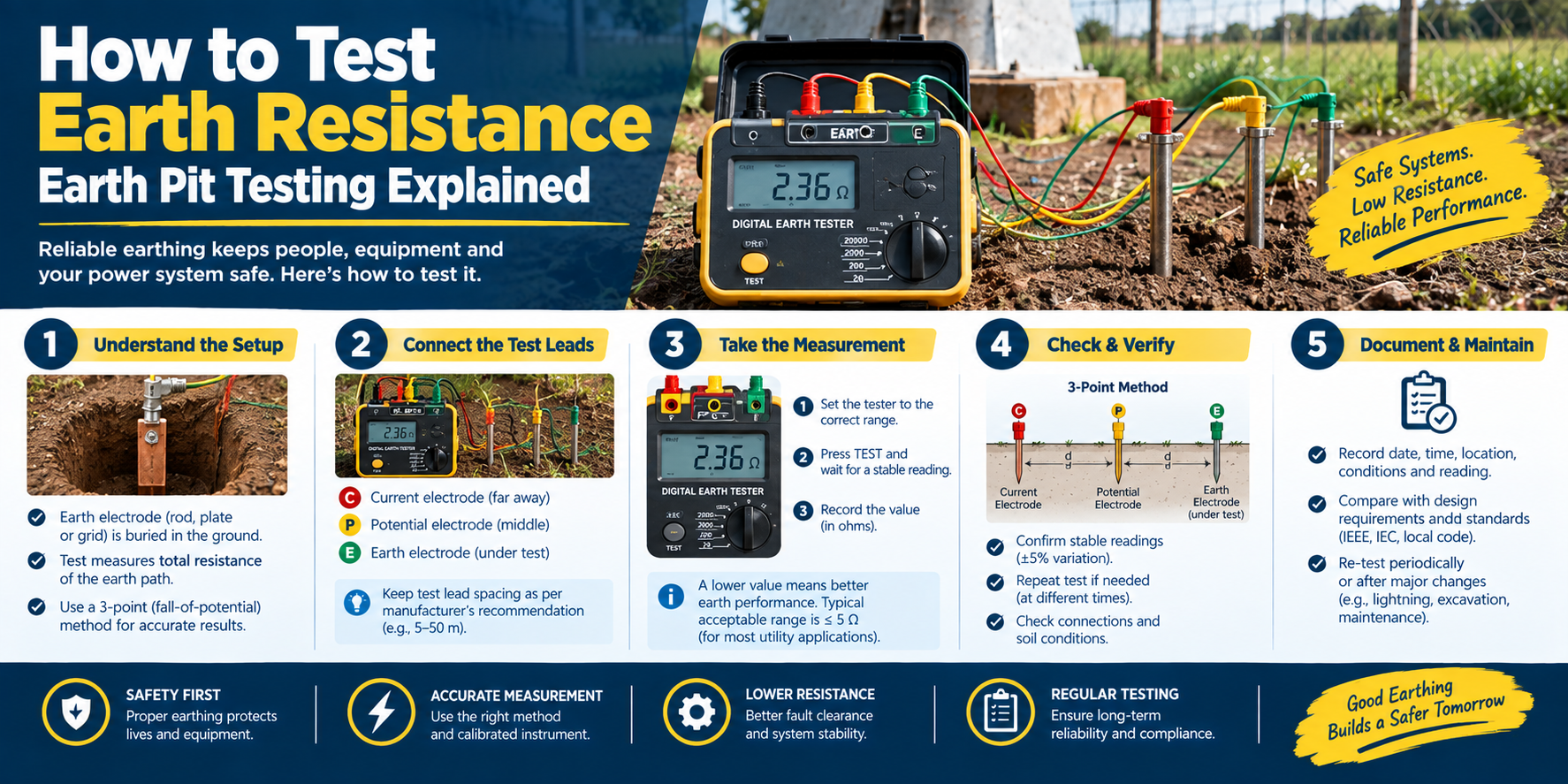
All earthing does the same job provide a low-resistance connection to the general mass of earth but the method affects how low a resistance you can achieve, how much space and digging it needs, and how well it suits your soil. Choosing the right type (and material) is what gives a safe, lasting earth. The earth resistance target is set by your standard (for example, common guidance calls for a low value such as 25 ohms or less for many installations, with lower for substations).
1. Rod (Pipe-in-Rod) Earthing
Rod earthing uses a metal rod electrode driven vertically into the soil. It’s the most common method for general earthing because it’s simple, fast, and reaches the moist, lower-resistivity soil at depth.
- A ground rod copper-bonded for long life and conductivity, or hot-dip galvanized for economy driven to depth.
- Coupling rods join rods to drive deeper in poor soil.
- Bonded with a ground rod clamp.
Rod earthing suits most sites and is easy to extend (more rods, or deeper) if the resistance is too high. (See our how-to-install-a-ground-rod guide.)
2. Pipe Earthing
Pipe earthing uses a galvanized iron (GI) pipe buried vertically in the ground, often in a pit with alternate layers of charcoal and salt around it to improve conductivity. The earth conductor connects to the pipe at the top.
- Common in many distribution and building installations.
- The pit and the charcoal/salt treatment help lower the resistance in the surrounding soil.
- Effective, but needs excavation and periodic watering of the pit in dry conditions.
Pipe earthing is a traditional, widely-used method, especially where a maintainable earth pit is wanted.
3. Plate Earthing
Plate earthing uses a metal plate copper or galvanized iron buried vertically in a pit, surrounded by charcoal and salt to improve conductivity. The earth conductor bolts to the plate.
- The large plate area gives good contact with the soil, so plate earthing can achieve a low resistance.
- Used where a low, stable earth resistance is needed and there’s room to dig a pit.
- Copper plates last longer and conduct better; GI plates are more economical.
Plate earthing is common for substations, larger installations, and where the soil suits a buried plate. (Related to the bearing principle of a stay plate, but for earthing, not anchoring.)
4. Strip / Wire Earthing
Strip earthing uses a horizontal strip or wire conductor (copper or GI) buried in a shallow trench. It’s used where vertical electrodes can’t reach low-resistivity soil (rocky ground) the horizontal conductor spreads contact over a long length instead of going deep.
- Suited to rocky or high-resistivity ground where driving deep is impractical.
- Often used for the earthing of transmission towers and in rocky terrain.
5. Mat / Grid Earthing
Mat (grid) earthing uses an interconnected network of buried conductors (and often rods) forming a grid under a substation. It creates a large, uniform earth that keeps step-and-touch voltages safe across the site.
- Used for substations and large installations.
- Bonded with strand and I-beam grounding clamps where the grid connects to structures and conductors.
Types of Earthing at a Glance
| Type | Electrode | Best for |
|---|---|---|
| Rod | Driven rod | General use, easy to extend |
| Pipe | Vertical GI pipe in pit | Distribution, maintainable pits |
| Plate | Buried plate in pit | Low resistance, substations |
| Strip/wire | Horizontal conductor | Rocky/high-resistivity ground |
| Mat/grid | Interconnected network | Substations, large sites |
The Material Discipline (Applies to All Types)
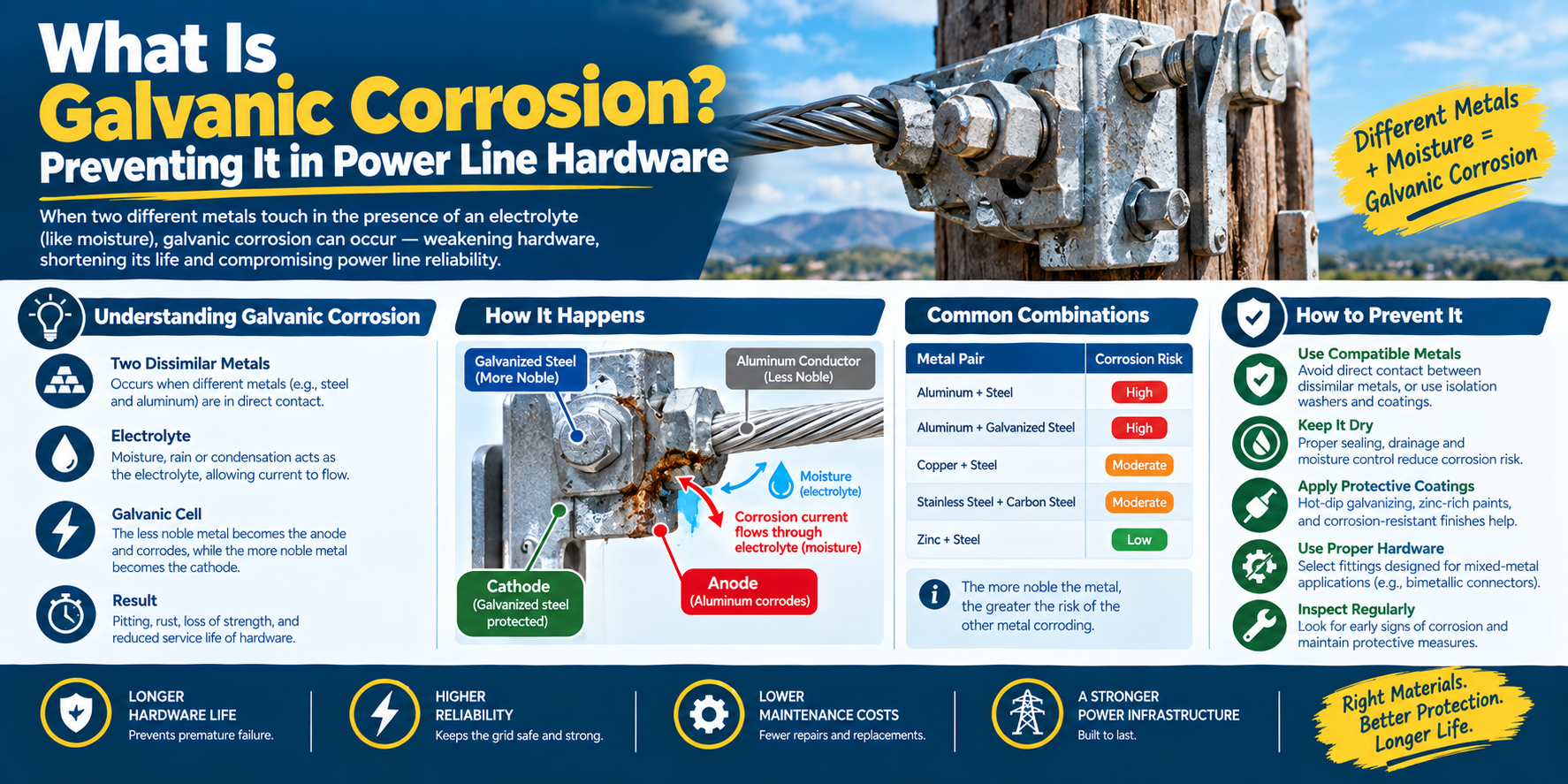
Whatever the earthing type, match the metals to avoid galvanic corrosion a copper conductor with a copper-alloy clamp on a copper-bonded electrode, or a zinc/steel system throughout. A galvanically mismatched earth bond corrodes underground and quietly raises the resistance over time. (See our how-to-ground-an-overhead-line guide.)
Types of Earthing: FAQ
What are the main types of earthing? The main types are rod earthing (a driven rod electrode), pipe earthing (a vertical GI pipe in a pit), plate earthing (a buried metal plate), strip/wire earthing (a horizontal conductor for rocky ground), and mat/grid earthing (an interconnected network for substations). Each gives a low-resistance path to earth.
What is the difference between pipe and plate earthing? Pipe earthing uses a vertical GI pipe buried in a pit; plate earthing uses a buried metal plate (copper or GI). The plate’s larger surface area can achieve a lower earth resistance, so plate earthing suits substations and low-resistance needs, while pipe earthing is common for distribution and maintainable pits.
Which type of earthing is best? It depends on the soil, space, and required resistance. Rod earthing is the most common for general use (simple, extendable); plate earthing gives a low resistance where there’s room to dig; strip earthing suits rocky ground; and mat/grid earthing is for substations. Match the method to the site.
What earthing is used in rocky soil? Strip (horizontal) earthing, because vertical rods and pipes can’t be driven deep into rock. A horizontal conductor buried in a trench spreads contact over a long length to reach enough low-resistivity soil. It’s common for tower earthing in rocky terrain.
Why are charcoal and salt used in earthing pits? Charcoal and salt around a pipe or plate electrode lower the resistivity of the surrounding soil and help retain moisture, improving the earth’s conductivity and lowering its resistance. Modern engineered earth-enhancing compounds serve the same purpose.
How do I lower earthing resistance? Drive deeper (couple rods to reach moist soil), add more electrodes spaced apart and bonded together, use a larger plate, or treat the soil with charcoal/salt or an earth-enhancing compound. Depth and electrode area are the main levers. (See our how-to-reduce-earth-resistance guide.)
The Bottom Line
The main types of earthing rod, pipe, plate, strip, and mat/grid all provide a low-resistance path to earth, but suit different soils, spaces, and resistance targets. Rod and plate earthing are the most common; strip earthing suits rocky ground; and mat/grid earthing is for substations. Match the method and the material to your site.
DAPENG Power (DP Power Fitting) manufactures the earthing hardware for these methods copper and galvanized ground rods, coupling rods, and the rod, strand, and I-beam bonding clamps. Tell us your soil, resistance target, and earthing method, and we’ll specify a matched earthing kit.