Distribution vs Transmission Lines: The Hardware Difference
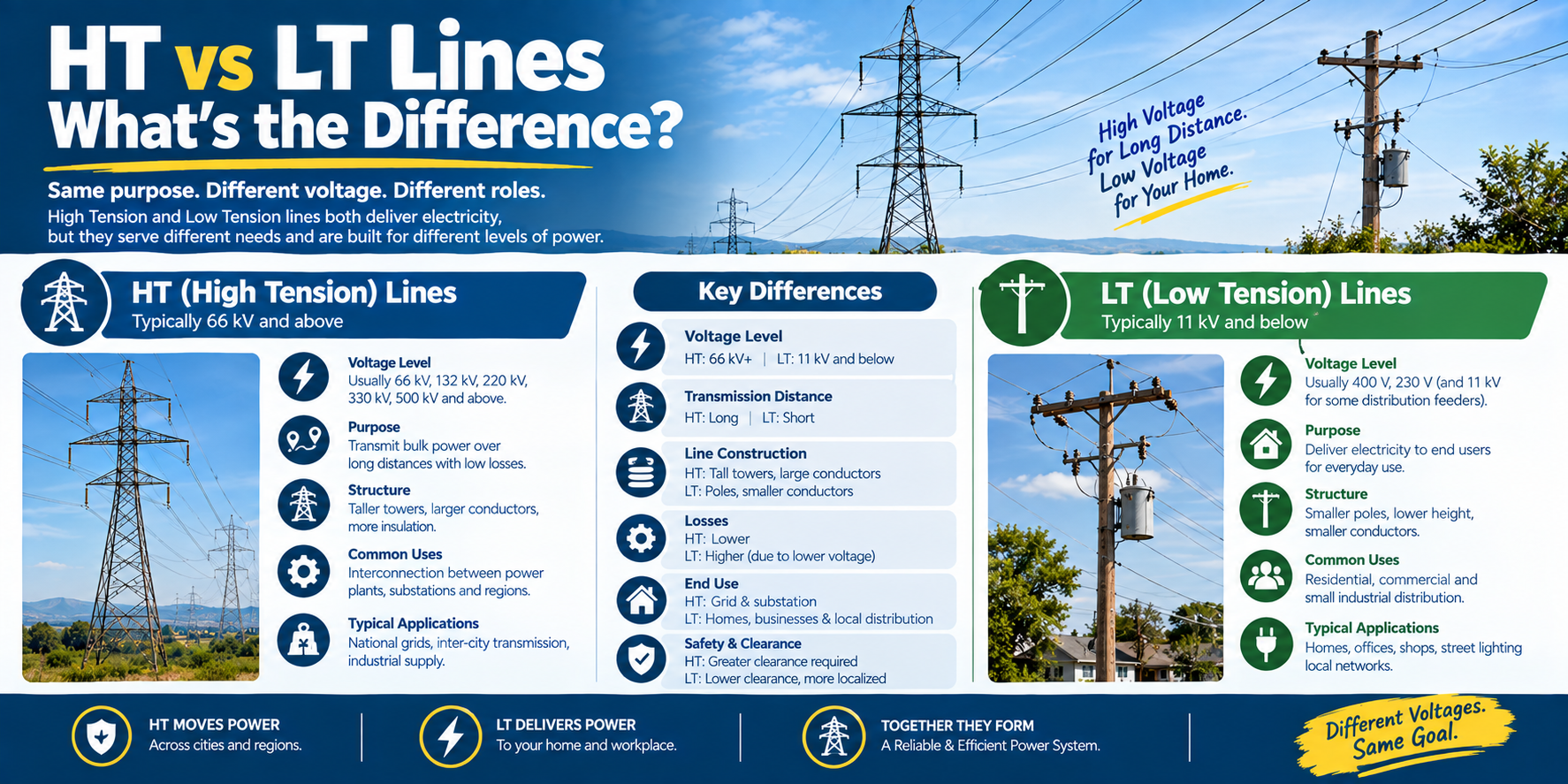
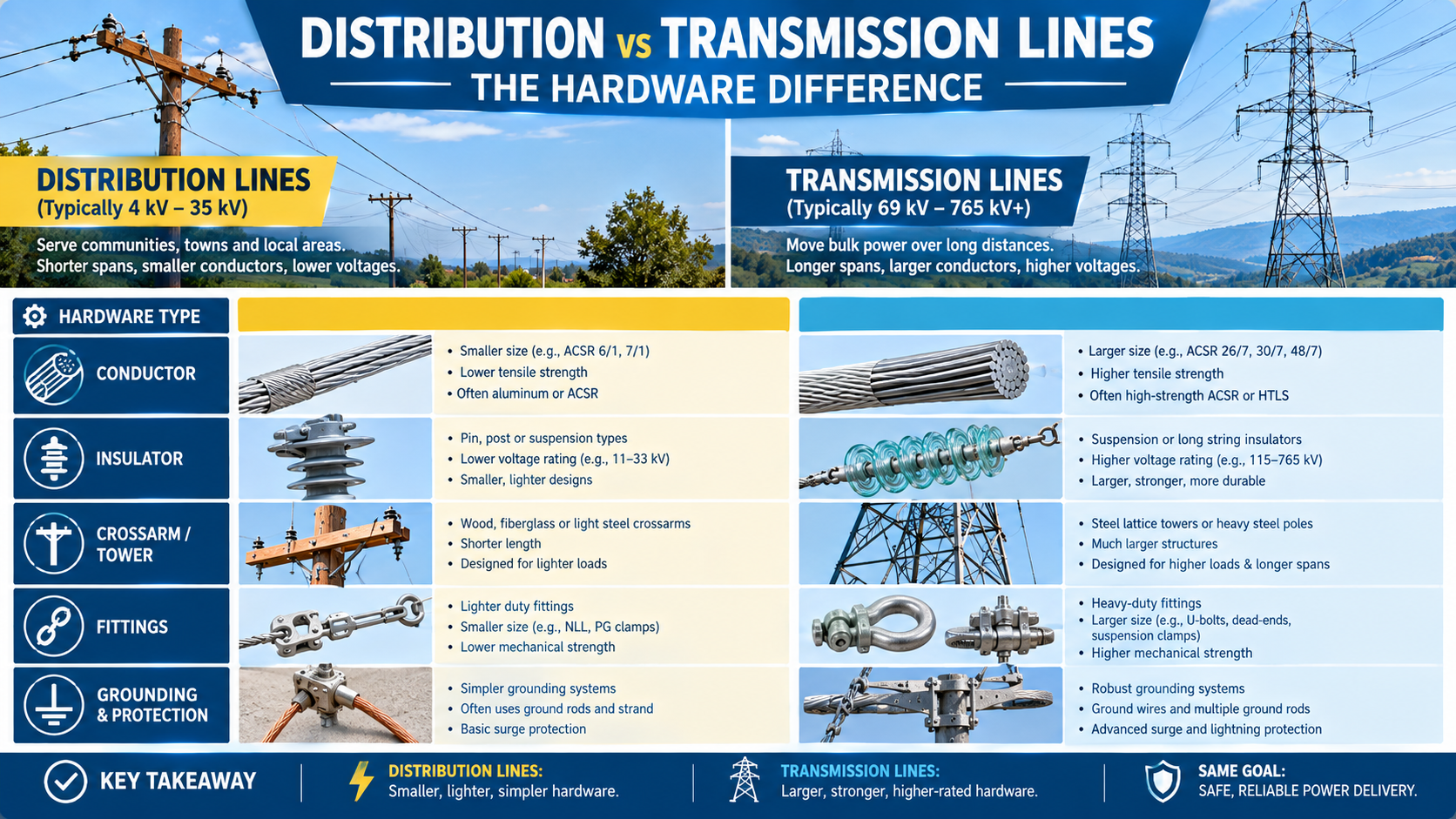
Transmission lines carry electricity at high voltage over long distances on tall towers, using suspension insulator strings (scaled with voltage), heavier conductor fittings, corona rings, and bundled-conductor hardware. Distribution lines carry lower voltage to homes and businesses on poles, using rigid pin and post insulators, lighter fittings, crossarms, and secondary/service hardware. The higher the voltage, the more insulation and the heavier the hardware so transmission and distribution need different fittings, sized to their very different duties.
“Transmission” and “distribution” are both overhead power lines, but they operate at different voltages and use different hardware. Specifying the wrong class of fitting is a costly mistake. This guide explains the difference and which hardware each one uses.
The Core Difference: Voltage and Distance
- Transmission lines move bulk power at high voltage over long distances, from generation to substations, on tall towers. High voltage means more insulation, bigger clearances, and heavier mechanical loads.
- Distribution lines take power at lower voltage from substations to end users, on poles along streets. Lower voltage means simpler insulation and lighter hardware, but more structures and connections.
Everything else the insulators, the fittings, the structures follows from that voltage-and-distance difference.
Insulators: Strings vs Rigid
The clearest hardware difference is the insulators:
- Transmission uses suspension insulator strings discs assembled into a string, with more discs for higher voltage. At the highest voltages, corona rings grade the field.
- Distribution uses rigid pin and post insulators, mounted on the crossarm simpler and cheaper, suited to the lower voltage.
(See our types-of-insulators and pin-vs-post-vs-suspension guides.)
Conductor Fittings: Heavy vs Light
- Transmission conductors are large and highly tensioned, needing heavier suspension clamps, strain clamps / dead-end grips, armor rods, and vibration protection (Stockbridge dampers). Bundled conductors add spacer-dampers.
- Distribution conductors are smaller; fittings are lighter, and many conductors are simply tied to insulators or held with light clamps. Spiral dampers may protect lighter cables.
Structures: Towers vs Poles
- Transmission uses tall steel towers (or large poles) with long insulator strings hanging or straining.
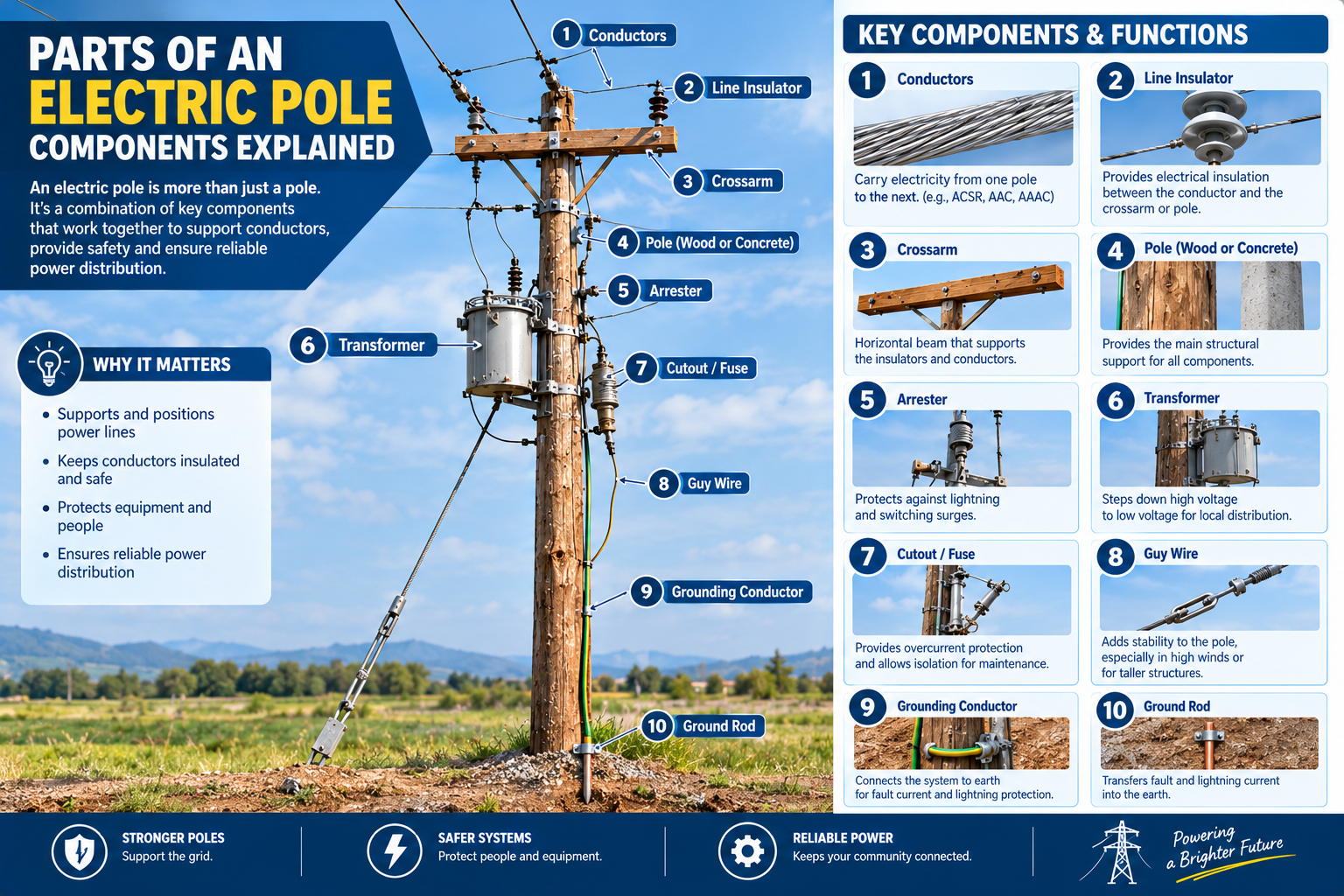
- Distribution uses poles with crossarms, secondary racks, and service hardware plus guys and grounding. (See our assemble-a-distribution-pole guide.)
Distribution vs Transmission Hardware at a Glance
| Transmission | Distribution | |
|---|---|---|
| Voltage | High | Lower |
| Distance | Long (bulk transfer) | Local (to users) |
| Insulators | Suspension strings (+ corona rings) | Rigid pin/post |
| Conductor fittings | Heavy clamps, armor rods, dampers | Lighter clamps, ties |
| Bundles | Common (spacer-dampers) | Rare |
| Structures | Tall towers/poles | Poles with crossarms |
| Secondary hardware | No | Yes (racks, spools) |
Where They Meet: Substations
Transmission and distribution meet at substations, where voltage is stepped down. Substations use their own hardware post insulators, structural steel, grounding, and connectors bridging the two systems. Both transmission and distribution hardware may appear around a substation.
Distribution vs Transmission Lines: FAQ
What is the difference between transmission and distribution lines? Transmission lines carry bulk power at high voltage over long distances on tall towers; distribution lines carry lower voltage to end users on poles. The voltage difference drives everything: transmission uses suspension insulator strings and heavy fittings, distribution uses rigid pin/post insulators and lighter hardware.
What insulators do transmission lines use? Suspension insulator strings discs assembled into a string, with the number of discs scaled to the voltage plus corona rings at the highest voltages. Distribution lines, by contrast, use rigid pin and post insulators mounted on crossarms.
Why does transmission hardware need to be heavier? Because transmission conductors are larger, more highly tensioned, and carry more mechanical load, and the higher voltage needs more insulation and clearance. So transmission fittings clamps, dead-ends, armor rods, dampers are heavier and more numerous than distribution’s lighter hardware.
Do distribution lines have secondary hardware? Yes distribution poles carry secondary and service conductors on racks and D-brackets with spool insulators, below the primary. Transmission lines don’t have this secondary/service layer; they carry only the high-voltage circuits.
What hardware do bundled conductors use? Bundled conductors (common on transmission) use spacer-dampers to hold the sub-conductors apart and damp vibration. Distribution lines rarely use bundles, so this hardware is a transmission feature.
Can the same fittings be used for transmission and distribution? Generally no they’re sized for very different voltages and loads. A distribution fitting is under-rated for transmission, and transmission hardware is oversized and uneconomical for distribution. Specify the fitting class to the line’s voltage and load.
The Bottom Line
Transmission and distribution are both overhead lines, but their voltage and distance make them need different hardware: transmission uses suspension strings, corona rings, heavy conductor fittings, and bundle hardware on tall towers; distribution uses rigid pin/post insulators, lighter fittings, crossarms, and secondary hardware on poles. Specify the hardware to the line class.
DAPENG Power (DP Power Fitting) manufactures hardware for both suspension insulators, strings, corona rings, and heavy conductor fittings for transmission; pin and post insulators, crossarms, and secondary hardware for distribution. Tell us your voltage and line class, and we’ll specify the right hardware.