What Is Sag and Tension in Overhead Lines?
Sag is how much an overhead conductor dips down between two supports; tension is the pulling force in the conductor that holds it up. They trade off: higher tension gives less sag (more ground clearance) but stresses the conductor and structures more; lower tension gives more sag and needs taller structures or shorter spans. Sag and tension change with temperature, ice, and wind, so lines are designed to keep enough clearance and stay within the conductor’s safe tension across all conditions.
Sag and tension are the two most fundamental quantities in overhead line design they determine ground clearance, structure loads, and conductor life. This guide explains what they are, why they matter, and how the line hardware manages them.
What Is Sag?
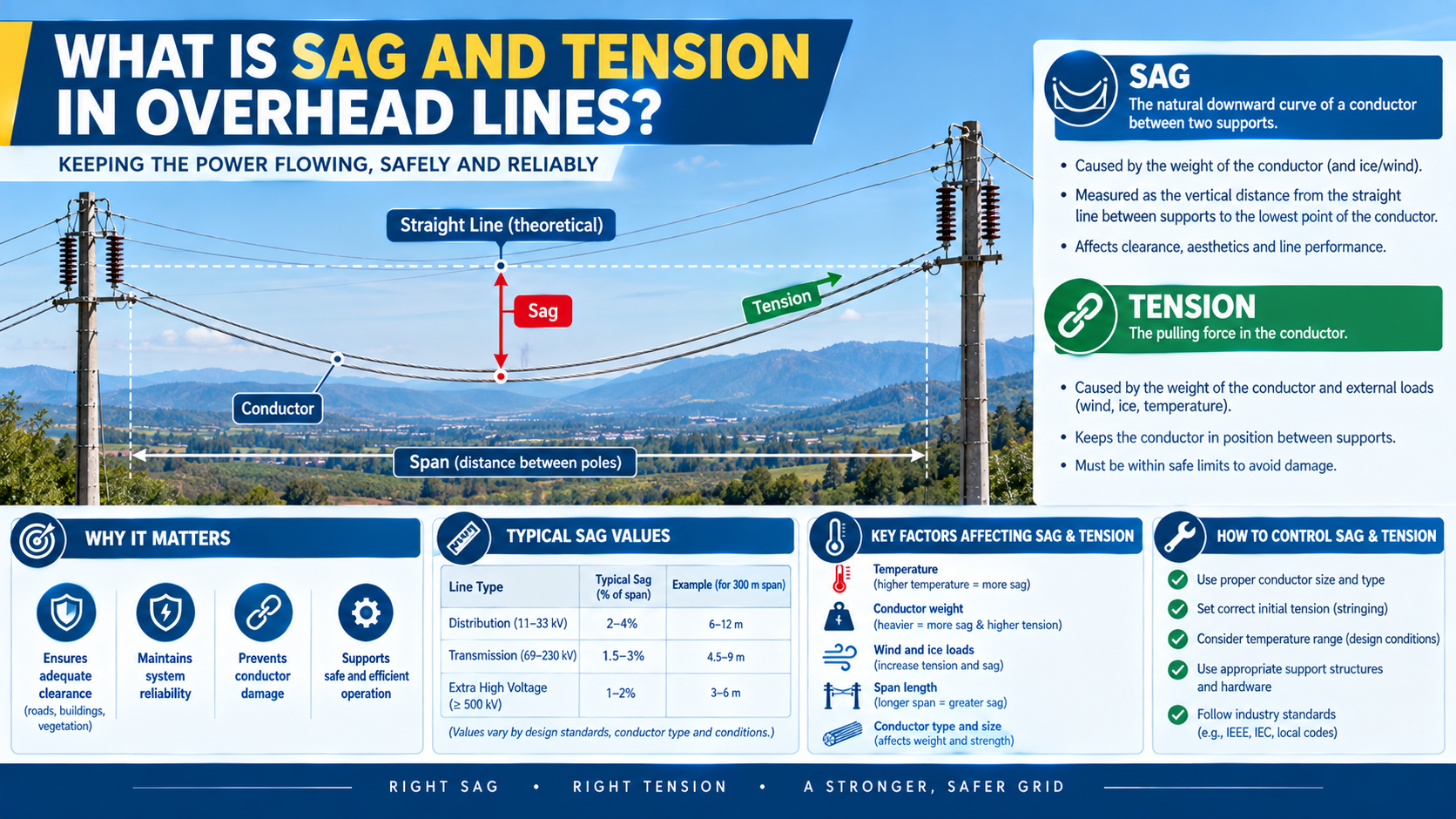
Sag is the vertical distance a conductor dips below a straight line between its two supports. A conductor strung between two poles doesn’t run perfectly straight gravity pulls it into a shallow curve (a catenary), and the lowest point’s drop below the supports is the sag.
Sag matters most for ground clearance: the conductor must stay a safe height above the ground, roads, and objects below, in all conditions. Too much sag and the conductor comes dangerously low; too little and the line is over-tensioned.
What Is Tension?
Tension is the pulling force along the conductor that holds it up against gravity. It’s the horizontal force the conductor exerts on the supports and terminations. Tension and sag are inversely related:
- Higher tension → the conductor is pulled tighter → less sag (more clearance) → but more stress on the conductor, structures, and dead-ends.
- Lower tension → more sag → less stress, but needs taller structures or shorter spans to keep clearance.
Line designers pick a tension that balances clearance against the loads the conductor and structures can safely carry.
Why Sag and Tension Change
Sag and tension aren’t fixed they change with conditions:
- Temperature conductors expand when hot (higher current or hot weather), increasing sag; they contract when cold, increasing tension. The worst sag is usually on the hottest day at high load; the worst tension on the coldest day.
- Ice ice loading adds weight, increasing both sag and tension.
- Wind wind adds transverse load and can increase tension.
So a line is designed for the worst cases: enough clearance at maximum sag (hot), and safe tension at maximum tension (cold, iced). The conductor is strung to a sag/tension that stays safe across the whole range.
How Hardware Manages Sag and Tension
The line hardware is what holds the designed tension and manages its effects:
- Dead-end / tension terminations at angle and dead-end structures, the full conductor tension is taken by a strain clamp, bolt-type tension clamp, or preformed dead-end grip. These must be rated for the maximum tension.
- Suspension supports at tangent structures, a suspension clamp supports the conductor’s weight while it hangs at the designed sag.
- Armor rods armor rods reinforce the conductor at supports, where tension and vibration concentrate stress.
- Vibration dampers the conductor’s tension makes it prone to aeolian vibration, controlled by dampers. (See our aeolian-vibration guide.)
The tension the line is designed to also drives the guy and anchor loads at angle and dead-end structures the guy resists the tension’s sideways pull. (See our guy/stay assembly guide.)
Sag and Tension: FAQ
What is sag in an overhead line? Sag is how far a conductor dips below the straight line between its two supports, caused by gravity pulling it into a shallow curve. It matters mainly for ground clearance the conductor must stay a safe height above the ground and objects below in all conditions.
What is tension in an overhead conductor? Tension is the pulling force along the conductor that holds it up against gravity, and the horizontal force it exerts on the supports and terminations. Higher tension means less sag but more stress; lower tension means more sag but less stress.
How are sag and tension related? They’re inversely related: higher tension gives less sag (more clearance) but more stress on the conductor and structures, while lower tension gives more sag but less stress. Designers choose a tension that balances clearance against safe loads.
Why do sag and tension change with temperature? Conductors expand when hot and contract when cold. Hot conditions (high current or hot weather) increase sag; cold conditions increase tension. Lines are designed for the worst cases enough clearance at maximum (hot) sag and safe tension at maximum (cold, iced) tension.
What hardware handles conductor tension? At angle and dead-end structures, strain clamps, bolt-type tension clamps, or preformed dead-end grips take the full conductor tension into the structure, rated for the maximum. At tangent structures, suspension clamps support the conductor at its designed sag. The tension also drives guy and anchor loads.
Does higher tension damage the conductor? Excessive tension over-stresses the conductor and increases vibration fatigue and structure loads, so it’s kept within safe limits. Tension is chosen to balance clearance (which wants higher tension) against conductor life and structure loads (which want lower tension), staying safe across all conditions.
The Bottom Line
Sag (how far the conductor dips) and tension (the force holding it up) are the two fundamentals of line design, inversely related and changing with temperature, ice, and wind. A line is designed to keep safe clearance at maximum sag and safe tension at maximum tension and the conductor hardware (dead-ends, suspension clamps, armor rods, dampers, guys) is rated and chosen to hold that tension and manage its effects.
DAPENG Power (DP Power Fitting) manufactures the fittings that hold your designed tension strain and tension clamps, dead-end grips, suspension clamps, armor rods, and dampers all within the overhead line fittings range. Tell us your conductor, span, and tension, and we’ll specify the fittings rated for it.