Insulator Specifications Explained: Voltage, Creepage & Mechanical Ratings
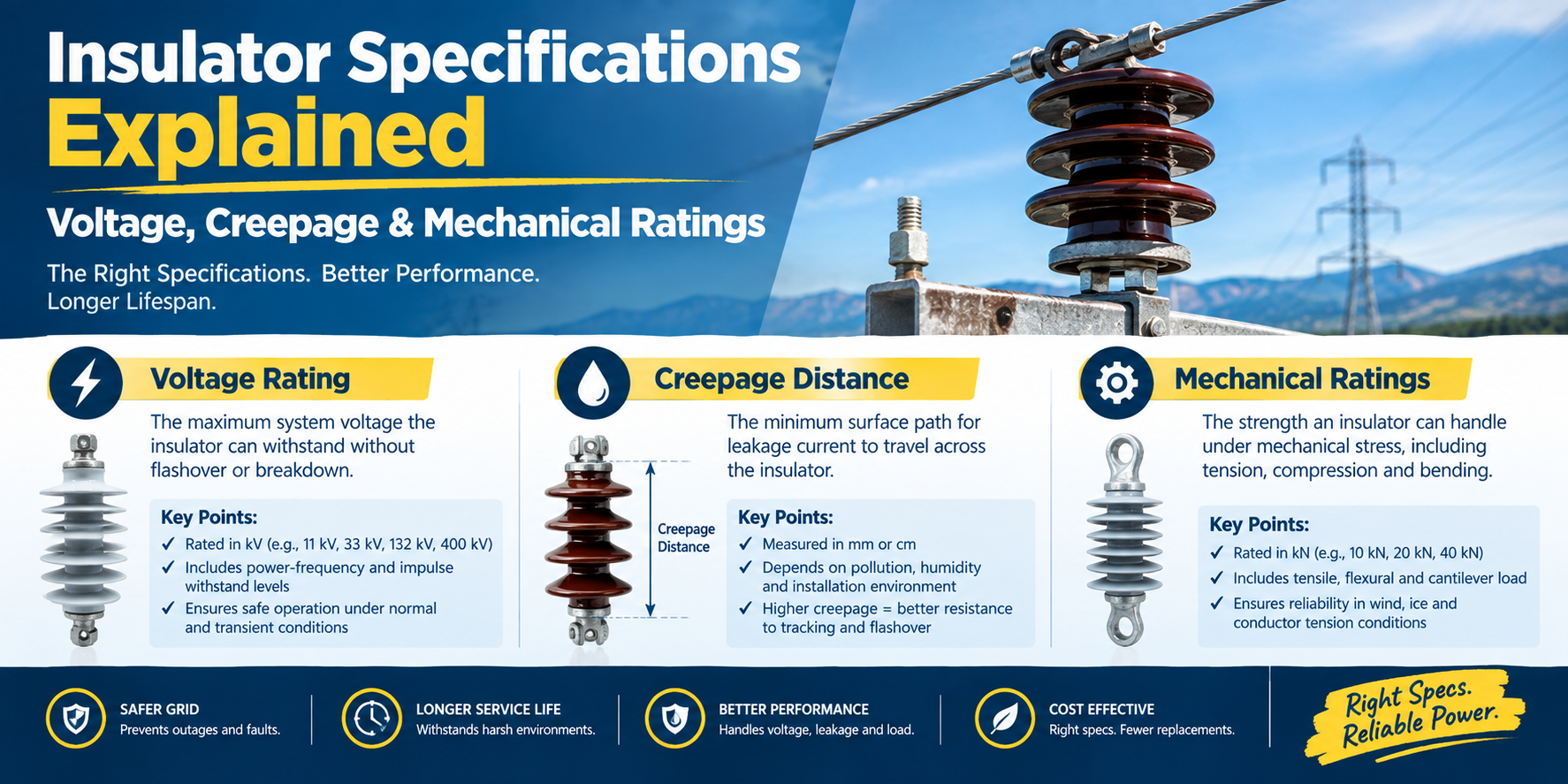
An insulator’s specification has four key dimensions: electrical ratings (system voltage and impulse/power-frequency withstand voltage, how much voltage it withstands), creepage distance (the surface leakage path, which must match the pollution level), mechanical rating (the load it can carry, M&E or SML, in kN), and coupling (the connection system and size, e.g., IEC 60120 ball-and-socket). To specify or compare insulators, you match all four to your line: enough voltage withstand, enough creepage for the environment, enough mechanical strength for the load, and the right coupling to mate with your hardware.
When you’re comparing insulators before buying, the datasheet is full of ratings, and choosing the wrong one leads to flashovers, mechanical failures, or fittings that don’t mate. This guide explains what each insulator specification means and how to read a datasheet so you specify the right insulator with confidence.
The Four Dimensions of an Insulator Spec
Every insulator must satisfy four things at once. A spec sheet reports all of them; you match each to your line.
1. Electrical Ratings Voltage Withstand
The electrical ratings say how much voltage the insulator holds off:
- System / rated voltage the line voltage it’s designed for.
- Power-frequency withstand voltage the AC voltage it withstands (wet and dry) without flashover.
- Lightning impulse withstand voltage (BIL) the surge (lightning) voltage it withstands.
These must exceed your system’s requirements with margin. For a suspension string, the electrical rating scales with the number of discs more discs, more withstand. These are defined under standards such as IEC 60383 (and related IEC/ANSI standards).
2. Creepage Distance the Pollution Dimension
Creepage distance (leakage distance) is the shortest path along the insulator’s surface between the energized and earthed ends lengthened by the sheds/ribs. It must match your pollution level: coastal, industrial, and desert environments require more creepage (a higher specific creepage, mm/kV) to resist surface tracking and flashover. IEC pollution classes set the required creepage. (See our creepage-and-pollution guide.) On a datasheet, check the total creepage against your pollution class and voltage.
3. Mechanical Rating the Load It Holds
The mechanical rating is the load the insulator can carry safely:
- For suspension discs, the Mechanical & Electrical (M&E) failing load or Specified Mechanical Load (SML), in kN.
- For rigid pin and post insulators, the cantilever/bending strength.
The mechanical rating must exceed the actual load the conductor’s weight (suspension) or tension (strain) plus wind/ice with your safety margin. Choosing enough voltage withstand but too little mechanical strength is a common, dangerous error. Mechanical strength standards include IEC 60305/60372 (discs) and related standards.
4. Coupling the Connection
The coupling is how the insulator connects to the next fitting ball-and-socket or clevis-and-tongue, at a specific size (e.g. the IEC 60120 ball designation: 16, 20, 24, 28 mm). Every fitting in a string must share one coupling system and size so they mate. On a datasheet, check the coupling type and size against your string hardware. (See our string-couplings guide.)
How to Read an Insulator Datasheet
Work through it in this order:
- Type & material pin, post, suspension; porcelain, glass, or composite.
- Electrical ratings system voltage, power-frequency and impulse withstand ≥ your requirements.
- Creepage total creepage ≥ your pollution class needs it to be.
- Mechanical rating M&E/SML or cantilever ≥ your load with margin.
- Coupling type and size mate with your hardware.
- Dimensions & weight fit and handling.
- Standards IEC/ANSI compliance matching your specification.
If all four ratings clear your requirements and the coupling mates, the insulator fits your line.
Why You Can’t Choose on One Rating Alone
The classic mistakes come from checking only one dimension:
- Voltage only → an insulator strong enough electrically but too weak mechanically (fails under load), or with too little creepage (flashes over in pollution).
- Creepage only → enough leakage path but wrong mechanical or coupling.
- Coupling only → mates with the hardware but under-rated electrically or mechanically.
A correct insulator satisfies all four voltage, creepage, mechanical, and coupling for your specific line. That’s why specifying insulators means matching the whole spec, not one headline number.
Insulator Specifications: FAQ
What are the main insulator specifications? The main specifications are the electrical ratings (system voltage, power-frequency and lightning-impulse withstand), the creepage distance (surface leakage path, matched to pollution), the mechanical rating (M&E/SML failing load or cantilever strength), and the coupling (type and size). All four must match your line.
What is creepage distance in an insulator specification? Creepage distance is the shortest path along the insulator’s surface between the energized and earthed ends, lengthened by the sheds. It must match the pollution level coastal, industrial, and desert environments need more creepage (higher mm/kV) to resist surface tracking and flashover.
What is the mechanical rating of an insulator? It’s the load the insulator can carry safely for suspension discs, the Mechanical & Electrical (M&E) failing load or Specified Mechanical Load (SML) in kN; for rigid pin/post insulators, the cantilever/bending strength. It must exceed the actual load (weight or tension plus wind/ice) with margin.
What does the coupling size on an insulator mean? The coupling is how the insulator connects to the next fitting ball-and-socket or clevis-and-tongue, at a size such as the IEC 60120 ball designation (16, 20, 24, 28 mm). Every fitting in a string must share the same coupling system and size to mate correctly.
How do I read an insulator datasheet? Check type and material, then confirm the electrical ratings, creepage, and mechanical rating all meet or exceed your requirements, that the coupling matches your hardware, and that it complies with your standards (IEC/ANSI). If all four ratings clear and the coupling mates, it fits your line.
What standards apply to insulators? Common international standards include IEC 60383 (electrical), IEC 60305/60372 (mechanical for discs), and IEC 60120 (ball-and-socket couplings), with related IEC and ANSI standards. Specify to the standards your utility requires so the insulator’s ratings are verified and comparable.
The Bottom Line
An insulator specification has four dimensions electrical withstand, creepage, mechanical strength, and coupling and a correct choice satisfies all four for your line, not just one headline number. Read the datasheet in order, match each rating to your voltage, pollution, load, and hardware, and confirm the standards. That’s how you specify or compare insulators reliably.
DAPENG Power (DP Power Fitting) manufactures insulators across the range pin, post, and suspension types and complete strings to IEC/ANSI standards, and will confirm the full specification for your line. Tell us your voltage, pollution level, mechanical load, and coupling, and we’ll provide insulators with datasheet ratings matched to your requirements.