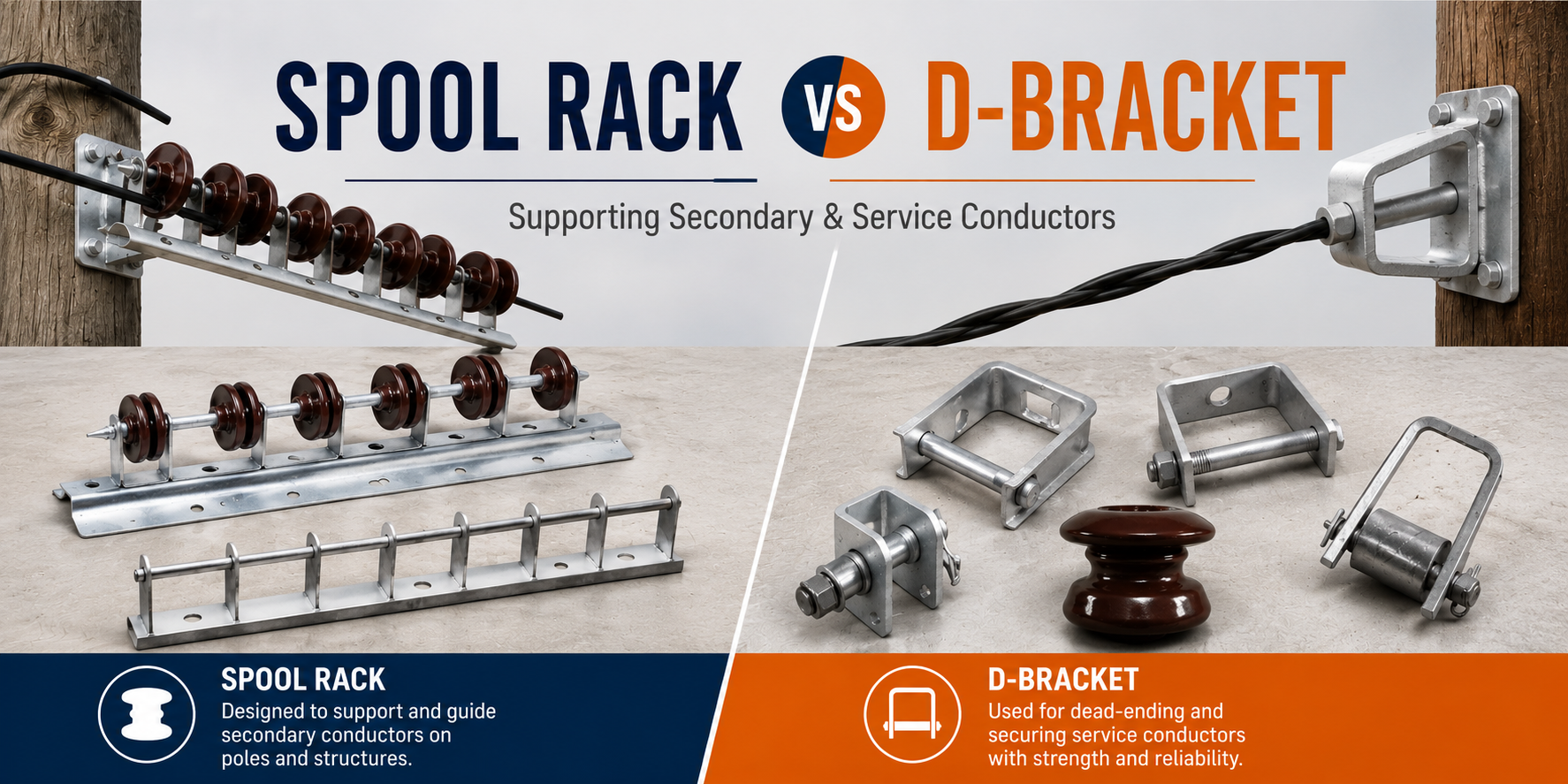
Spool Rack vs D-Bracket: Supporting Secondary & Service Conductors
Both hold spool insulators to support low-voltage secondary and service conductors on a pole; the difference is how many. A secondary rack is a multi-position steel rack that stacks several spools (2-way, 3-way, up to 6-way) for several conductors. A D-bracket (D-iron) is a single-position bracket carrying one spool for one conductor. Use a rack for several stacked conductors; use a D-bracket for a single service, tap, or drop.
Below the primary line, the secondary and service conductors need supporting too, spaced, insulated, and tidy. Two fittings do it, and the choice is simply how many conductors you’re carrying. This guide clears up the rack-vs-bracket decision and the rack/spool relationship people often confuse.
Rack and Bracket Are Holders; Spools Are the Insulators
First, the point that trips people up: neither the rack nor the bracket is the insulator. Both are steel holders that carry spool insulators and the spool is what insulates the conductor. So a working secondary support is always holder + spool + conductor:
- The holder (rack or bracket) provides the mounting and the position(s).
- The spool insulator sits in each position; the conductor ties into its groove.
Racks and brackets are supplied to take standard spools, with or without the spools fitted.
Secondary Rack Several Conductors, Stacked
A secondary rack is a vertical steel rack with multiple positions commonly 2-way, 3-way, up to 6-way each holding a spool. It stacks several secondary/service conductors neatly down the pole, spaced apart, in one fitting.
Use a rack where you’re carrying several secondary conductors a full secondary, a multi-conductor service and want them supported compactly in one mounting. The number of ways matches the number of conductors: one position per conductor.
D-Bracket One Conductor
A D-bracket (D-iron) is a single-position D-shaped bracket that carries one spool for one conductor. It’s the compact, economical choice where you need just one support point a single service drop, an individual tap, or a single low-voltage wire and a full rack would be more than necessary.
Think of the D-bracket as one position of a rack, supplied as a standalone bracket.
Secondary Rack vs D-Bracket: Comparison
| Secondary Rack | D-Bracket | |
|---|---|---|
| Positions | Multiple (2-way to 6-way) | Single |
| Conductors | Several, stacked | One |
| Best for | Full secondary, multi-conductor service | Single drop, tap, or wire |
| Carries | Multiple spool insulators | One spool insulator |
| Mounting | Bolted/banded to pole | Bolted/banded to pole |
How Do I Choose?
The rule is simple: count the conductors.
- Several secondary/service conductors at a point → secondary rack (pick the number of ways to match).
- One conductor at a point → D-bracket.
Many poles use both a rack for the main secondary run, and D-brackets for individual taps or service drops branching off. Choose each fitting by how many conductors it supports at its location.
Mounting and the Rest of the Secondary
Both mount to the pole bolted or banded, commonly with a pole band and carry the conductors on spools. The service drop itself terminates with a drop-wire clamp. Together with the spool insulators, these make up the secondary/service hardware set; specify them together for a pole.
Secondary Rack vs D-Bracket: FAQ
What is the difference between a secondary rack and a D-bracket? A secondary rack is a multi-position steel rack that holds several spool insulators for several secondary conductors, stacked down the pole. A D-bracket (D-iron) is a single-position bracket holding one spool for one conductor. Rack = several; D-bracket = one.
Do the rack and bracket include the spool insulators? They can be supplied with or without spools both are made to take standard spool insulators. The rack or bracket is the steel holder; the spool insulator does the insulating. Specify whether you want spools included and their size.
How many ways of secondary rack do I need? One position (spool) per secondary/service conductor: 2-way for two conductors, 3-way for three, up to the multi-way racks. Match the number of ways to the number of conductors you’re carrying.
When should I use a D-bracket instead of a rack? When you need to support just one conductor at a point a single service drop, an individual tap, or one low-voltage wire where a full rack would be more than necessary. The D-bracket is the compact single-position choice.
How are they mounted? Both bolt or band to the pole, commonly via a pole band. Send your pole and mounting method and the fitting is supplied to fit, with the mounting hardware if needed.
What holds the service drop wire? A drop-wire clamp terminates the service drop at the point of attachment. The rack or D-bracket supports the secondary/service conductors along the pole; the drop-wire clamp handles the drop termination.
The Bottom Line
Secondary racks and D-brackets both hold spool insulators to support low-voltage conductors the choice is how many. Use a secondary rack (2-way to 6-way) for several stacked conductors; use a D-bracket for one. Many poles use both. Match the fitting to the conductor count and mount it with the right pole hardware.
DAPENG Power (DP Power Fitting) makes both secondary racks and D-brackets with the spool insulators, drop-wire clamps, and pole bands that complete the secondary hardware. Tell us how many conductors you’re supporting and we’ll recommend the rack or bracket and quote it with the spools.