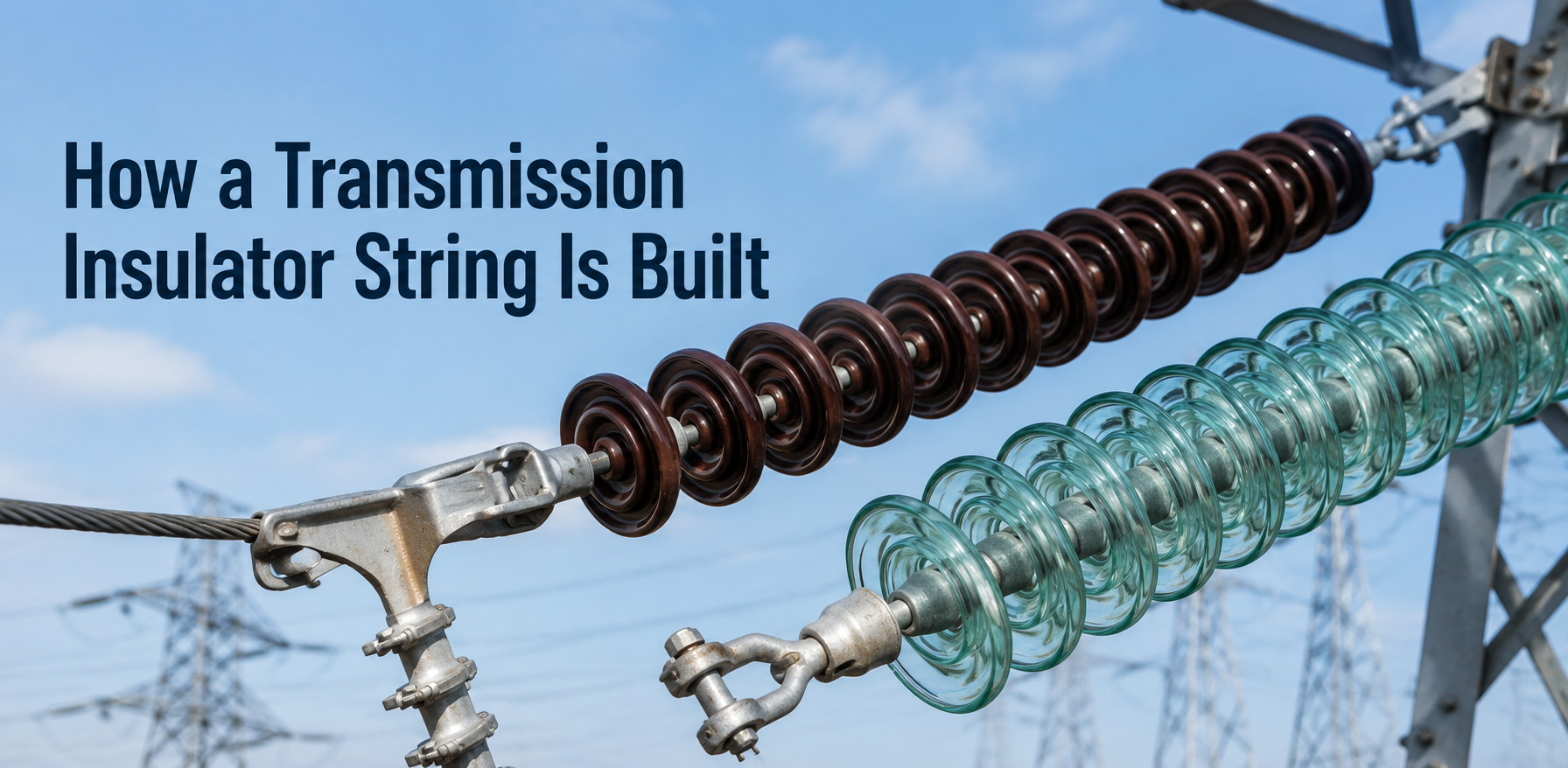
How a Transmission Insulator String Is Built
A transmission insulator string is a chain from the structure to the conductor: a structure attachment, a top end fitting, a series of insulator discs (as many as the voltage requires), a bottom end fitting, and a conductor clamp, all connected by a matched coupling system. Higher voltages add more discs; twin/multi-conductor arrangements add a yoke plate; and high voltages add corona rings to grade the electric field. Suspension strings hang vertically (tangent structures); tension strings take the line pull (angle/dead-end structures).
A transmission insulator string looks like a simple chain of discs, but it’s a carefully assembled set of coordinated parts. Understanding how it’s built helps you specify a complete, correct string. This guide walks through the assembly, top to bottom.
The Two Kinds of String
- Suspension (tangent) string hangs vertically from the structure, supporting the conductor at a straight-run tower. It carries the conductor’s weight and holds it away from the earthed structure.
- Tension (strain / dead-end) string set in line with the conductor to take the full line tension at an angle or dead-end structure. It’s the termination point of the conductor’s pull.
Both are built from the same kinds of parts; the difference is orientation and the load they take.
Building the String, Top to Bottom
1. Structure attachment
The string starts at the tower a u-shackle or bracket connects the string to the structure’s attachment point.
2. Top end fitting
A transition fitting connects the structure attachment to the first insulator disc’s coupling for a ball-and-socket string, a socket clevis or ball eye matches the string’s coupling system.
3. The insulator discs
The heart of the string: a series of suspension insulators (cap-and-pin discs), coupled together ball-to-socket. The number of discs is set by the voltage the higher the system voltage, the more discs, so the string provides enough insulation and creepage. This scalability is exactly why strings are used on transmission: you add discs for higher voltage. (See our guide on choosing insulators for the voltage logic.)
4. Bottom end fitting
A transition fitting connects the last disc to the conductor clamp a ball clevis or socket eye, matched to the coupling system.
5. Conductor clamp
At the bottom, the conductor is held: a suspension clamp on a tangent (suspension) string, or a strain clamp on a tension (dead-end) string. On tangent structures, armor rods often reinforce the conductor at the clamp against vibration.
The Add-Ons That Complete a String
Yoke plates for twin and multi-conductor
When the string supports twin or multiple sub-conductors (bundled phases) or must distribute load across multiple string legs, a yoke plate (link plate) spreads the load across the legs and provides the geometry to hold the bundle. Yoke plates are what turn a single-leg string into a multi-leg or bundled arrangement.
Corona rings for high voltage
At high voltages, the electric field concentrates at the metal ends of the string, which can cause corona (audible noise, radio interference, and long-term degradation). A corona ring (grading ring) fitted at the string end smooths the field, reducing corona. Corona rings become necessary above a voltage threshold set by the design.
Coupling system and size
Every joint in the string uses one matched coupling system and size (ball-and-socket or clevis-and-tongue, to the IEC designation), so every part mates. This is the thread that runs through the whole assembly specify the coupling and every fitting is ordered to match. (See our couplings guide for the ball-and-socket vs clevis-and-tongue detail.)
The Complete String as a Specification
When you specify a string, you’re specifying a coordinated set: the number and type of discs (by voltage and pollution), the end fittings and coupling (by system and size), the conductor clamp (suspension or strain), the yoke plate (if bundled/multi-leg), the corona ring (if high voltage), and the structure attachment. Every part must share the coupling system, and every part must meet the string’s mechanical rating (the load it holds) and electrical rating (voltage, creepage). Suppliers provide complete insulator strings assembled to your specification, or the parts to assemble.
Insulator String Assembly: FAQ
What are the parts of an insulator string? From the structure down: a structure attachment (u-shackle/bracket), a top end fitting, the insulator discs, a bottom end fitting, and a conductor clamp connected by a matched coupling. Twin/bundled strings add a yoke plate; high-voltage strings add a corona ring.
How many insulator discs are in a string? The number is set by the system voltage (and pollution level): higher voltages need more discs for enough insulation and creepage. That scalability adding discs for higher voltage is why strings are used on transmission. Confirm the disc count against your voltage and the specific insulator rating.
What is the difference between a suspension and a tension string? A suspension (tangent) string hangs vertically and supports the conductor at a straight-run structure. A tension (strain/dead-end) string is set in line with the conductor to take the full line tension at an angle or dead-end. Both use similar parts; the difference is orientation and load.
What is a yoke plate used for in a string? A yoke plate distributes load across multiple string legs and provides the geometry for twin or bundled sub-conductors. It turns a single-leg string into a multi-leg or bundled arrangement, holding the bundle and sharing the load.
When do I need a corona ring on a string? At high voltages, where the electric field concentrates at the string’s metal ends and would cause corona (noise, interference, degradation). A corona ring grades the field to reduce corona. The voltage threshold for needing one is set by the design.
Do all the string fittings need to match? Yes every joint uses one coupling system and size (e.g. ball-and-socket to the IEC designation), so all fittings mate. Specify the coupling system and size and every end fitting, disc, and yoke plate is ordered to match. Mixing systems or sizes means the parts won’t connect.
The Bottom Line
A transmission insulator string is an assembled chain structure attachment, end fittings, insulator discs (scaled to voltage), conductor clamp joined by a matched coupling system, with a yoke plate for bundled/multi-leg arrangements and a corona ring at high voltage. Specify it as a coordinated set that shares one coupling and meets both the mechanical and electrical ratings.
DAPENG Power (DP Power Fitting) manufactures the complete string suspension insulators and strings, the ball eye, ball clevis, socket eye, socket clevis, and u-shackle couplings, yoke plates, corona rings, and the suspension and strain clamps that terminate the conductor. Tell us your voltage, structure type, conductor, and pollution level, and we’ll specify a complete string.