Preformed vs Bolted Dead-Ends: Which Conductor Termination?
A preformed dead-end (a helical grip wrapped onto the conductor) grips along its length for a full-strength, tool-free, vibration-friendly termination fast to install and gentle on the conductor. A bolted dead-end (a tension/strain clamp) grips by bolted compression robust, re-openable, and familiar, but a more concentrated grip that must be correctly assembled. Choose preformed for speed, full strength, and fatigue performance on most conductors; choose bolted where a mechanical clamp is specified or preferred, or for larger conductors and specific duties.
At every angle and dead-end structure, the conductor has to be terminated held against the full line tension. Two proven methods dominate: preformed helical grips and bolted clamps. This guide compares them so you specify the right one for your conductor and line.
What Is a Preformed Dead-End?
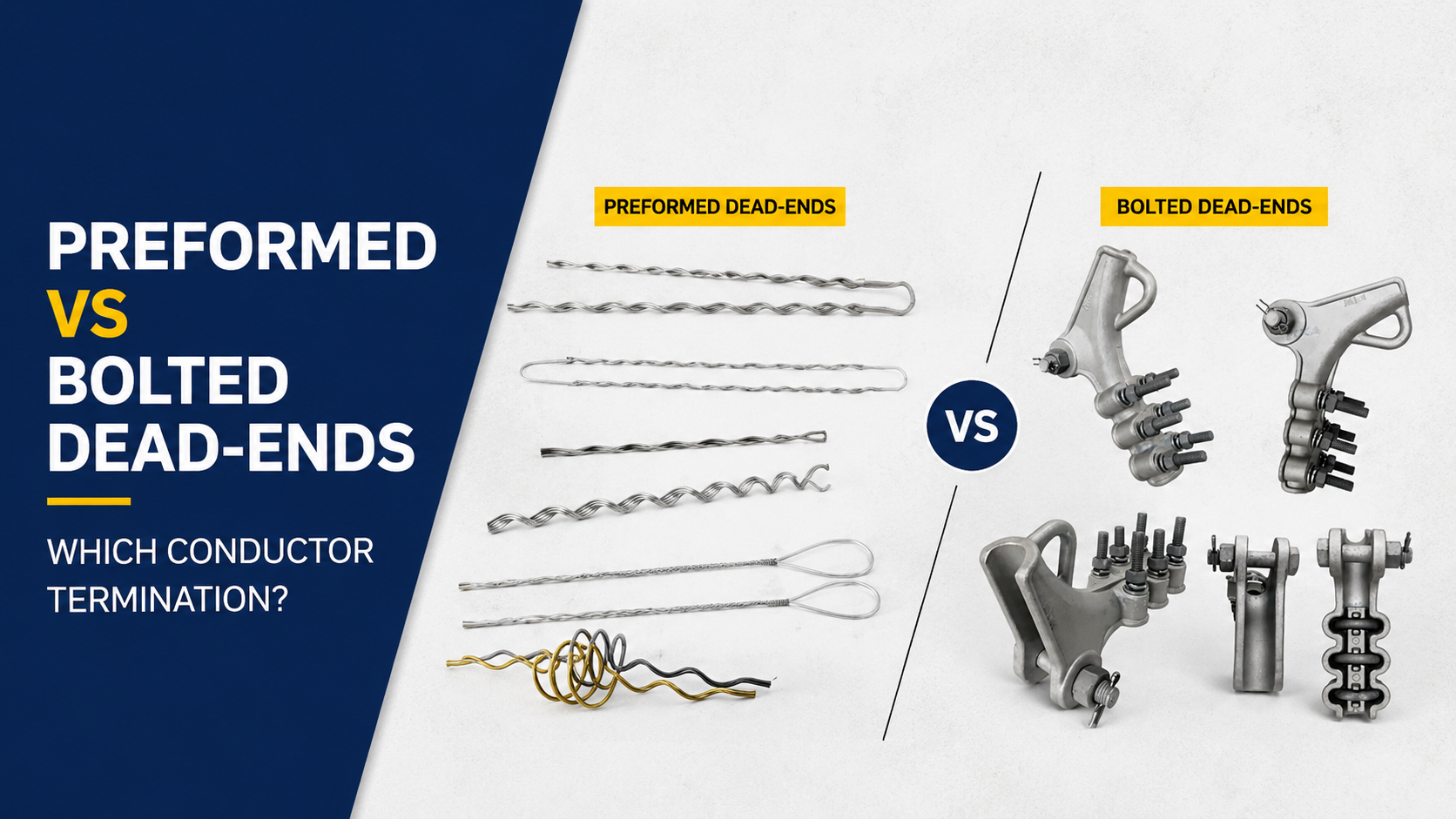
A preformed dead-end grip is a set of helical (spiral) rods, factory-formed to the conductor size, that you wrap onto the conductor by hand. As they wrap, they grip along their full length, distributing the load and holding the conductor at close to its full rated strength, with an eye at the end to attach to the structure.
Preformed dead-ends are valued for:
- Full-strength, distributed grip no concentrated crushing of the conductor.
- Tool-free, fast installation wrap on, no bolts.
- Fatigue performance the distributed grip and resilient action handle vibration well at the termination.
- Economy low cost per termination.
They come in forms for different scales and duties distribution-scale grips, pole-top dead-ends, and OPGW/transmission tension clamps.
What Is a Bolted Dead-End?
A bolted dead-end a bolt-type tension clamp or strain clamp grips the conductor by bolted compression: the conductor is clamped between bolted plates or in a bolted body, held by the clamping force. It’s a mechanical, re-openable termination familiar to crews everywhere.
Bolted dead-ends are valued for:
- Robust, mechanical grip that can be inspected and re-opened.
- Familiarity long-established, widely specified.
- Specific duties some larger conductors, some utility standards, and some applications call for a bolted clamp.
The trade-offs: a bolted clamp is a more concentrated grip than a distributed preformed one, it takes more install effort (bolts to torque correctly), and correct assembly/torque is essential to reach its rated hold.
Preformed vs Bolted: Comparison
| Preformed dead-end | Bolted dead-end | |
|---|---|---|
| Grip | Distributed (helical, full length) | Bolted compression (concentrated) |
| Strength | Near full conductor strength | To rated value (assembly-dependent) |
| Install | Tool-free, wrap on, fast | Bolts to torque, slower |
| Vibration/fatigue | Good (resilient, distributed) | Depends on design |
| Re-openable | No – single-use | Yes |
| Best for | Most conductors; speed & fatigue | Specified bolted duties; some larger conductors |
How Do I Choose?
Choose a preformed dead-end when…
- You want fast, tool-free installation across many terminations.
- You want a full-strength, distributed grip that’s gentle on the conductor.
- Vibration/fatigue performance at the termination matters.
- Cost and speed are priorities and the conductor size suits a preformed grip.
Choose a bolted dead-end when…
- Your utility standard specifies a bolted tension/strain clamp.
- You want a re-openable, inspectable mechanical termination.
- The conductor or duty calls for a bolted clamp (e.g. certain larger conductors or specific applications).
Match to the conductor and duty
Both are sized to the conductor and rated to the line tension. Whichever you choose, confirm it’s rated for your conductor and tension with your safety margin — the termination holds the full line tension and must not be the weak point. That rating is a datasheet figure to confirm, never estimated.
Installing Each One Right
Preformed: use the grip made for your exact conductor size, wrap it on fully so it grips along its length, and form the eye to the structure. Correct size = full strength. Bolted: assemble to the conductor and torque the bolts to specification a bolted clamp only reaches its rated hold when correctly assembled and torqued.
Where the Termination Fits
A dead-end terminates the conductor at an angle or strain structure and attaches to the insulator string or structure hardware. At tangent (straight-run) structures, the conductor is instead supported (not terminated) by a suspension clamp a different job. And where the conductor needs protection or vibration reinforcement at a support, armor rods do that. Specify the termination as part of the whole overhead line fitting assembly.
Preformed vs Bolted Dead-Ends: FAQ
What is the difference between a preformed and a bolted dead-end? A preformed dead-end is a helical grip wrapped onto the conductor, gripping along its length for a full-strength, tool-free termination. A bolted dead-end is a clamp that grips by bolted compression re-openable and mechanical, but more concentrated and needing correct torque. Preformed = fast and distributed; bolted = mechanical and re-openable.
Which is stronger, a preformed or bolted dead-end? A preformed dead-end holds close to the conductor’s full strength via its distributed grip. A bolted dead-end holds to its rated value when correctly assembled and torqued. Both, correctly specified and installed, hold the full line tension; preformed is often preferred for fatigue performance.
Are preformed dead-ends better for vibration? Generally yes the distributed, resilient grip of a preformed dead-end handles vibration at the termination well, which is one reason they’re widely used. Bolted clamps’ vibration performance depends on the specific design.
When should I use a bolted tension clamp instead of a preformed grip? When your utility standard specifies it, when you want a re-openable mechanical termination, or when the conductor size or duty calls for a bolted clamp. Preformed grips suit most conductors for speed and fatigue; bolted clamps suit specified bolted duties.
Do preformed dead-ends need tools? No they wrap onto the conductor by hand, which makes them fast to install. Bolted dead-ends need their bolts torqued to specification.
How do I size a dead-end? Both are sized to the conductor and rated to the line tension. Match the dead-end to your exact conductor and confirm its rating against your tension with your safety margin. Tell your supplier the conductor and tension and they’ll confirm the fitting.
The Bottom Line
Both preformed and bolted dead-ends terminate a conductor against full line tension with different strengths. Choose the preformed dead-end for fast, tool-free, full-strength, fatigue-friendly terminations on most conductors; choose the bolted dead-end where a mechanical, re-openable clamp is specified or the conductor/duty calls for it. Size either to the conductor and confirm its rating.
DAPENG Power (DP Power Fitting) makes both preformed dead-end grips (including distribution, pole-top, and OPGW/transmission forms) and bolt-type tension and strain clamps plus the suspension clamps and armor rods that complete the line. Tell us your conductor and tension, and we’ll recommend the termination and confirm its rating.