
In the high-stakes world of global energy distribution, the failure of a single $15 bolt can trigger a localized blackout costing millions in industrial downtime. Imagine a coastal transmission corridor in Southeast Asia or the Gulf Coast of the USA during a tropical cyclone. As 150 mph winds apply massive eccentric loads to conductors, the entire system relies on the mechanical integrity of the Pole Line Hardware securing the grid.
If hardware suffers from hydrogen embrittlement or sub-par zinc bonding, the resulting domino effect of falling towers is a significant financial and safety liability. For procurement officers and structural engineers, selecting a Tier-1 Chinese manufacturer is no longer just about cost-efficiency; it is about securing a supply chain capable of delivering precision-engineered components that meet the world’s most stringent metallurgical standards.
At our advanced manufacturing facility in China, we produce industrial-grade Pole Line Hardware designed for extreme environmental resilience. This guide explores the critical entities, technical cross-standards (GB/T vs. ASTM/ISO), and procurement logic necessary for building a future-proof overhead network.
What is Pole Line Hardware?
Pole Line Hardware is a specialized category of structural fittings, fasteners, and support components used to secure overhead electrical and telecommunication lines to utility poles or towers. These components are primarily fabricated from high-tensile structural grade steel (ASTM A36, Q235B, or Q355B) and undergo hot-dip galvanization (ISO 1461 / ASTM A153) to ensure corrosion resistance in outdoor environments.
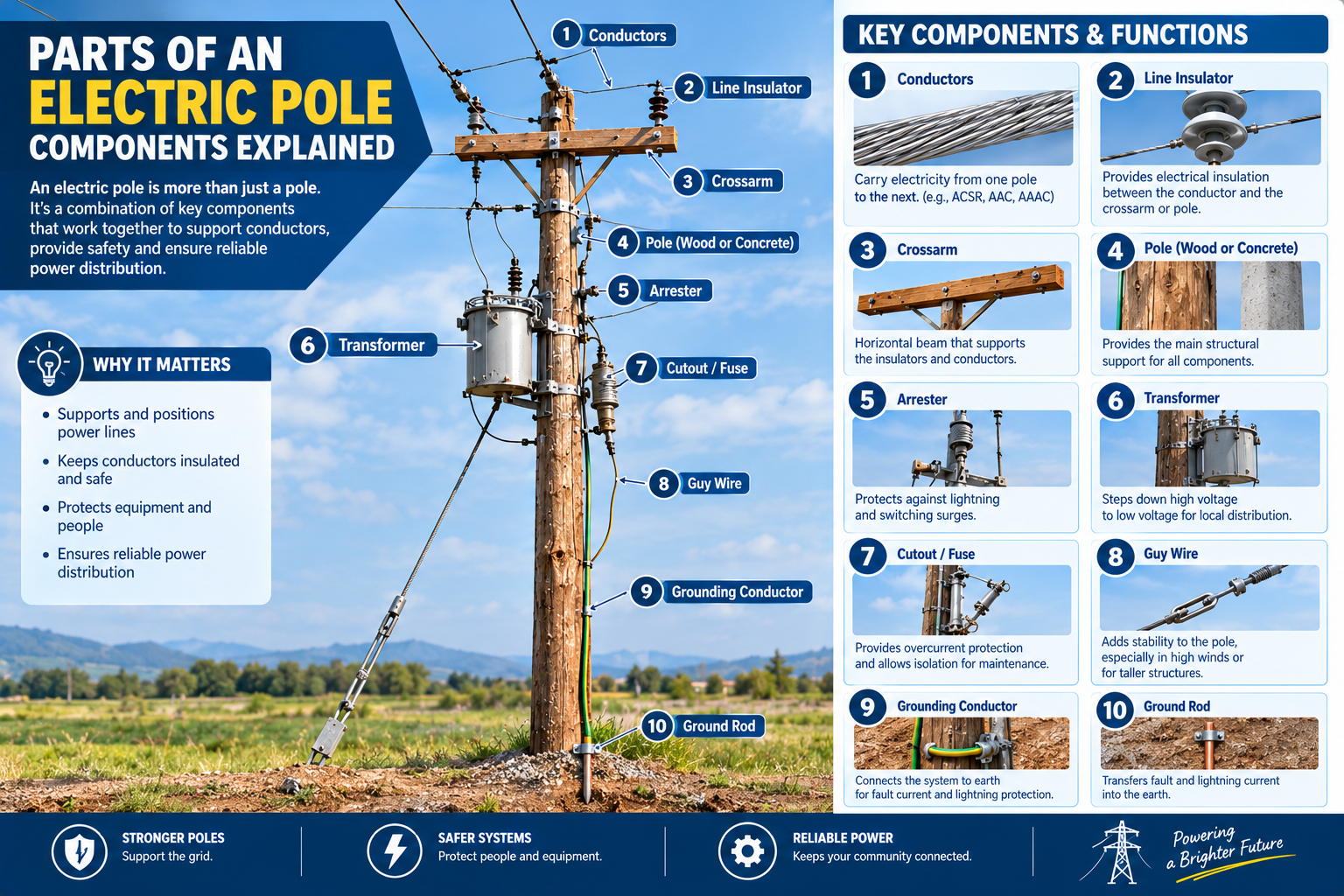
The hardware ecosystem includes guy wire attachments (anchor rods), support braces (crossarm braces), conductor fittings (dead-end grips), and fastening bolts (double arming bolts). Modern pole line hardware is engineered to withstand specific mechanical stresses, with Yield Strength $\geq$ 355 MPa and a 50-year service life, providing the mechanical interface between the conductor, the insulator, and the support structure.
Strategically, these components must maintain structural stability under peak ice accumulation, wind-induced Aeolian vibration, and thermal expansion cycles ranging from -40°C to +50°C.
Technical Metallurgy: How Chinese Precision Meets Global Standards
Beyond the basic shape of the hardware lies the science of metallurgy. Modern Chinese manufacturing hubs have transitioned from high-volume casting to precision forging and CNC machining, aligning domestic GB/T standards with international equivalents to ensure seamless global interoperability.
1. Material Composition and Yield Strength
Our hardware utilizes Q355B steel, which is the direct equivalent of ASTM A572 Grade 50.
- Yield Strength: $\geq$ 355 MPa.
- Tensile Strength: 470–630 MPa.
- Elongation: $\geq$ 21% (at 20°C).
These metrics ensure that under extreme tension, the hardware deforms elastically before failure, providing a critical safety margin for utility engineers.
2. Corrosion Resistance and Salt Spray Testing
In high-humidity regions like the Philippines, Indonesia, or the coastal USA, oxidation is the primary driver of TCO (Total Cost of Ownership).
- Hot-Dip Galvanization: We provide a zinc coating thickness of 80–100 microns ($600–700 g/m^2$) per ISO 1461.
- Performance: Our hardware withstands up to 1,000 hours in Neutral Salt Spray (NSS) testing per ASTM B117, ensuring zero red rust in maritime environments.
Entity-Based Classification: The Core Components of an Overhead Grid
To build a resilient network, procurement teams must categorize hardware based on its mechanical role within the Entity of the utility pole.
Guying and Anchoring Systems
This category includes Anchor Rods, guy clamps, and thimbles. These components transfer the lateral tension of the pole into the ground. Our anchor rods feature rolled threads (not cut threads), which preserve the grain flow of the steel and increase shear strength by 30%.
Support and Bracing Hardware
Cross arm Braces (Flat, V-type, and Alley braces) provide the structural skeleton for conductors. We maintain a tolerance controlled within ±0.05mm on bolt-hole alignment, ensuring that field technicians can install hardware rapidly without on-site modifications.
Fastening and Bolting Entities
Utility poles require specialized Double Arming Bolts and Square Head Machine Bolts. Manufactured to ANSI C135.1 standards, these fasteners are designed with “fetter drive” threads or standard UNC threads that allow for high-torque application without stripping the galvanized layer.
Insulator and Conductor Fittings
From Spool Bolts to Suspension Clamps, these fittings represent the final interface with the energized line. Our aluminum alloy clamps are gravity-cast to ensure zero internal porosity, preventing the “corona discharge” effect that leads to energy loss.
Pro Tip: Engineering Teams can request a CAD Drawing (.dwg/.step), Material Test Report (MTR), and a detailed FOB (Shanghai/Ningbo) or CIF Price List for any hardware category here.
Manufacturing Excellence: The China High-Tech Hub Advantage
Consequently, sourcing from a China-based manufacturer provides access to a vertically integrated supply chain that Western suppliers often struggle to match in terms of lead time and scalability.
Precision Forging and CNC Machining
Unlike traditional sand casting, our eye bolts and anchor rods are manufactured using Closed-Die Forging. This process ensures that the grain structure of the metal follows the contour of the part, maximizing fatigue resistance. CNC machining then ensures that all threaded sections meet 6G/6H tolerance classes for effortless assembly.
Automated Galvanizing and Surface Treatment
Surface integrity is non-negotiable. Our automated galvanizing lines utilize a “centrifugal spinning” process for small fasteners. This prevents “zinc clogs” in the threads, a common defect in low-tier manufacturing that forces field workers to re-tap threads, destroying the corrosion protection.
Third-Party Quality Assurance (QA)
To bridge the “Trust Gap,” we integrate third-party inspections into our workflow.
- Ultrasonic Testing (UT): Used on high-load anchor rods to detect internal fissures.
- Chemical Composition Analysis: Spectrometer testing on every heat of steel to verify Carbon (C), Manganese (Mn), and Silicon (Si) levels.
- SGS/TUV Verification: We offer pre-shipment inspection reports to ensure the goods in the container match the Material Test Report (MTR).
The Procurement Logic: Addressing TCO, MOQ, and Logistics
Sourcing from China is a strategic decision focused on Total Cost of Ownership (TCO). While the unit price is lower, the true value lies in the reduction of long-term maintenance costs and supply chain stability.
1. MOQ Flexibility and OEM/ODM Capabilities
We recognize that regional utilities have unique local challenges such as high-salinity in Karachi or extreme ice loads in the USA. Our facility offers OEM/ODM capabilities, allowing for custom-dimensioned cross arm braces or specialized pole bands that are not available in standard catalogs. We offer flexible Minimum Order Quantities (MOQ) for tiered project rollouts.
2. Port Logistics and Global Shipping
Strategically located near the Port of Ningbo and Shanghai, we minimize internal transit times.
- Lead Times: 14–21 days for standard ANSI/IEC hardware.
- Packaging: Steel-strapped, seaworthy crates with VCI (Volatile Corrosion Inhibitor) liners to prevent “white rust” during the 30-day ocean transit to the USA or Europe.
Installation Best Practices for Long-Term Reliability
Beyond the technical specifications, the longevity of Pole Line Hardware depends on field precision.
Torque Management
Under-tightened bolts lead to mechanical vibration and galling, while over-tightened fasteners can exceed the yield strength of the steel. We provide recommended torque charts (N·m) based on bolt grade and diameter to ensure optimal clamping force.
Material Compatibility
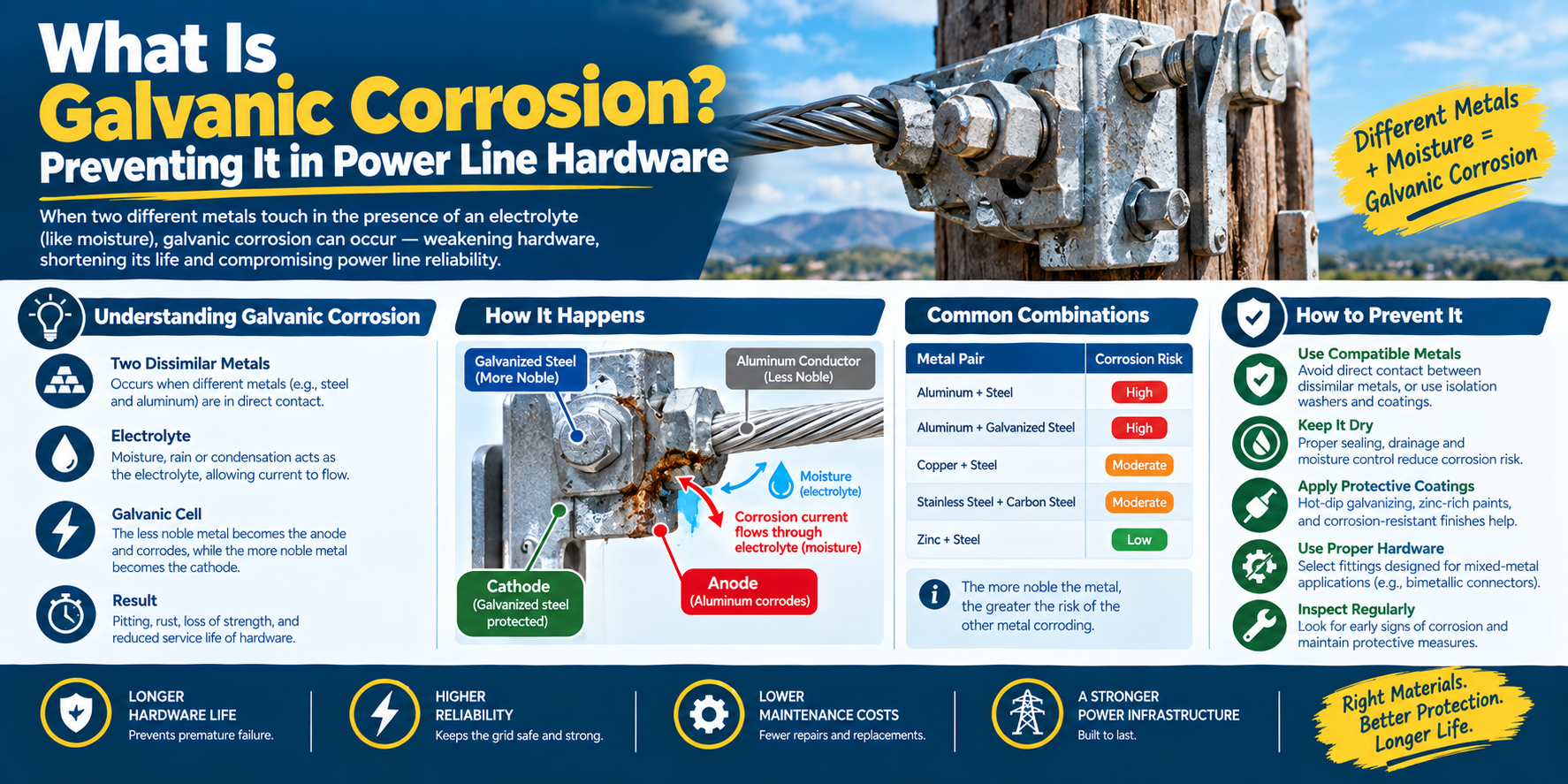
Crucially, avoid mixing galvanized hardware with stainless steel components without an insulating barrier. This prevents galvanic corrosion, where the zinc layer is prematurely exhausted by the electrical potential difference between the two metals.
Environmental Site Audits
In regions with high industrial pollution (SO2 exposure), we recommend double-dipped galvanization or a secondary polymer coating to extend the service life of pole top pins and insulator brackets.
Final Verdict: Why a High-Tech China Partnership is the Future
The global demand for grid modernization requires a partner that can scale with speed without compromising on metallurgical precision. Pole Line Hardware from our facility is not just made in China it is engineered for the world.
By aligning GB/T 13912 surface quality with ASTM A153 durability, we provide global procurement officers with a risk-free path to infrastructure scalability. Secure your grid’s future with hardware designed to last half a century.
Request a Bulk Quote / Download ISO Certification Today
Partner with a world-class manufacturer. Our engineering team is ready to provide custom CAD support and a competitive CIF quote for your next infrastructure project.
FAQ Section
- Q: Does your hardware meet ANSI C135.1 standards for the US market?
- A: Yes. We manufacture specifically for the North American market, ensuring all hardware meets or exceeds ANSI C135.1 and ASTM A153 Class C standards.
- Q: What is the typical lead time for a 20ft container of Pole Line Hardware from Shanghai?
- A: Standard production is 15–20 days. Ocean transit to the USA West Coast is ~18 days; to Southeast Asia is ~7–10 days.
- Q: How do you prevent “White Rust” during ocean shipping?
- A: We use VCI (Volatile Corrosion Inhibitor) packaging and ensure all hardware is completely dry before seaworthy palletization.
- Q: Can I request a 3.1 Material Certificate with my order?
- A: Absolutely. Every shipment is accompanied by a full EN 10204 3.1 Material Test Report verifying the chemical and mechanical properties.
- Q: Do you offer custom branding (OEM) on the hardware?
A: Yes, we can forge or stamp your company logo/batch code onto components for project traceability.