Pin vs Post vs Suspension Insulators: How to Choose by Voltage
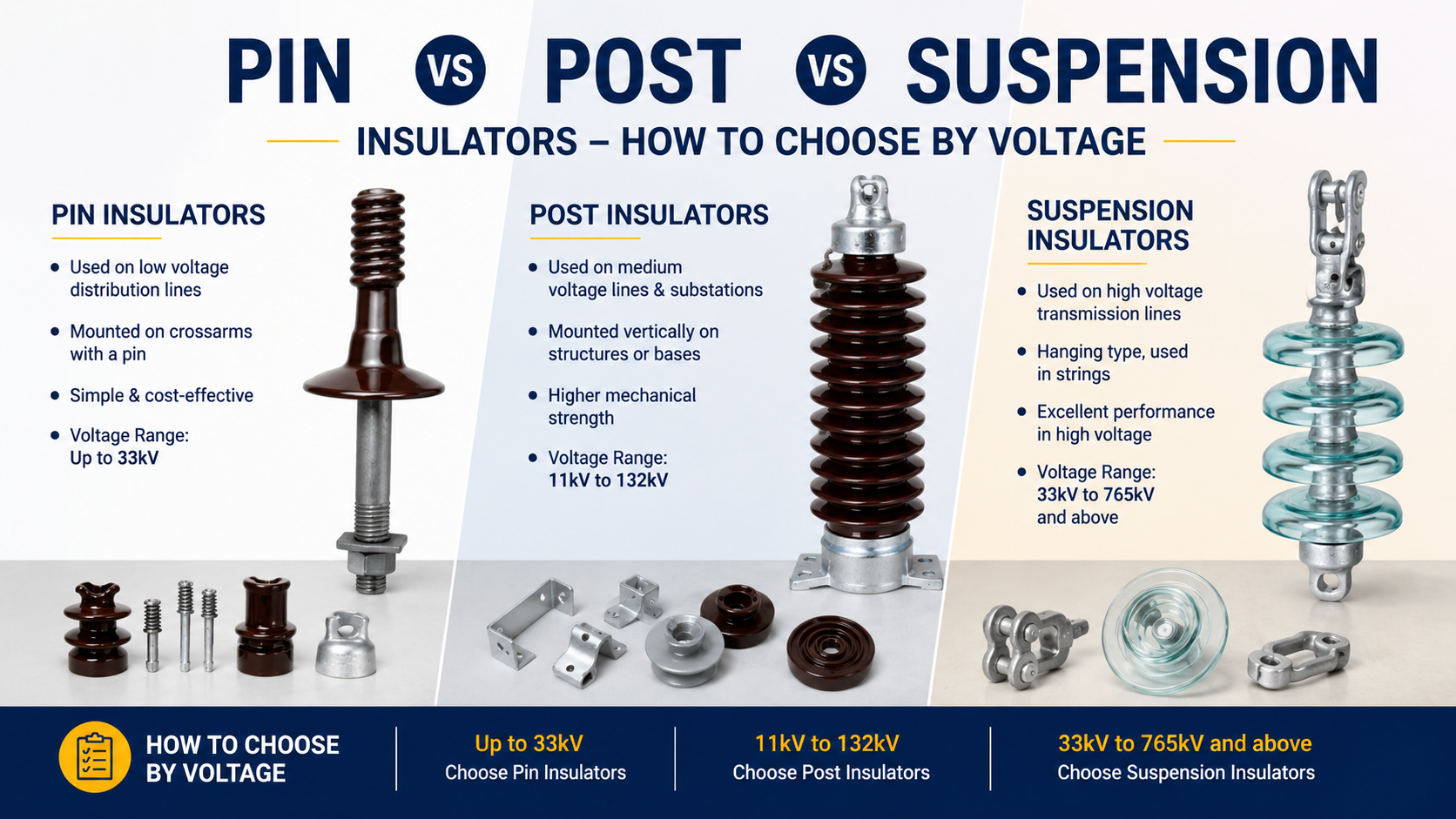
The insulator type depends on the voltage and the structure. Pin and post insulators are rigid, top-of-structure insulators used mainly on lower-voltage distribution lines, holding the conductor above the crossarm or pole top. Suspension insulators are disc/cap-and-pin units assembled into strings that hang from the structure, used on higher-voltage transmission lines, where the string length grows with the voltage. As a rule: lower distribution voltages → pin/post; transmission voltages → suspension strings.
Every overhead line needs to hold its energized conductors away from the earthed structure, and the insulator is what does it. But pick the wrong insulator type and you either overspend or under-insulate. This guide explains the three main types, how they differ, and most usefully how to choose the right one for your voltage and structure.
The Three Main Insulator Types
Pin insulators
A pin insulator sits on a pin mounted on the crossarm or pole top, with the conductor tied into a groove near its top. It’s a rigid insulator that holds the conductor above the structure. Pin insulators are simple and economical and are used mainly on lower-voltage distribution lines, on tangent (straight-run) and light-angle structures.
Post insulators
A post insulator is also a rigid, top-of-structure insulator, but of a line-post design typically a solid porcelain or composite column mounted vertically or horizontally, carrying the conductor on top or at the end. Post insulators handle distribution and sub-transmission voltages and can offer better mechanical performance and a cleaner profile than a pin insulator at similar voltages. They’re common where a stronger, more compact rigid insulator is wanted.
Suspension insulators
A suspension insulator is a single disc (cap-and-pin) unit that is assembled with others into an insulator string the higher the voltage, the more discs in the string. The string hangs from the structure (suspension/tangent) or takes the line tension (strain/dead-end), with the conductor at the bottom. Suspension strings are the standard for transmission lines, because you scale the insulation simply by adding discs.
Pin vs Post vs Suspension: Comparison
| Pin | Post | Suspension | |
|---|---|---|---|
| Form | Rigid, on a pin | Rigid line-post column | Discs assembled into a string |
| Mounting | Top of crossarm/pole | Vertical/horizontal on structure | Hangs from structure |
| Voltage range | Lower distribution | Distribution / sub-transmission | Transmission (scales with kV) |
| How you increase insulation | Larger unit (limited) | Larger/taller unit | Add more discs |
| Typical use | Tangent distribution | Distribution, compact designs | Transmission tangent & strain |
| Conductor position | In a top/side groove | On top or at end | At the bottom of the string |
How Do I Choose the Right Insulator?
1. Start with the voltage
This is the primary driver. Lower distribution voltages are well served by pin or post insulators rigid, economical, top-of-structure. As voltage rises into transmission levels, suspension strings take over, because you can scale a string to the voltage simply by adding discs, which a single rigid insulator can’t match. The exact voltage boundaries depend on your utility’s standards and the specific insulator ratings confirm the rating against your kV.
2. Then the structure and duty
- Tangent (straight run): a pin/post insulator on distribution, or a suspension string on transmission.
- Angle / dead-end (strain): the line tension must be taken on transmission this is a strain (tension) string of suspension discs; on distribution, a heavier post or a strain arrangement.
- Compact or aesthetic designs: post insulators offer a cleaner, stronger rigid profile.
3. Then the environment
Pollution, salt, and contamination raise the creepage (leakage-distance) the insulator needs. Coastal, industrial, or desert environments call for higher-creepage insulators or more discs in a string. Match the insulator’s creepage class to your pollution level this is a specification to confirm for your site.
4. Confirm the mechanical and electrical ratings
Every insulator has electrical ratings (voltage, impulse withstand) and a mechanical rating (the load it holds). The insulator must meet both for your line the voltage/creepage for the electrical duty and the mechanical strength for the conductor tension and structure loads. These are the figures to confirm on the datasheet for your specific line.
The short rule: distribution → pin or post; transmission → suspension strings (discs scale with voltage); raise creepage for polluted environments; and always confirm the electrical and mechanical ratings for your line.
Where Do Stay, Guy-Strain, and Spool Insulators Fit?
Beyond the three main line-insulator types, a few specialized insulators serve specific jobs:
- Spool insulators carry secondary/service conductors on racks and brackets.
- Stay insulators and guy-strain insulators are inserted in guys/stays to isolate them. These aren’t alternatives to pin/post/suspension for the phase conductors they’re for secondary conductors and guys. Choose them by their specific role, not by the line voltage alone.
Pin vs Post vs Suspension Insulators: FAQ
What is the difference between pin and suspension insulators? Pin insulators are rigid units mounted on a pin on top of the structure, used mainly on lower-voltage distribution lines. Suspension insulators are discs assembled into a hanging string, used on higher-voltage transmission lines, where you add discs as the voltage rises.
When should I use a post insulator instead of a pin insulator? Use a post insulator where you want a stronger, more compact rigid insulator often at distribution and sub-transmission voltages, or for cleaner compact designs. Pin insulators are simpler and more economical for basic lower-voltage distribution.
How do I choose an insulator by voltage? Lower distribution voltages generally use pin or post insulators; transmission voltages use suspension strings, adding discs as the voltage increases. The exact boundaries depend on your standards and the specific insulator ratings, so confirm the rating against your kV.
What insulator do I need for a polluted or coastal environment? One with higher creepage (leakage distance) a higher-creepage insulator class, or more discs in a suspension string. Coastal salt, industrial, and desert pollution all raise the creepage requirement, so match the insulator’s creepage class to your pollution level.
Do suspension insulators come as single discs or complete strings? Both a suspension insulator is a single disc, and multiple discs are assembled with couplings into a complete string sized to the voltage. Suppliers provide the discs, the couplings, and complete strings as needed.
The Bottom Line
Choosing an insulator starts with voltage and structure: pin and post insulators for distribution, suspension strings for transmission (scaling with kV), with creepage raised for polluted environments and both electrical and mechanical ratings confirmed for your line. Spool, stay, and guy-strain insulators handle their own specific jobs.
DAPENG Power (DP Power Fitting) manufactures the full insulator range, pin, post, and suspension insulators, complete strings, and the spool, stay, and guy-strain types. Tell us your voltage, structure, mechanical load, and pollution level, and we’ll recommend the right insulator and confirm its ratings.