Spiral Vibration Damper vs Stockbridge Damper: Which One Do You Need?
A spiral vibration damper is a lightweight, clip-on plastic spiral that controls aeolian vibration on light cables ADSS, OPGW, and small conductors economically and without tools. A Stockbridge damper is a weighted, tuned-mass device (weights on a short messenger) used on larger conductors and higher-energy vibration, where a tuned mass is needed to absorb the energy. The rule of thumb: spiral for light cables, Stockbridge for heavier conductors. Match the damper to the cable and the span.
Wind blows across an overhead cable and makes it vibrate small, constant oscillations called aeolian vibration. Left uncontrolled, that vibration causes fatigue: the cable and its fittings crack and fail over years. Vibration dampers stop it. But there are two very different dampers, and choosing the wrong one either wastes money or leaves the cable under-protected. This guide explains how each damper works, when to use which, and how to match the damper to your cable.
What Is Aeolian Vibration, and Why Does It Matter?
When steady wind flows across a taut cable, it sheds vortices that make the cable oscillate up and down at high frequency and small amplitude. This is aeolian vibration. It’s not dramatic to look at, but over months and years it works the metal at the points where the cable is clamped and supported causing fatigue cracking of the conductor strands and the fittings. On a long line exposed to steady wind, unmanaged aeolian vibration is a real cause of premature failure.
A vibration damper absorbs or disrupts that oscillation so the fatigue never accumulates. The question is which damper and that depends on the cable.
What Is a Spiral Vibration Damper?
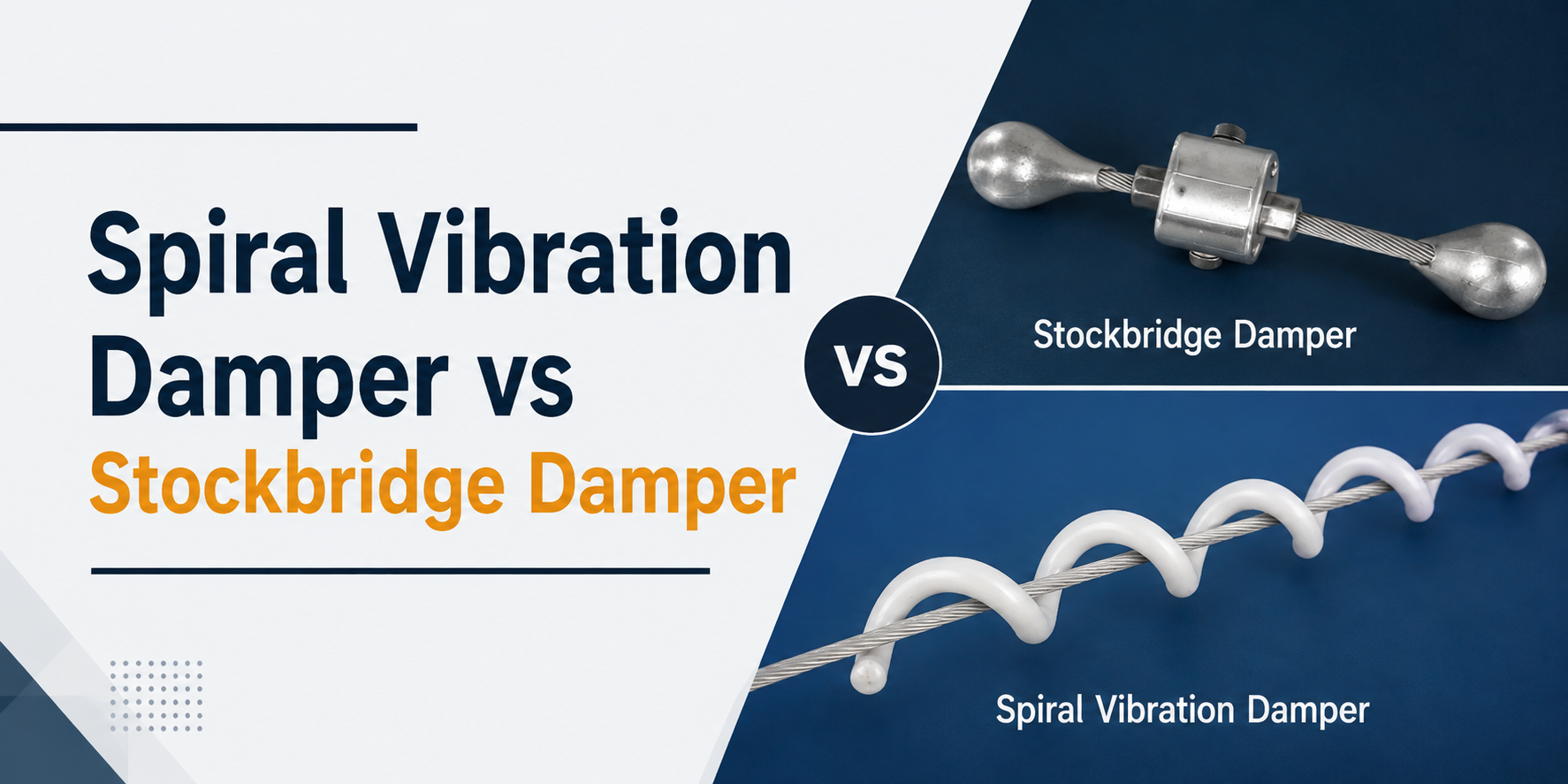
A spiral vibration damper is a molded helical (spiral) rod, usually a tough UV-stable plastic, that clips onto the cable near the support. It controls vibration by two mechanisms: it detunes the cable (changing its vibration characteristics so the destructive resonance doesn’t build) and it impacts/damps the oscillation directly.
Its advantages are simplicity and light weight:
- It clips on by hand no tools, no bolts.
- It adds very little weight, which matters on a light cable that a heavy damper would overload.
- It’s economical, so protecting a whole line of light cable is affordable.
Spiral dampers are the standard, economical choice for ADSS, OPGW, and small conductors light cables where their tool-free, lightweight protection is exactly right. On ADSS especially, a light dielectric-friendly spiral damper suits the cable far better than a heavy metallic device.
What Is a Stockbridge Damper?
A Stockbridge damper is a tuned-mass device: two weights on the ends of a short flexible messenger cable, clamped to the conductor. When the conductor vibrates, the weights on their messenger vibrate too but tuned to move out of phase and absorb the vibration energy, dissipating it as the messenger flexes.
Because it uses a tuned mass, a Stockbridge damper can absorb substantial vibration energy which is what larger conductors and higher-energy vibration need. The weights and messenger are matched (tuned) to the conductor and the expected vibration frequencies, so the damper works across the range the line experiences.
Stockbridge dampers are the standard choice for larger transmission conductors and situations with higher vibration energy, where the light detuning action of a spiral damper wouldn’t absorb enough.
Spiral vs Stockbridge: The Comparison
| Spiral Vibration Damper | Stockbridge Damper | |
|---|---|---|
| Mechanism | Detuning + impact (lightweight spiral) | Tuned mass (weights on messenger) |
| Weight | Very light | Heavier |
| Best cable | ADSS, OPGW, small conductors | Larger conductors |
| Vibration energy | Lower | Higher |
| Installation | Clip-on, tool-free | Bolted clamp |
| Cost | Lower | Higher |
| Typical use | Distribution, fiber cables, light spans | Transmission conductors, high-energy spans |
The one-line version: spiral = light cables, low cost, clip-on; Stockbridge = heavier conductors, tuned mass, higher energy.
How Do I Choose Between a Spiral and a Stockbridge Damper?
The choice is driven mainly by the cable and the vibration energy:
1. What cable are you protecting?
- ADSS, OPGW, or small conductors (light cables) → spiral vibration damper. It’s lightweight (won’t overload the cable), economical, and dielectric-friendly for ADSS.
- Larger transmission conductors → Stockbridge damper. The tuned mass absorbs the higher energy these cables carry.
2. How much vibration energy?
Higher vibration energy long spans, high tension, steady exposed wind favors the Stockbridge damper’s energy-absorbing tuned mass. Lower energy on light cable is well handled by the spiral damper.
3. Span and terrain
Long, exposed spans through open, windy terrain generate more vibration and often call for the more capable Stockbridge damper on transmission conductors. Shorter or sheltered spans on light cable are well served by spiral dampers.
4. Cost and installation
Spiral dampers are cheaper and clip on without tools, so protecting a long run of light cable is fast and affordable. Stockbridge dampers cost more and bolt on, justified by the energy they absorb on heavier conductors.
The short rule most projects use: light cables (ADSS/OPGW/small conductors) → spiral; larger conductors and higher-energy spans → Stockbridge. When in doubt, match the damper to the cable diameter and the span, and ask your hardware supplier to confirm.
A Note on ADSS: Why Spiral Is Usually Right
For ADSS cable specifically, the spiral vibration damper is usually the better tool: it’s light, dielectric-friendly, and matched to smaller cable diameters. A heavy metallic Stockbridge damper is generally unnecessary and less suitable for a light dielectric cable. Stockbridge-type dampers for ADSS do exist for special long-span or large-diameter cases, with clamps designed for the dielectric sheath but for most ADSS, spiral is the standard. If your route mixes cable types, specify the right damper family for each.
What About Bundled Conductors?
If your line runs bundled conductors (two or more sub-conductors per phase), the vibration and spacing conversation changes: you use spacer dampers, which hold the sub-conductors at a fixed separation and damp vibration in one device. That’s a different tool for a different configuration neither a plain spiral nor a plain Stockbridge damper so if you have bundles, start the damping conversation there.
How Many Dampers, and Where?
Damper quantity and placement depend on the span length, tension, cable, and terrain they’re positioned near the supports where vibration concentrates, and long spans may need dampers at both ends (and sometimes more). This is an engineering calculation, not a fixed number, so give your supplier the span, tension, cable, and terrain and let them advise quantity and placement. Under-damping leaves the cable exposed; the right number protects it for the line’s life.
Spiral vs Stockbridge Damper: FAQ
What is the difference between a spiral and a Stockbridge damper? A spiral damper is a lightweight clip-on plastic spiral that detunes and damps vibration on light cables. A Stockbridge damper is a heavier tuned-mass device (weights on a messenger) that absorbs higher vibration energy on larger conductors. Spiral suits light cables; Stockbridge suits heavier conductors.
Which vibration damper is best for ADSS cable? For most ADSS, a spiral vibration damper is best it’s lightweight, dielectric-friendly, economical, and matched to smaller cable diameters. A heavy Stockbridge damper is usually unnecessary for light ADSS, though special long-span or large-diameter ADSS cases exist.
When should I use a Stockbridge damper instead of a spiral one? Use a Stockbridge damper on larger transmission conductors and higher-energy spans, where a tuned mass is needed to absorb the vibration energy. A spiral damper’s lighter detuning action may not be enough on those cables.
Do I need a vibration damper at all? On spans exposed to steady wind, yes aeolian vibration causes fatigue that fails cables and fittings over time. Whether a specific span needs damping, and how many dampers, depends on the span, tension, cable, and terrain. Sheltered or very short spans may not need them.
How do I know how many dampers to install? It’s an engineering calculation based on span length, tension, cable type, and terrain. Dampers go near the supports where vibration concentrates; longer spans may need them at both ends or more. Give your supplier the span details and they’ll advise quantity and placement.
What damper do bundled conductors use? Bundled conductors use spacer dampers, which maintain the spacing between sub-conductors and damp vibration in a single device different from both spiral and Stockbridge dampers, which are for single conductors and light cables.
The Bottom Line
Both spiral and Stockbridge dampers control the aeolian vibration that would otherwise fatigue your cables but they’re built for different cables. Spiral vibration dampers are lightweight, economical, and clip-on, ideal for ADSS, OPGW, and small conductors. Stockbridge dampers use a tuned mass to absorb higher energy, ideal for larger transmission conductors. Match the damper to the cable and the span, use spacer dampers for bundles, and let the span/tension/terrain drive the quantity.
DAPENG Power (DP Power Fitting) manufactures the full range spiral vibration dampers, Stockbridge vibration dampers, spacer dampers for bundles, and armor rods for conductor reinforcement at the support. Tell us your cable, span, tension, and terrain, and we’ll recommend the right damper and quantity, and quote it with the matching ADSS/OPGW or conductor hardware.