If you’ve ever looked at an overhead power line and wondered how those heavy conductors stay securely in place, the answer lies in the hardware holding them up. Among the most critical components are suspension clamps and strain clamps, two types of fittings that might look similar to the untrained eye but serve fundamentally different purposes.
Choosing the wrong one for your application can lead to conductor damage, sagging lines, or even catastrophic failure. This guide breaks down everything you need to know about suspension clamps vs strain clamps, their functions, applications, and how to select the right one for your project.
What Is a Suspension Clamp?
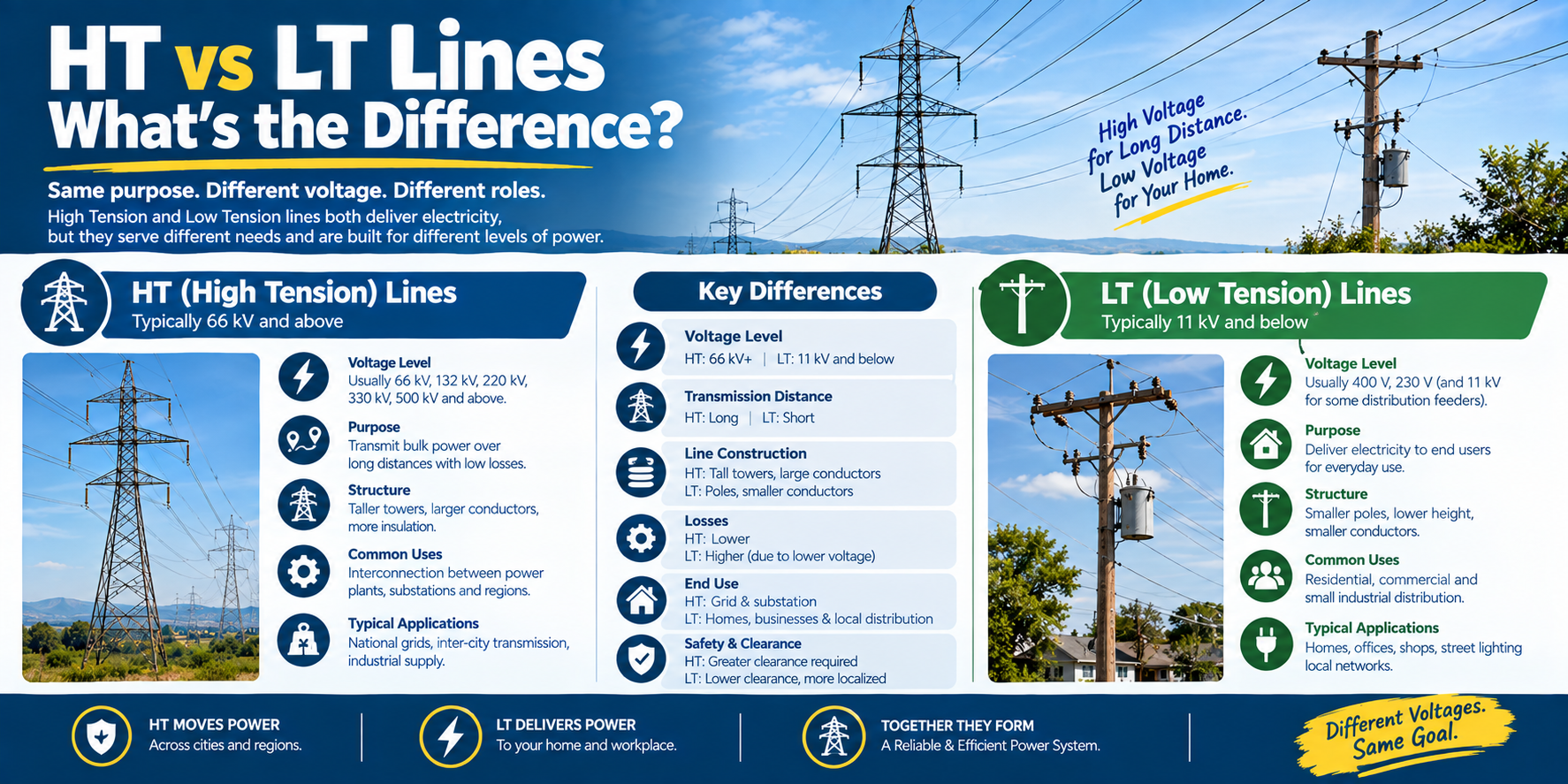
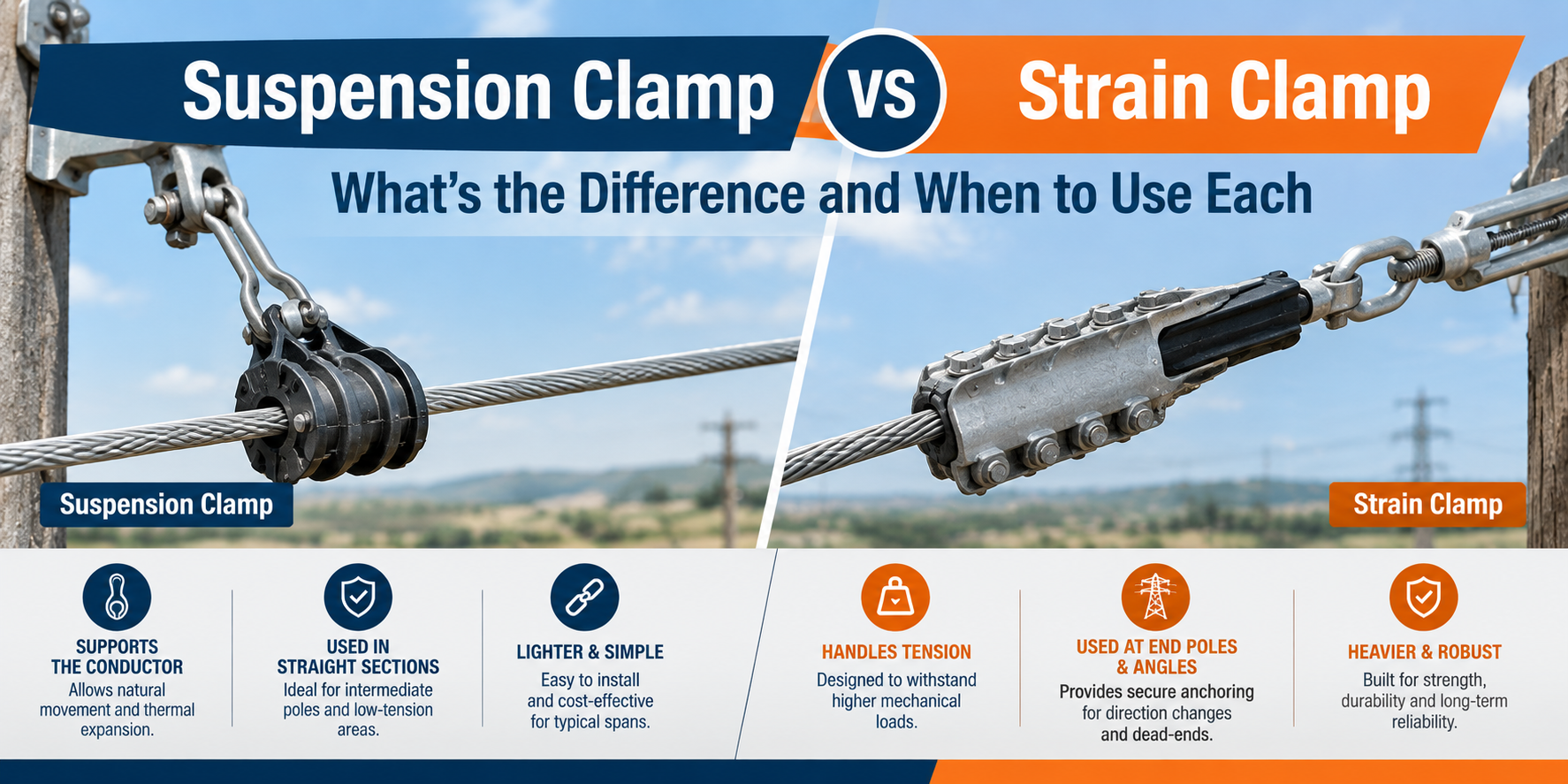
A suspension clamp is a hardware device designed to support and suspend conductors from utility poles or transmission towers along straight sections of an overhead line.
Think of it as a cradle for the conductor. It holds the cable securely but allows limited movement to accommodate:
-
Thermal expansion and contraction
-
Wind-induced oscillations
-
Vibration from normal operation
Key Design Features
Suspension clamps are typically constructed in U-shaped or C-shaped configurations that securely cradle the conductor. They are usually made from:
-
Aluminum alloy – Lightweight and corrosion-resistant
-
High-strength polymer – For modern, lightweight applications
-
Ductile iron – For heavy-duty applications
The grooved design protects the conductor insulation and provides flexibility while resisting vibration.
Primary Function
The primary role of a suspension clamp is to provide stable support without imposing significant tension on the line. It holds the conductor’s weight, allowing it to hang freely and maintain the correct sag.
Typical Applications
-
Straight-line sections of overhead distribution lines
-
Medium- and low-voltage systems
-
Aerial Bundled Cable (ABC) installations
-
Railway catenary systems
-
Urban power distribution where dynamic loads and thermal expansion must be accommodated
What Is a Strain Clamp?
A strain clamp (also referred to as a dead-end clamp) is designed to anchor conductors firmly to poles or towers at points where the conductor is subjected to high mechanical tension.
Unlike suspension clamps, which allow movement, strain clamps hold the conductor firmly in a fixed position and bear the full mechanical tension of the line.
Key Design Features
Strain clamps are engineered to withstand substantial mechanical loads and are typically made from:
-
Galvanized steel – For high strength and corrosion resistance
-
Aluminum alloy – For lighter applications
-
Reinforced materials with additional coatings for enhanced durability under prolonged stress
The gripping mechanism is designed to prevent conductor slippage even under extreme tension.
Primary Function
Strain clamps anchor conductors and transfer mechanical tension directly to the tower or pole. They maintain conductor tension, preventing sagging and ensuring structural integrity under varying environmental and operational stresses.
Typical Applications
-
Dead-end poles or line terminations
-
Sharp directional changes (angle points) in the line
-
High-voltage transmission lines
-
Regions prone to heavy ice or wind loads where maintaining conductor tension is critical
-
High-tension segments of power lines
Tension Clamp: The Third Player
Before we dive deeper into the comparison, it’s worth mentioning the tension clamp—a closely related but distinct component.
A tension clamp is used to manage and maintain the correct conductor tension, especially over long spans. While strain clamps anchor conductors at endpoints, tension clamps are used in long-span transmission lines to:
-
Control and balance conductor tension
-
Distribute mechanical loads evenly
-
Prevent excessive sagging
In practice, the terms “strain clamp” and “tension clamp” are sometimes used interchangeably, but tension clamps are specifically designed for managing loads across long spans, while strain clamps focus on anchoring at endpoints and direction changes.
Suspension Clamp vs Strain Clamp: Key Differences at a Glance
| Feature | Suspension Clamp | Strain Clamp |
|---|---|---|
| Primary Function | Supports conductor vertically | Anchors conductor under tension |
| Movement Allowance | Flexible; permits limited movement | Minimal; holds conductor firmly fixed |
| Tension Bearing | Does NOT bear full line tension | Bears FULL mechanical tension |
| Installation Point | Intermediate poles (straight sections) | Line ends, angle points, dead-ends |
| Load Capacity | Low to moderate | High |
| Typical Materials | Aluminum alloy, polymer | Galvanized steel, reinforced materials |
| Installation Complexity | Relatively straightforward | Requires precise tensioning and specialized tools |
| Environmental Focus | Flexibility for thermal expansion and vibration | Durability under severe mechanical stress |
How They Work Together
In a complete overhead line system, suspension clamps and strain clamps function as a coordinated system:
-
Suspension clamps support the conductor along straight sections
-
Strain clamps secure the conductor at endpoints and direction changes
-
Tension clamps maintain consistent mechanical balance across spans
Together, they:
-
Reduce mechanical stress on conductors
-
Prevent conductor sagging
-
Enhance overall safety and durability
How to Choose the Right Clamp for Your Project
Selecting between a suspension clamp and a strain clamp depends on several critical factors. Here’s what to consider:
1. Line Configuration
-
Straight spans with minimal tension → Suspension clamp
-
Dead-ends, corners, or high-tension segments → Strain clamp
2. Mechanical Load Requirements
-
Low to moderate loads → Suspension clamp
-
High tensile forces → Strain clamp
3. Conductor Specifications
-
Consider conductor size, type, and material
-
Ensure compatibility with aluminum, ACSR, or steel conductors
4. Environmental Conditions
-
Coastal areas (salt corrosion) → Choose corrosion-resistant materials
-
Industrial zones (pollution) → Consider additional protective coatings
-
Cold climates (ice load) → Heavy-duty strain clamps may be required
-
High-wind regions → Both types need appropriate vibration resistance
5. Voltage Level
-
Higher voltage systems require stronger clamps
-
Medium- and low-voltage systems typically use suspension clamps
6. Installation and Maintenance
-
Suspension clamps are generally easier to install
-
Strain clamps demand precise tensioning during installation
Material Considerations
Both clamp types are typically manufactured from high-strength materials, but the choice depends on the application:
| Material | Best For | Key Advantage |
|---|---|---|
| Aluminum Alloy | Standard overhead lines | Lightweight, corrosion-resistant |
| Galvanized Steel | Heavy-load, long-span transmission | High strength, corrosion protection |
| Ductile Iron | Heavy-duty applications | Exceptional durability |
| Stainless Steel | Marine/corrosive environments | Maximum corrosion resistance |
| Reinforced Polymer | Modern lightweight designs | UV resistance, lightweight |
Common Mistakes to Avoid
❌ Using a Suspension Clamp at a Dead-End
Suspension clamps are not designed to bear full line tension. Using one at a dead-end or angle point risks conductor slippage and line failure.
❌ Using a Strain Clamp on a Straight Span
Strain clamps restrict conductor movement. Using them on straight spans can increase mechanical stress and reduce the line’s ability to accommodate thermal expansion.
❌ Ignoring Environmental Factors
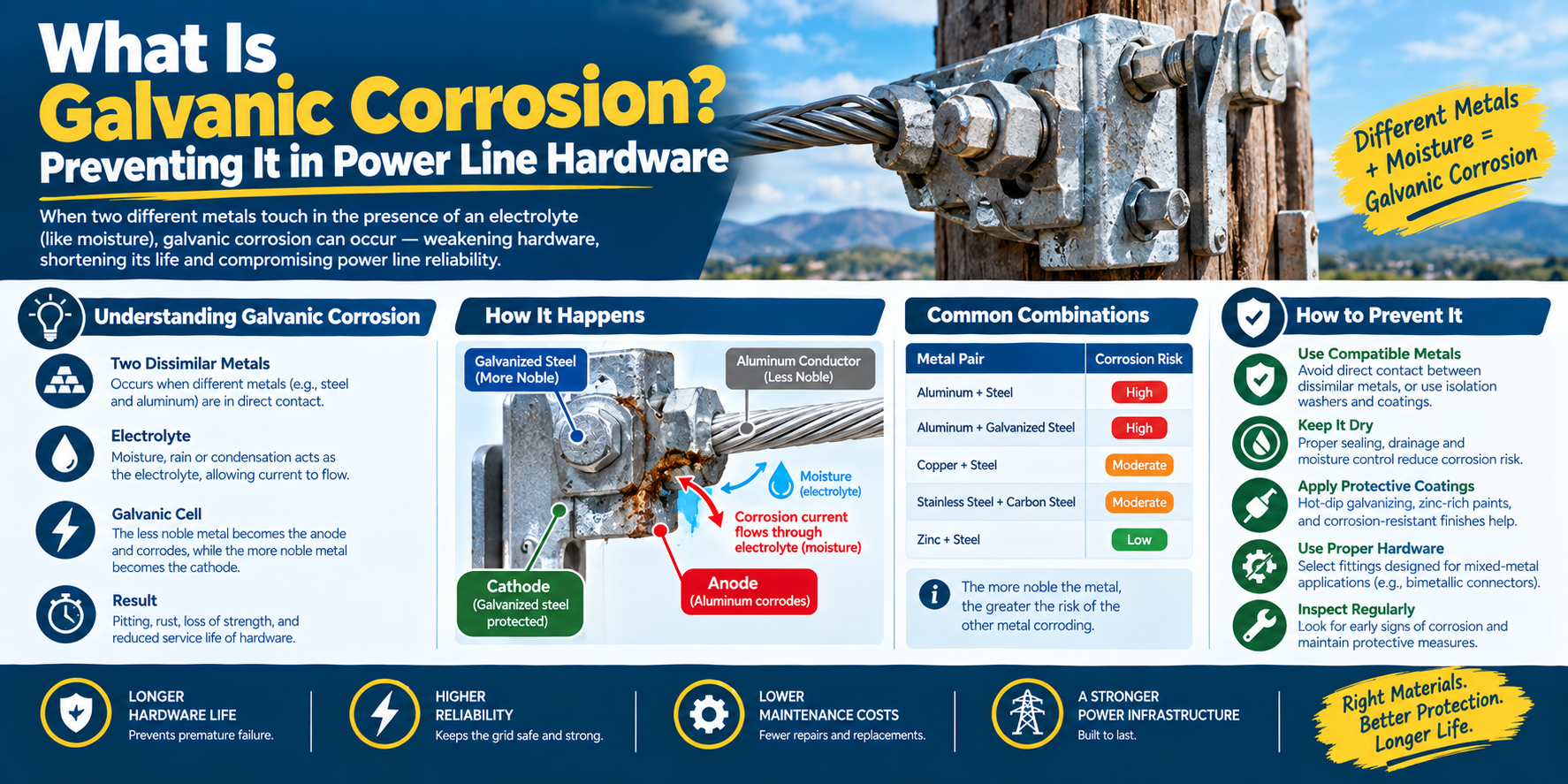
Coastal and industrial environments require enhanced corrosion protection. Standard galvanization may not be sufficient.
❌ Overlooking Conductor Compatibility
Always verify that the clamp is compatible with your conductor material and diameter.
Quality Indicators to Look For
When sourcing suspension or strain clamps, look for:
-
Compliance with international standards (IEC, ANSI, ASTM)
-
Hot-dip galvanization per ASTM A153 or ISO 1461 for corrosion protection
-
Material Test Reports (MTR) for traceability
-
Mechanical and tensile testing documentation
-
Third-party inspection (SGS, TÜV, Intertek)
Conclusion
Understanding the difference between suspension clamps and strain clamps isn’t just technical trivia—it’s essential for designing safe, reliable, and long-lasting overhead power lines.
Suspension clamps provide flexible support along straight sections, allowing conductors to move with thermal expansion and wind.
Strain clamps anchor conductors firmly at dead-ends, corners, and high-tension points, bearing the full mechanical load.
Together, they form the backbone of overhead power distribution and transmission networks.
Ready to source high-quality clamps for your next project?
Explore our complete range of overhead line fittings:
-
Suspension Clamps – Reliable conductor support for straight-line spans
-
Strain Clamps – High-tension anchoring for dead-ends and angle points
-
Bolt Type Tension Clamp – Secure conductor terminations
-
Overhead Line Fittings – Complete hardware solutions for transmission and distribution