Types of Electrical Insulators Used in Overhead Lines
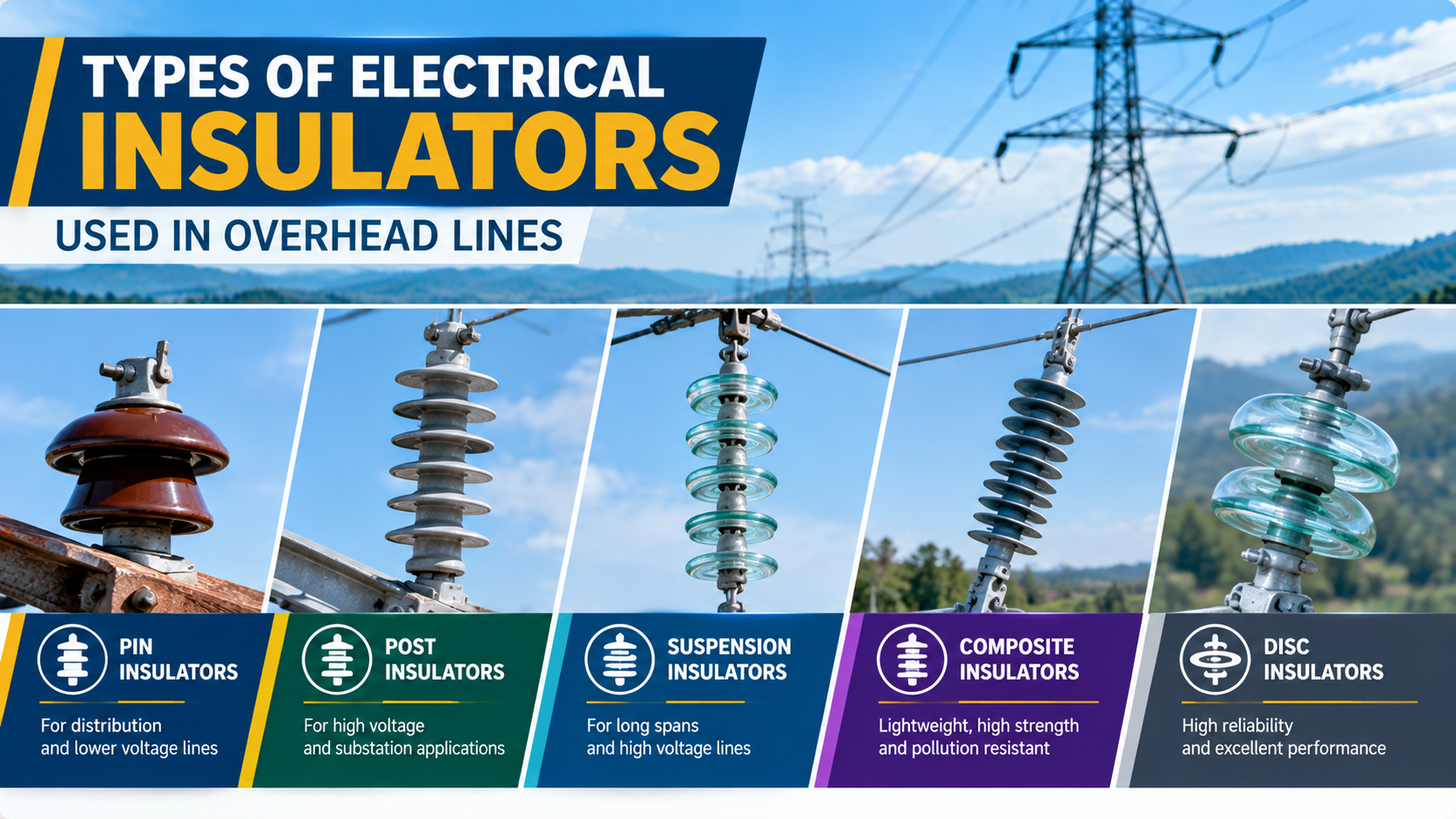
The main types of electrical insulators used in overhead power lines are pin, post, suspension, strain, stay, spool, and shackle insulators. Pin and post insulators are rigid, top-of-structure types for distribution voltages; suspension insulators form hanging strings for transmission (adding discs as voltage rises); strain insulators take line tension at angles and dead-ends; and stay, spool, and shackle insulators serve guys, secondary conductors, and low-voltage lines. Each type matches a voltage level, mechanical duty, and position on the structure.
Insulators do one essential job hold energized conductors away from the earthed structure but they come in several types, each suited to a different voltage, position, and duty. This guide explains the main types of electrical insulators used in overhead lines and what each is for.
Why There Are Different Types
An insulator must handle the voltage (enough electrical strength and creepage), the mechanical load (the conductor’s weight or tension), and its position on the structure (top-mounted, hanging, or in-line). No single design does all of that across every voltage and situation so the industry uses several types, each optimized for a role. Choosing the right one starts with knowing the types.
1. Pin Insulators
Pin insulators are among the oldest and most common types. They’re rigid insulators mounted on a pin on the crossarm or pole top, with the conductor tied into a groove near the top. Made of one or more pieces of porcelain, glass, or composite, they’re used mainly on distribution lines (commonly up to around 33 kV). Above that, they become large and uneconomical, so other types take over. Pin insulators suit tangent (straight-run) and light-angle structures.
2. Post Insulators
Post insulators are rigid, like pin insulators, but of a line-post design a taller column with more sheds, mounted vertically or horizontally. They handle higher distribution and sub-transmission voltages than pin insulators and offer better mechanical performance and a cleaner, more compact profile. They’re common where a stronger rigid insulator or a compact design is wanted. (See our pin-vs-post-vs-suspension guide.)
3. Suspension Insulators
Suspension insulators are single disc (cap-and-pin) units assembled into a hanging string. The number of discs is chosen by voltage the higher the voltage, the more discs which makes them the standard for transmission lines, where you scale insulation simply by adding units. They hang vertically from the structure (suspension) and allow the conductor to move. Above about 33 kV, suspension strings generally replace pin insulators.
4. Strain (Tension) Insulators
Strain insulators are suspension discs assembled into a string set in line with the conductor to take the full line tension at angle and dead-end structures. Mechanically they’re the same disc units as suspension insulators, but arranged to resist tension rather than support weight. The conductor is terminated here with a strain clamp or dead-end grip. (See our suspension-vs-tension-structures guide.)
5. Stay / Guy-Strain Insulators
Stay insulators and guy-strain insulators are inserted into a guy (stay) to isolate it electrically while carrying the mechanical load so the guy can’t become energized and hazardous. They’re mechanical links that also break the electrical path, used on guyed structures where isolation is required.
6. Spool Insulators
Spool insulators are small reel-shaped insulators for secondary and service (low-voltage) conductors, carried on secondary racks or D-brackets. The conductor ties into the spool’s groove. They’re the standard for the low-voltage secondary side of distribution.
7. Shackle Insulators
Shackle insulators are another low-voltage type, used on secondary distribution and at angles on low-voltage lines, mounted on a bracket or bolt. Like spool insulators, they serve the low-voltage end rather than the primary line.
Types of Insulators at a Glance
| Type | Rigid or hanging | Typical use |
|---|---|---|
| Pin | Rigid | Distribution (to ~33 kV) |
| Post | Rigid | Distribution / sub-transmission |
| Suspension | Hanging string | Transmission (scales with kV) |
| Strain | In-line string | Angles & dead-ends (takes tension) |
| Stay / guy-strain | In-guy link | Isolating guys |
| Spool | Small reel | Secondary / service conductors |
| Shackle | Small | Low-voltage distribution |
How Insulators Are Made
Overhead-line insulators are made from materials chosen for high electrical resistance and mechanical strength: porcelain (the traditional, widely used material), toughened glass, and modern composite/polymer (silicone rubber over a fiberglass core), which is light and offers a hydrophobic surface useful in polluted environments. The material choice interacts with the type, voltage, and environment. (See our creepage-and-pollution guide for harsh-environment selection.)
Types of Insulators: FAQ
What are the main types of insulators used in overhead lines? The main types are pin, post, suspension, strain, stay, spool, and shackle insulators. Pin and post are rigid types for distribution; suspension and strain form strings for transmission and terminations; stay, spool, and shackle serve guys, secondary conductors, and low-voltage lines.
What is the difference between pin and suspension insulators? Pin insulators are rigid units mounted on a pin on top of the structure, used on distribution lines (to ~33 kV). Suspension insulators are discs assembled into a hanging string for transmission lines, where you add discs as the voltage rises. Pin = rigid, distribution; suspension = string, transmission.
Which insulator is used for high-voltage transmission? Suspension insulators, assembled into strings, are used for high-voltage transmission. The number of discs increases with voltage, so the string scales to the required insulation which is why strings, not single rigid insulators, are used at transmission levels.
What insulator is used for guy wires? A stay insulator or guy-strain insulator is inserted into the guy to isolate it electrically while carrying the mechanical load, so the guy can’t become energized. It’s used on guyed structures where the design requires guy isolation.
What material are insulators made from? Porcelain (traditional and widely used), toughened glass, and composite/polymer (silicone rubber over a fiberglass core). Composite insulators are light with hydrophobic surfaces useful in polluted environments. The material is chosen with the type, voltage, and environment.
How do I choose the right insulator type? By voltage (pin/post for distribution, suspension/strain for transmission), position (top-mounted, hanging, in-line, in-guy, secondary), mechanical load, and environment (creepage for pollution). Match the type to the role. (See our insulator selection and creepage guides.)
The Bottom Line
Overhead lines use several insulator types, each matched to a voltage, a mechanical duty, and a position: pin and post for distribution, suspension and strain for transmission and terminations, and stay, spool, and shackle for guys, secondary conductors, and low-voltage lines. Knowing the types is the first step; matching one to your voltage, load, and environment is the second.
DAPENG Power (DP Power Fitting) manufactures the full insulator range pin, post, suspension, stay, guy-strain, and spool insulators, plus complete strings. Tell us your voltage, structure, load, and environment, and we’ll recommend the type and confirm its ratings.