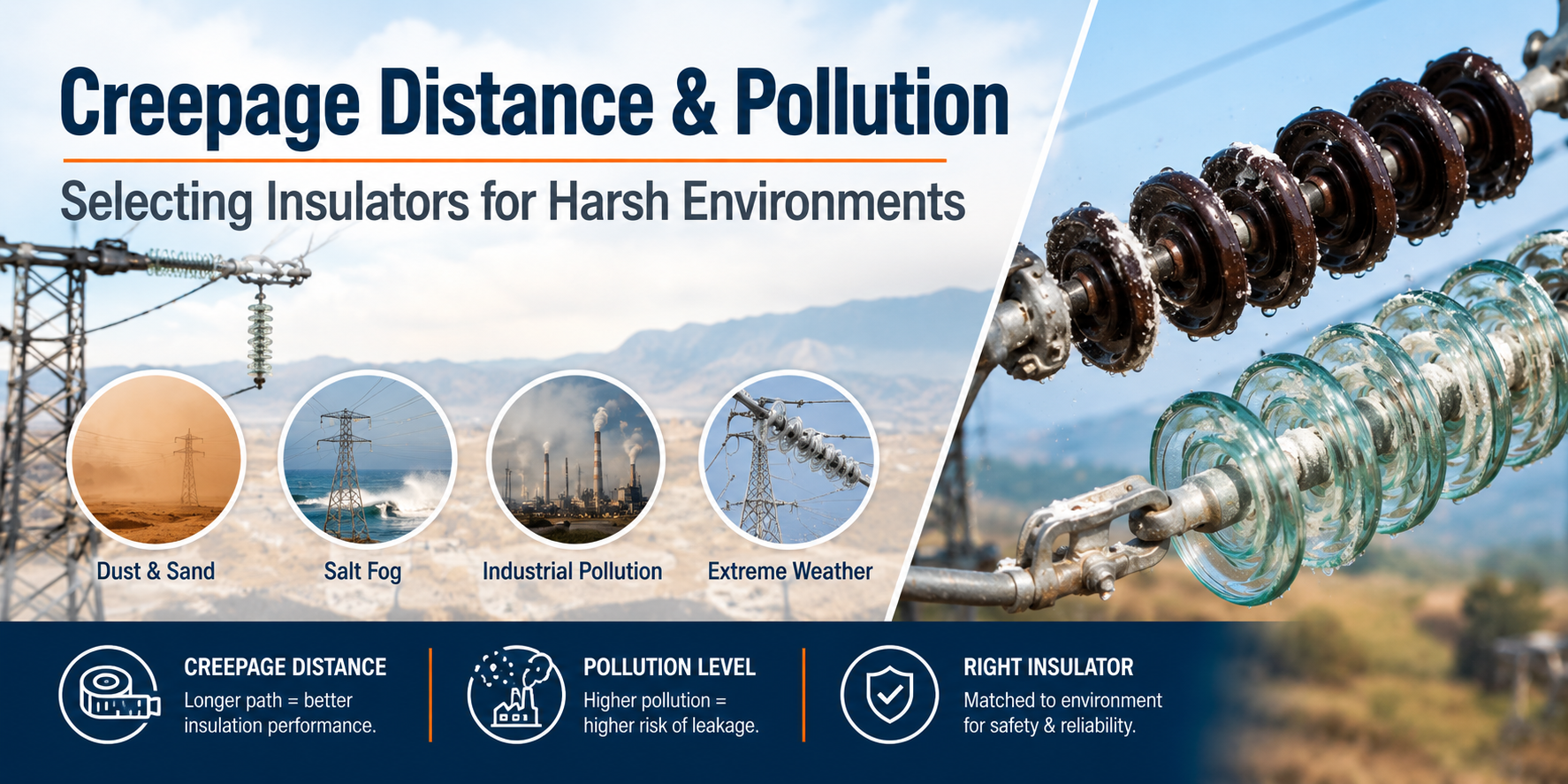
Creepage Distance & Pollution: Selecting Insulators for Harsh Environments
Creepage distance (leakage distance) is the length of the path along an insulator’s surface between the conductor and the earthed end. In polluted environments coastal salt, industrial, desert dust contamination, and moisture- current can track along that surface, and if the creepage is too short, it can flash over. So harsh environments require more creepage: a higher creepage class, a longer insulator, or more discs in a suspension string. Match the insulator’s creepage to your pollution level (classified by IEC) as well as its voltage.
Two lines at the same voltage can need very different insulators if one is in clean air and the other in coastal salt spray. The difference is creepage distance, driven by pollution and getting it wrong causes flashovers. This guide explains creepage, how pollution drives it, and how to select insulators for harsh environments.
What Is Creepage Distance?
Creepage distance (also called leakage distance) is the shortest path along the surface of the insulator from the energized end to the earthed end. It’s not the straight-line (air) distance it follows the contours of the sheds/skirts, which is why insulators have those ribbed profiles: the ribs lengthen the surface path without making the insulator physically longer.
Creepage matters because, in the real world, the insulator’s surface gets contaminated and wet, and current can then track along the surface rather than being held off through clean air. The longer the creepage path, the harder it is for that surface current to bridge the whole insulator so more creepage means more resistance to pollution-driven flashover.
Why Pollution Drives the Requirement
A clean, dry insulator surface is an excellent insulator. The problem is pollution plus moisture:
- Pollution deposits a conductive layer on the surface salt from coastal spray, conductive dust from industry, desert dust that becomes conductive when damp.
- Moisture (dew, fog, light rain, humidity) wets that layer, making it conductive.
- Together, they let leakage current flow along the surface, which can heat, dry-band, arc, and ultimately flash over the whole insulator a line fault.
The dirtier the environment, the more creepage you need to keep that surface current from bridging the insulator. That’s why the environment, not just the voltage, sets the insulator.
Pollution Levels and Creepage Classes
Environments are classified by pollution severity international standards (IEC) define pollution classes from light to very heavy, roughly:
- Light clean rural/inland areas, low pollution.
- Medium some industry or moderate coastal influence.
- Heavy strong coastal (salt), industrial, or dusty environments.
- Very heavy severe coastal/industrial, extreme contamination.
Each class corresponds to a minimum specific creepage (creepage per unit of voltage) the insulator must provide. So selecting an insulator for a harsh environment means: identify the pollution class, then choose an insulator whose creepage meets or exceeds the class requirement for your voltage. The specific figures come from the standards and the insulator datasheet confirm them for your line.
How to Get More Creepage
When the environment demands more creepage than a standard insulator provides, you have several routes:
- Higher-creepage insulator design insulators with deeper or more sheds provide more creepage in the same overall length. Anti-fog and open-profile designs are made for polluted environments.
- More discs in a suspension string for suspension insulators and strings, adding discs increases both the electrical strength and the total creepage. This is the natural way to scale a transmission string for pollution.
- Larger/longer rigid insulators for pin and post insulators, a larger unit provides more creepage.
- Composite insulators in some heavily polluted environments, composite (silicone) insulators offer hydrophobic surfaces that resist surface tracking.
The right route depends on the insulator type and the pollution severity. Match the creepage to the class, confirm against the datasheet, and you protect against pollution flashover.
Don’t Forget the Mechanical and Electrical Ratings
Creepage is the pollution dimension of insulator selection but the insulator must also meet its electrical ratings (voltage, impulse withstand) and its mechanical rating (the load it holds). Selecting for a harsh environment means satisfying all three: enough creepage for the pollution, enough electrical strength for the voltage, and enough mechanical strength for the line. All are datasheet figures to confirm for your specific line. (See our pin/post/suspension selection guide for the type-and-voltage dimension.)
Creepage Distance & Pollution: FAQ
What is creepage distance on an insulator? Creepage distance (leakage distance) is the shortest path along the insulator’s surface from the energized end to the earthed end. The ribbed sheds lengthen this surface path. More creepage means more resistance to current tracking along a polluted, wet surface and thus to flashover.
Why does pollution matter for insulator selection? Pollution deposits a conductive layer (salt, dust, industrial deposits) on the insulator surface, and when moisture wets it, current can track along the surface and flash over. Dirtier environments need more creepage to prevent this, so the environment not just the voltage drives the insulator choice.
What insulator do I need for a coastal environment? One with higher creepage suited to the coastal (salt) pollution class a higher-creepage or anti-fog insulator design, more discs in a suspension string, or a composite insulator with a hydrophobic surface. Match the creepage to the coastal pollution severity for your voltage.
How do I increase creepage distance? Use a higher-creepage insulator design (deeper/more sheds), add more discs to a suspension string, use a larger rigid insulator, or use composite insulators in severe pollution. Each increases the surface path so pollution-driven surface current can’t bridge the insulator.
What are insulator pollution classes? International standards (IEC) classify environments by pollution severity roughly light, medium, heavy, and very heavy each requiring a minimum specific creepage (creepage per unit voltage). Identify your pollution class and select an insulator whose creepage meets it for your voltage.
Does more creepage replace the voltage and mechanical ratings? No creepage is the pollution dimension only. The insulator must also meet its electrical ratings (voltage, impulse) and its mechanical rating (load). Selecting for a harsh environment means satisfying all three, confirmed on the datasheet.
The Bottom Line
Creepage distance is the surface path that resists pollution-driven flashover, and harsh environments coastal, industrial, desert demand more of it. Identify your pollution class, then select an insulator whose creepage meets it (via a higher-creepage design, more discs, a larger unit, or composite), while still meeting the voltage and mechanical ratings. The environment sets the creepage; get it right and you prevent pollution flashovers.
DAPENG Power (DP Power Fitting) manufactures insulators across the range pin, post, and suspension types and complete strings and can specify the creepage class for your environment. Tell us your voltage, pollution level (coastal, industrial, desert, clean), and mechanical load, and we’ll recommend the insulator and confirm its creepage and ratings.