Transmission lines are the backbone of the electrical power system, acting as the medium through which electricity is transmitted from power plants to substations and ultimately to consumers. They consist of metallic conductors supported by towers or poles, designed to carry high-voltage energy over long distances efficiently. Together with substations, transmission lines form an interconnected network that ensures reliable electricity delivery, even if one line encounters a fault.
Components of a Transmission Line
A transmission line is made up of several key components that ensure efficient and safe power delivery.
Conductors
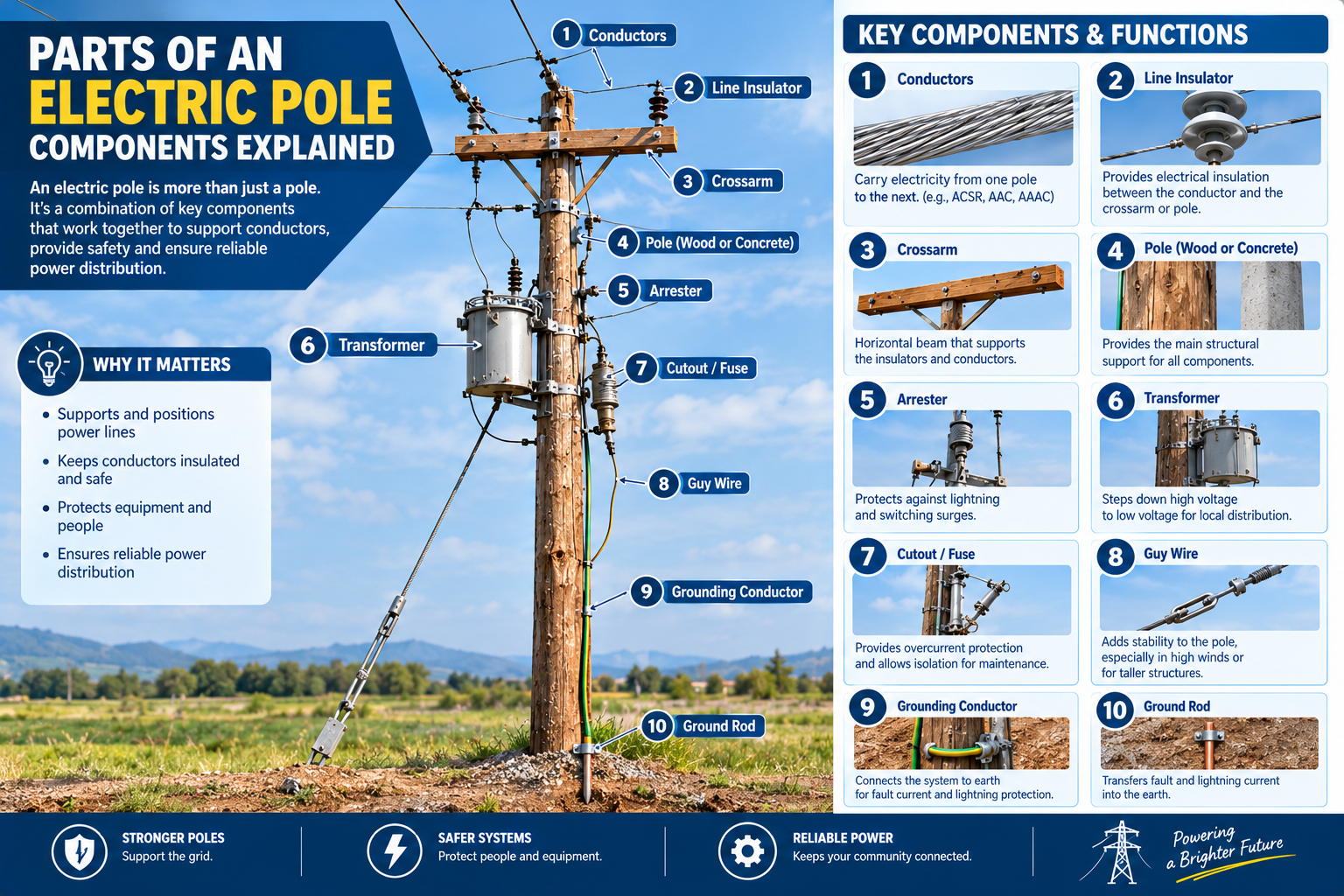
Conductors are materials that carry electrical energy from the generation point to the end users. They are designed to offer minimal resistance to electrical flow.
-
Material: Copper was traditionally used for its excellent conductivity, but modern lines often use aluminum due to its lighter weight and similar conductivity.
-
Configuration: The number of conductors depends on the number of circuits per phase.
Support Structures
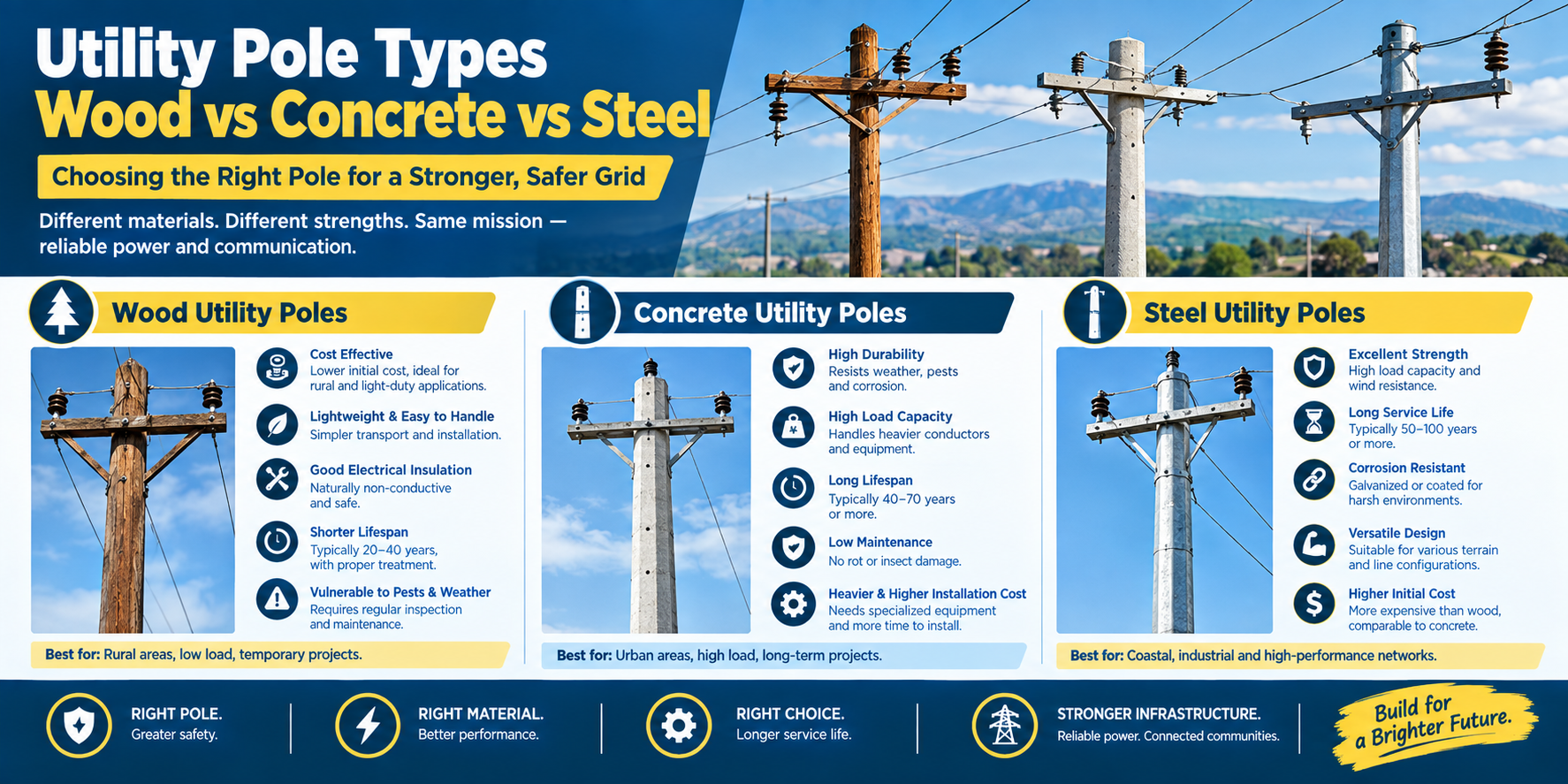
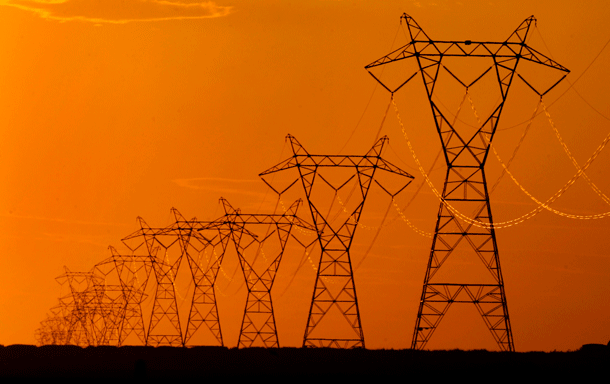
These are typically lattice towers or poles that hold conductors above the ground. They maintain the required clearance for safety and prevent sagging of cables.
Insulators
Insulators mechanically support the conductors while keeping them electrically isolated from the structure and each other. Common insulator types include porcelain, glass, and composite insulators.
Ground Wires
Ground wires protect the transmission line from lightning and atmospheric disturbances. They are installed at the top of high-voltage lines and redirect lightning strikes safely to the ground.
Electrical Characteristics of Transmission Lines
Several properties affect a transmission line’s ability to transmit electricity efficiently:
-
Resistance (R): Opposition to electrical current flow, causing some energy loss.
-
Series Inductance (L): Energy storage in the magnetic field around the conductors, affecting current changes.
-
Shunt Capacitance (C): Ability of the line to store electrical energy along its length.
-
Shunt Conductance (G): Opposes leakage currents between conductors, complementing resistance.
Series resistance and inductance occur along the conductor, while shunt capacitance and conductance occur between conductors.
Types of Transmission Lines
Transmission lines can be classified based on electrical balance, geometry, location, and voltage rating.
Electrical Balance Based
-
Balanced Lines: Each conductor carries current, and the signal is measured as the potential difference between conductors.
-
Unbalanced Lines: One conductor is grounded, creating a reference at zero potential, while the other carries the signal.
Based on Geometry
-
Single Wire Lines: Contain all conductors in one cable.
-
Double Transmission Lines: Parallel conductors separated by low-conductivity insulation.
-
Coaxial Cables: High-frequency transmission with a central conductor and an outer conductor serving as a return path.
-
Radiant Cables: Coaxial cables with slotted outer conductors, allowing energy to radiate like an antenna.
Based on Location
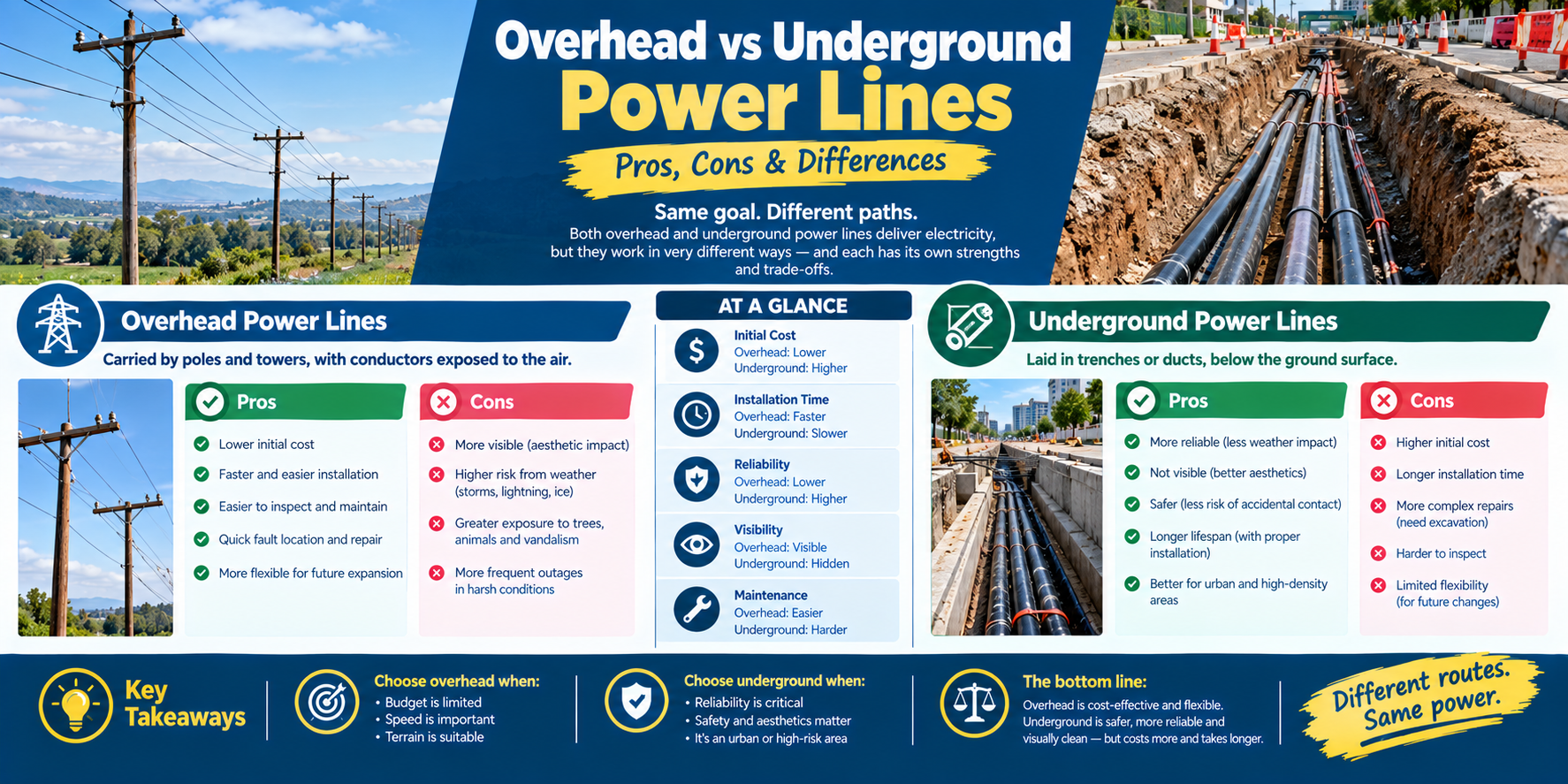
Overhead Transmission Lines
-
Bare conductors supported on towers or poles.
-
Classified by length:
-
Short Lines: <50 km, voltage <20 kV
-
Medium Lines: 50–150 km, voltage 20–100 kV
-
Long Lines: >150 km, voltage >100 kV
-
Underground Transmission Lines
-
Insulated cables buried in trenches or ducts.
-
Components include conductors, insulation, metallic sheath, bedding, armoring, and protective serving.
-
Classified by insulation type and voltage rating.
Based on Voltage
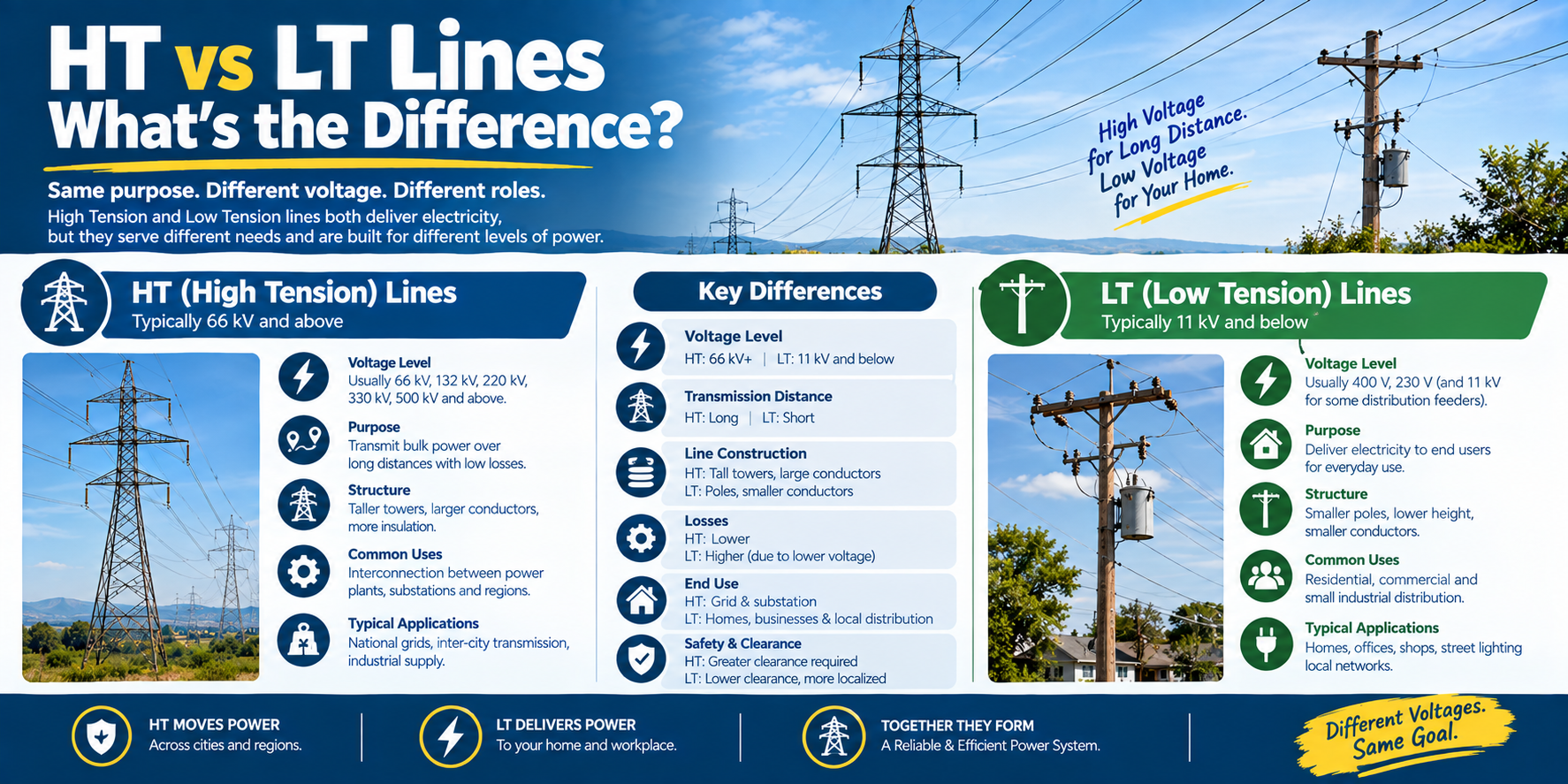
Transmission lines are also categorized according to the voltage they carry:
| Voltage Range | Classification |
|---|---|
| Beyond 132 kV | Extra Super Voltage (E.S.V.) |
| 33–66 kV | Extra High-Tension (E.H.T.) |
| 22–33 kV | Super-Tension (S.T.) |
| 1–11 kV | High-Tension (H.T.) |
| Up to 1 kV | Low-Tension (L.T.) |
Right-of-Way (ROW) and Environmental Considerations
Transmission lines are typically built within a Right-of-Way (ROW), which can range from 100 to 2,000 feet wide. ROWs allow for:
-
Maintenance access
-
Vegetation management
-
Safety clearances
Environmental considerations include:
-
Impact on wildlife movement and habitats
-
Wetland and waterway protection
-
Sedimentation and invasive species control
-
Bird collision and electrocution risks
Maintenance of ROWs often involves mechanical or chemical vegetation control, which can impact plant diversity and surrounding ecosystems.
How Electricity Travels: Generation, Transmission, and Distribution
Electricity Generation
Electricity is generated at power plants using fossil fuels, nuclear, hydroelectric, solar, wind, or biomass. Generation voltage is typically low, between 2–30 kV.
Transmission
Transmission moves electricity from generation sites to load centers over long distances. Substations step up voltage (up to 500 kV) to reduce energy loss during transmission.
Distribution
After reaching load centers, substations step down voltage for safe delivery to homes and businesses. The distribution network is analogous to local roads connecting neighborhoods, while transmission lines are the “highways” transporting electricity between cities.
Transmission Line Analysis Considerations
Designers must account for several transmission line effects:
-
Characteristic Impedance: Determines voltage and current reflection.
-
Propagation Delay: Time taken for signals to travel.
-
Induction and Capacitance: Affect line efficiency and voltage stability.
-
Reflected Waves: Occur due to impedance mismatches.
Understanding these parameters ensures efficient and reliable power delivery.
Summary
Transmission lines are critical infrastructure for electricity delivery. Key points:
-
Comprised of conductors, support structures, insulators, and ground wires
-
Classified by electrical balance, geometry, location, and voltage
-
Overhead vs. underground lines are selected based on environment, geography, and cost
-
Voltage classification determines cable type and insulation requirements
-
ROW and environmental impacts must be managed responsibly
-
Substations play a vital role in stepping voltage up and down for efficient delivery
By understanding these fundamentals, engineers, technicians, and stakeholders can design, maintain, and optimize transmission lines for safe, reliable, and efficient power delivery.