Types of Overhead Line Fittings: A Complete Guide
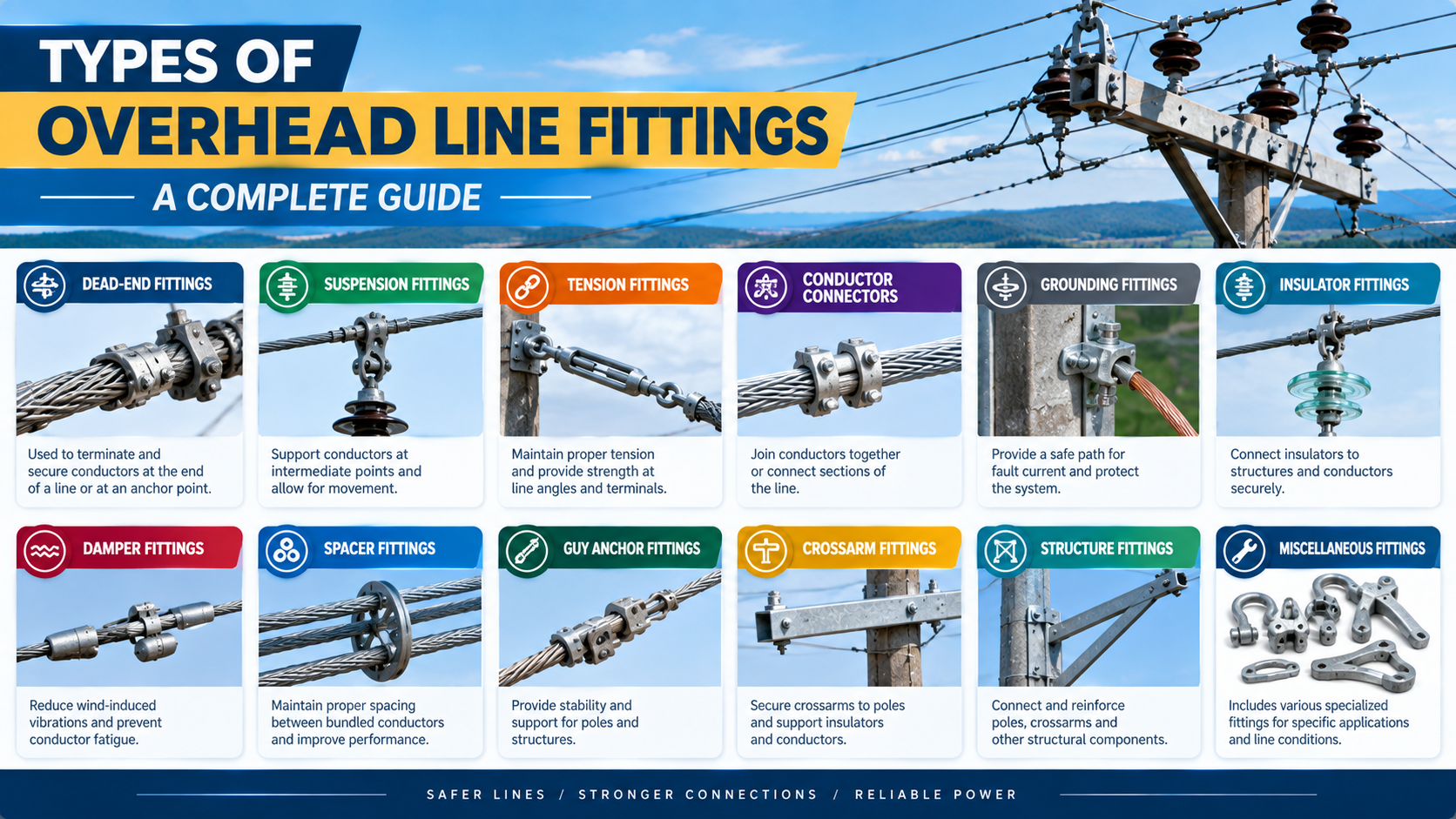
Overhead line fittings are the metal hardware that supports, terminates, connects, protects, and insulates conductors on a power line. The main types are suspension clamps (support the conductor at tangent structures), tension/strain clamps and dead-ends (terminate it at angles and ends), connectors (tap or join conductors), insulator string hardware (couplings, yoke plates, corona rings), vibration protection (dampers, armor rods), and spacers (for bundled conductors). Each type has a specific job in getting the conductor safely and reliably from tower to tower.
A power line is held together by dozens of small fittings, each doing a specific job. Knowing the types helps you specify a complete, correct set. This guide walks through the main categories of overhead line fittings and what each does a map of the whole hardware family.
What Are Overhead Line Fittings?
Overhead line fittings (also called line hardware or conductor fittings) are the metal components that attach the conductor to the structure and manage it along the line supporting its weight, taking its tension, connecting it electrically, protecting it from vibration, and insulating it from the earthed structure. They’re distinct from the conductor and insulators themselves; they’re the hardware that holds and manages both. Browse the full overhead line fittings range.
1. Suspension Clamps Supporting the Conductor
At tangent (straight-run) structures, the conductor is supported by a suspension clamp that cradles it and carries its weight while allowing movement. On transmission, armor rods reinforce the conductor at the clamp, and armor-grip suspension is used for severe vibration duty. Suspension clamps are the most numerous conductor fitting, since most structures on a line are tangent.
2. Tension & Strain Clamps and Dead-Ends Terminating the Conductor
At angle and dead-end structures, the conductor’s full tension is taken by a termination: a strain clamp, a bolt-type tension clamp, or a preformed dead-end grip. These grip the conductor fully and carry its tension into the structure. (See our preformed-vs-bolted dead-ends guide.)
3. Connectors Tapping and Joining Conductors
To connect conductors electrically, connectors are used: a parallel-groove clamp bolts two bare conductors together, a hot-line clamp makes live-workable connections, and an insulation-piercing connector taps insulated cable without stripping. (See our how-to-tap-a-conductor guide.)
4. Insulator String Hardware Couplings & Links
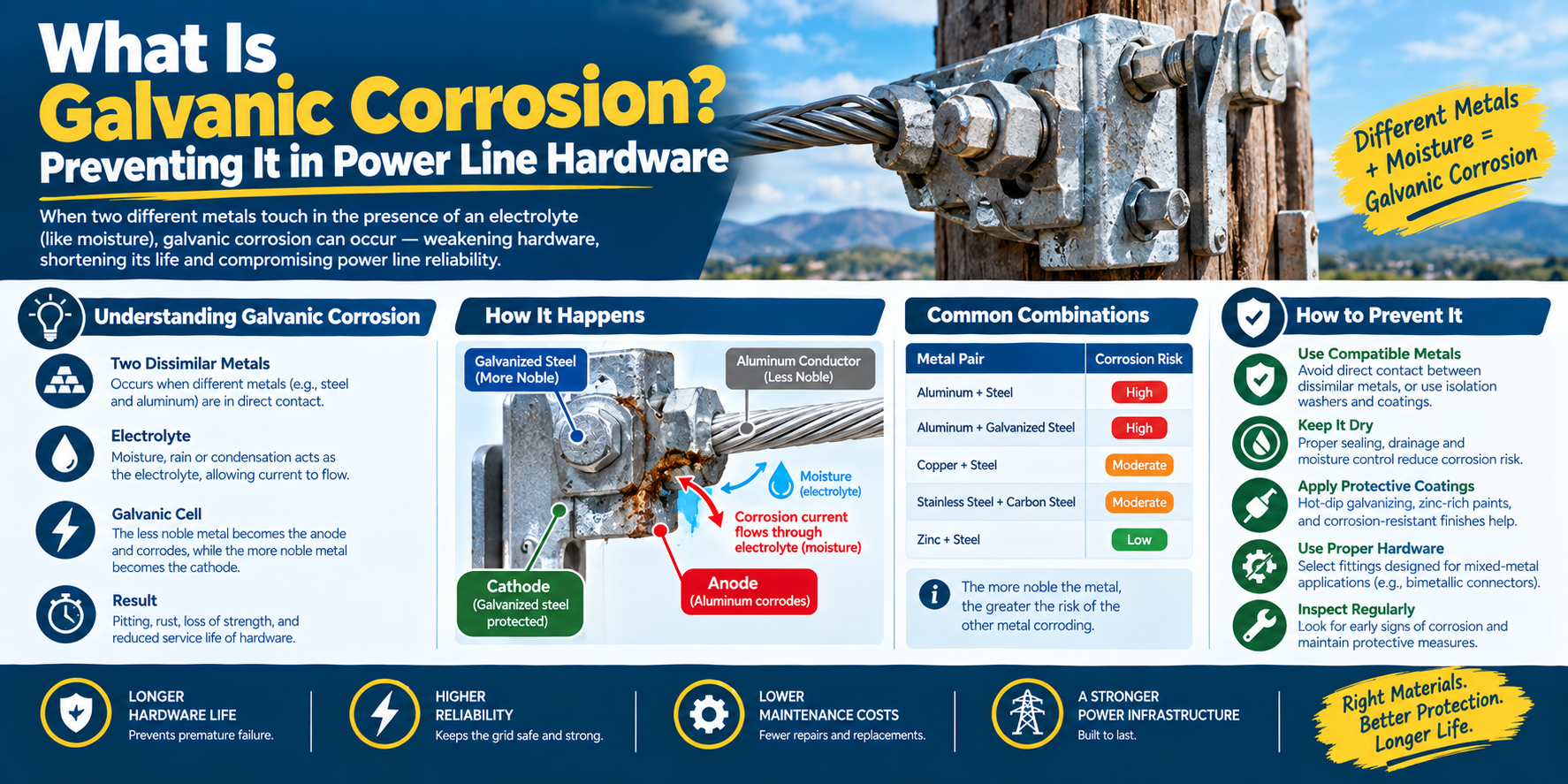
Insulator strings are assembled from coupling and link fittings: ball eye, ball clevis, socket eye, socket clevis, u-shackles, yoke plates (for bundled/multi-leg strings), and corona rings (for high voltage). These connect the string from the structure to the conductor. (See our string couplings and string-assembly guides.)
5. Vibration Protection Dampers & Armor Rods
Wind causes aeolian vibration that fatigues conductors. Vibration protection fittings control it: Stockbridge dampers (heavier conductors), spiral dampers (light cables/ADSS), and armor rods (reinforce at supports). (See our aeolian-vibration guide.)
6. Spacers Managing Bundled Conductors
On bundled (multi-sub-conductor) transmission lines, spacer-dampers and bolted cable spacers hold the sub-conductors at the correct spacing (and damp vibration). (See our bundled-conductors guide.)
7. Span & Support Fittings
Other conductor-management fittings include span clamps (support/tap at a span) and crossover clamps (maintain clearance where conductors cross).
Overhead Line Fittings at a Glance
| Category | Job | Examples |
|---|---|---|
| Suspension clamps | Support conductor (tangent) | Suspension clamp, armor-grip suspension |
| Tension/strain/dead-end | Terminate conductor (angle/end) | Strain clamp, tension clamp, dead-end grip |
| Connectors | Tap/join conductors | PG clamp, hot-line clamp, IPC |
| String hardware | Assemble insulator strings | Ball/socket/clevis, yoke plate, corona ring |
| Vibration protection | Control vibration | Stockbridge/spiral damper, armor rods |
| Spacers | Manage bundles | Spacer-damper, cable spacer |
Types of Overhead Line Fittings: FAQ
What are overhead line fittings? Overhead line fittings are the metal hardware that supports, terminates, connects, protects, and insulates conductors on a power line suspension and tension clamps, connectors, insulator string hardware, dampers, armor rods, and spacers. They hold and manage the conductor from tower to tower.
What is the difference between a suspension clamp and a tension clamp? A suspension clamp supports the conductor at a tangent (straight-run) structure, carrying its weight while letting it move. A tension (strain/dead-end) clamp terminates the conductor at an angle or dead-end, taking its full tension into the structure. Support vs terminate is the difference.
What fittings connect insulator strings? Ball-and-socket and clevis-and-tongue coupling fittings ball eye, ball clevis, socket eye, socket clevis plus u-shackles, yoke plates (for bundled strings), and corona rings (for high voltage). They assemble the string from the structure down to the conductor clamp.
What fittings protect conductors from vibration? Vibration dampers (Stockbridge for heavier conductors, spiral for light cables/ADSS) reduce the vibration energy, and armor rods reinforce the conductor at the support. On bundled lines, spacer-dampers also damp vibration while maintaining sub-conductor spacing.
How do I connect or tap one conductor to another? With a connector: a parallel-groove clamp for a permanent bolted tap on bare conductors, a hot-line clamp for live-workable connections, or an insulation-piercing connector to tap insulated cable without stripping. For dissimilar metals (copper-aluminum), use a bimetallic connector.
How do I specify a complete set of overhead line fittings? Work through the line: suspension clamps at tangent structures, tension/dead-end clamps at angles and ends, connectors for taps/joints, string hardware for the insulators, vibration protection where exposed, and spacers for bundles. Specify by conductor, tension, structure type, and voltage.
The Bottom Line
Overhead line fittings fall into clear categories suspension (support), tension/strain/dead-end (terminate), connectors (tap/join), string hardware (assemble insulators), vibration protection, and spacers each with a specific job. Knowing the types lets you map and specify a complete set for your line.
DAPENG Power (DP Power Fitting) manufactures the full overhead line fittings range across every category above, plus insulators, pole line hardware, and grounding. Tell us your conductor, tension, structures, and voltage, and we’ll specify the complete fitting set.