Managing Bundled Conductors: Spacers & Spacer-Dampers
High-voltage transmission lines often use bundled conductors two, three, four, or more sub-conductors per phase to carry more current and reduce corona and reactance. But sub-conductors must be kept at a fixed spacing so they don’t clash, and they’re prone to wind-induced motion. Spacers hold the sub-conductors apart at set intervals; spacer-dampers do the same while also damping vibration and sub-conductor oscillation. On most bundled transmission lines, spacer-dampers are the standard fitting because they solve spacing and vibration in one device.
Look closely at a high-voltage transmission line, and you’ll often see not one wire per phase but two, three, or four, held apart by small fittings at intervals. That’s a conductor bundle, and it needs managing. This guide explains why bundles are used and how spacers and spacer-dampers keep them working.
Why Bundle Conductors?
Instead of one large conductor per phase, transmission lines often use a bundle of several smaller sub-conductors. Bundling has real electrical advantages:
- More current capacity several conductors carry more than one, with better heat dissipation.
- Reduced corona a bundle behaves electrically like a larger-diameter conductor, lowering the surface electric field and thus corona (noise, interference, loss).
- Lower reactance bundles reduce the line’s inductive reactance, improving power transfer.
These benefits make bundling standard on high-voltage transmission. But a bundle only works if the sub-conductors stay correctly spaced along the whole span.
The Problem: Keeping Sub-Conductors Apart
Left unmanaged, the sub-conductors in a bundle would:
- Clash swing together and hit each other in wind, damaging the conductors and disturbing the electrical benefits of the bundle.
- Oscillate bundles are prone to their own wind-induced motions (sub-span oscillation), on top of ordinary aeolian vibration.
So the bundle must be held at a fixed spacing at intervals along the span, and its motion must be controlled. That’s the job of spacers and spacer-dampers.
Spacers vs Spacer-Dampers
Spacers
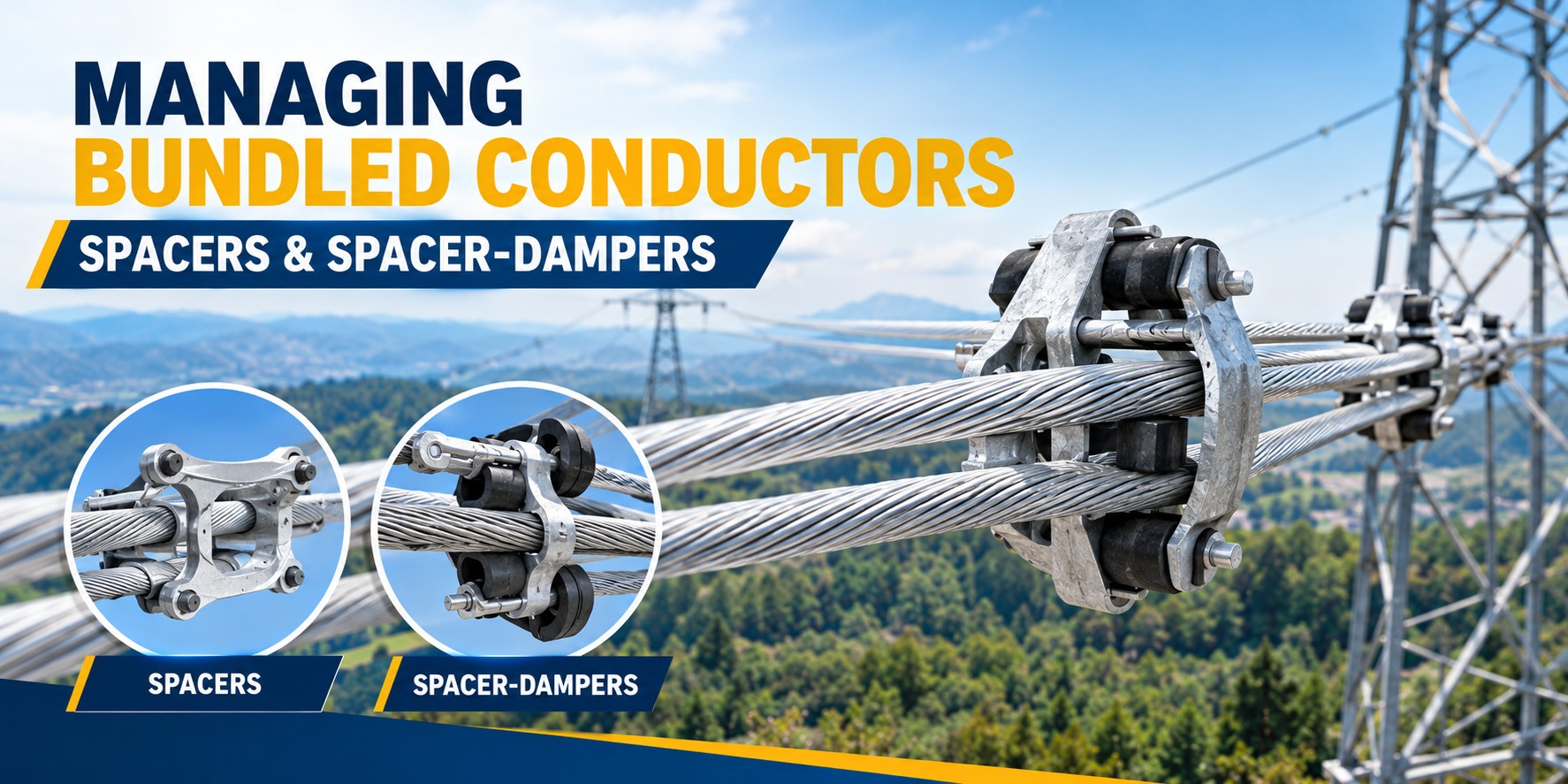
A spacer is a rigid fitting clamped to the sub-conductors at intervals, holding them at the designed spacing so they can’t clash or drift together. A bolted cable spacer is the basic version it maintains the geometry of the bundle. Spacers solve the spacing problem.
Spacer-dampers
A spacer-damper does both jobs: it holds the sub-conductors at the correct spacing and incorporates a damping mechanism (flexible/articulated arms or elastomer elements) that absorbs vibration and sub-span oscillation. So it maintains the bundle geometry while also protecting against the fatigue that vibration causes. On most bundled transmission lines, the spacer-damper is preferred because it handles spacing and vibration in a single fitting, reducing the number of separate devices needed.
How Do I Choose and Place Them?
- Bundle configuration the number of sub-conductors (twin, triple, quad) and their spacing set the spacer/spacer-damper type and geometry.
- Spacing along the span spacers/spacer-dampers are placed at intervals (sub-spans) along the span; the interval and count are an engineering calculation based on the span, conductor, tension, and vibration exposure.
- Spacer or spacer-damper for most bundled transmission lines with vibration exposure, spacer-dampers are standard; plain spacers may suffice in low-vibration situations or where separate dampers handle vibration.
Give your supplier the bundle configuration (number and spacing of sub-conductors), the span, conductor, and tension, and they’ll specify the spacer-damper type and the placement.
How This Relates to Single-Conductor Vibration
On a single conductor, aeolian vibration is controlled with dampers (Stockbridge or spiral) and armor rods at the supports (see our aeolian-vibration guide). On a bundle, the spacer-damper adds the sub-conductor spacing job and handles the bundle’s own oscillation modes a different tool for a different configuration. A bundled line may use both spacer-dampers along the span and conventional dampers/armor rods at the terminations, depending on the design.
Managing Bundled Conductors: FAQ
Why are transmission conductors bundled? Bundling several sub-conductors per phase increases current capacity, reduces corona (by behaving like a larger-diameter conductor), and lowers reactance all advantages on high-voltage transmission. The trade-off is that the bundle must be kept correctly spaced along the span.
What is a conductor spacer? A spacer is a rigid fitting clamped to the sub-conductors of a bundle at intervals, holding them at the designed spacing so they don’t clash or drift together. A bolted cable spacer maintains the bundle geometry.
What is a spacer-damper? A spacer-damper holds the sub-conductors at the correct spacing and also damps vibration and sub-span oscillation, using flexible or elastomer elements. It solves spacing and vibration in one fitting, which is why it’s standard on most bundled transmission lines.
What is the difference between a spacer and a spacer-damper? A spacer only maintains sub-conductor spacing; a spacer-damper maintains spacing and also damps vibration. For bundled lines with vibration exposure, spacer-dampers are preferred; plain spacers suit low-vibration cases or where separate dampers handle vibration.
How far apart are spacers placed? At intervals (sub-spans) along the span, with the interval and count set by an engineering calculation based on the span, conductor, tension, and vibration exposure. There’s no universal spacing give your supplier the details for a recommendation.
Do bundled conductors still need normal vibration dampers? They can spacer-dampers handle the bundle’s spacing and its oscillation modes along the span, but a design may still use conventional dampers or armor rods at terminations. It depends on the line; the spacer-damper is specifically the bundle-management fitting.
The Bottom Line
Bundled conductors give transmission lines more capacity, less corona, and lower reactance but the sub-conductors must be kept correctly spaced and their motion controlled. Spacers hold the spacing; spacer-dampers hold the spacing and damp vibration, which is why they’re the standard fitting on most bundled lines. Specify the type and placement by the bundle configuration, span, and exposure.
DAPENG Power (DP Power Fitting) manufactures bundle hardware spacer-dampers and bolted cable spacers along with the dampers and armor rods that protect conductors generally, all within the overhead line fittings range. Tell us your bundle configuration, span, conductor, and tension, and we’ll specify the spacer-dampers and placement.