

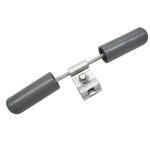
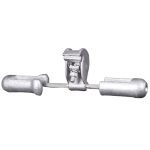
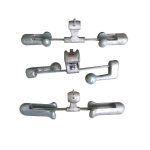
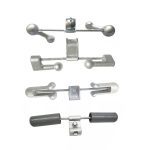
Description
Why Do Conductors Fail at the Clamp, and What Stops It?
The most expensive vibration on a transmission line is the one nobody can see. In a steady breeze of just 1-7 m/s, vortex shedding sets a conductor humming, vertical oscillations of a few millimeter’s at frequencies up to 100 Hz and beyond. Stand under the line, and you’d never notice. But at the mouth of every suspension clamp and tension fitting, those millions of daily bending cycles concentrate into metal fatigue: strands crack one by one, invisibly, until an inspection, or an outage, finds them.
This is Aeolian vibration, and the device engineered to defeat it has carried its inventor’s name since the 1920s: the Stockbridge vibration damper. If your line design, OPGW route, or maintenance program is asking how many dampers per span, what size, and where exactly do they go, this page answers all three, and our engineering team does the calculation with every order.
How a Stockbridge Damper Works
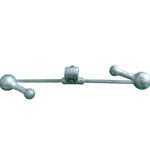
The design is elegantly simple and precisely tuned:
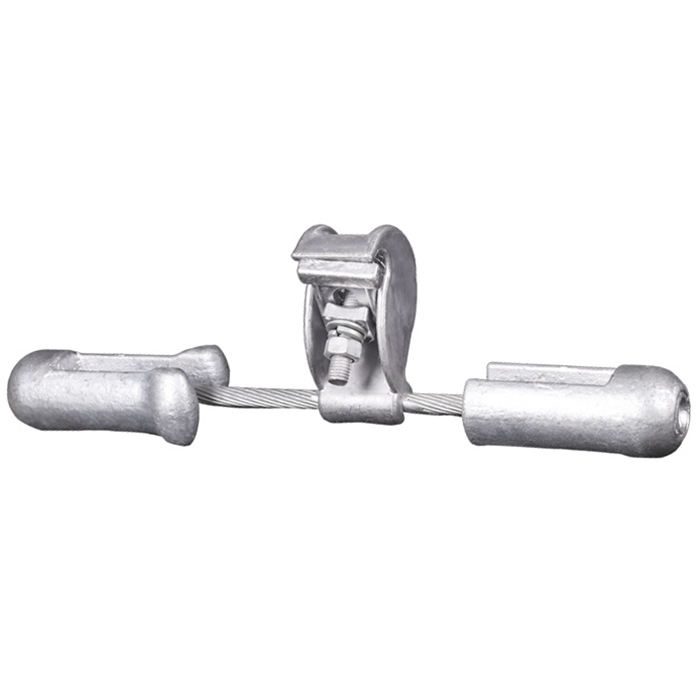
- A central clamp bolts the damper to the conductor, OPGW, or earth wire
- A short length of stranded steel messenger cable extends from each side of the clamp
- A shaped metal weight hangs at each end of the messenger
When the cable vibrates, the weights oscillate on the flexible messenger. The strands of the messenger cable flex and rub against one another, converting vibration energy into heat through inter-strand friction, draining the energy out of the span before it can accumulate into damaging bending at the clamps.
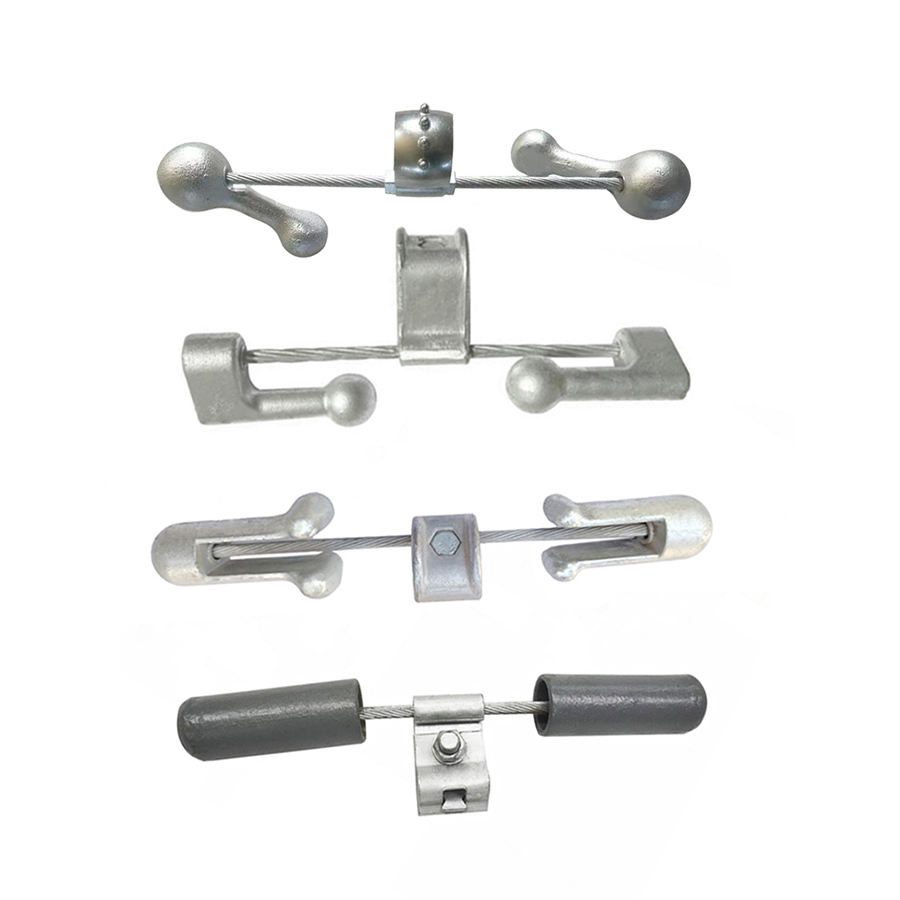
Modern 4R (four-resonance) designs take this further: asymmetric weights and messenger lengths give the damper four distinct resonant responses instead of two, covering a wider band of the Aeolian frequency range, which matters, because wind doesn’t excite a span at just one frequency. International requirements and testing for these devices are covered by IEC 61897, the standard for Aeolian vibration dampers on overhead lines.
One honest boundary, because it matters: Stockbridge dampers control Aeolian vibration, the small-amplitude, high-frequency kind. They are not a cure for galloping, the large, slow, ice-and-wind-driven oscillation controlled by different devices entirely. A supplier who promises you both from one damper is telling you something about their engineering. We won’t.
Why Buyers Choose DAPENG Stockbridge Dampers
- Sized to your cable, not “universal fit.” Damper mass and messenger response must match the cable’s diameter and tension to absorb energy where the span produces it. Send the cable datasheet and span data; every damper in the quotation is confirmed against it.
- The placement calculation ships with the dampers. A damper at the wrong position sits at a vibration node doing almost nothing. Our orders include the placement distances for your span/tension data, the detail that turns hardware into protection.
- Materials matched to the job. Corrosion-resistant aluminum alloy clamps that grip without gouging, galvanized steel messenger strand, and weights finished for decades of weather, with clamp liners appropriate to conductor, OPGW, or earth-wire surfaces.
- Batch-tested, with paper to prove it. Clamp slip, resonance response, and fastener integrity verified per production batch, reports supplied with shipment, aligned with IEC 61897 test practice.
- One factory for the whole span end. Dampers ship in the same order as the preformed tension clamps, suspension assemblies, and armor rods they protect, matched to the same cable, kitted per your structure schedule.
Use-Case Deep Dive
How many Stockbridge dampers does a span need, and where are they installed?
Both answers come from the same inputs: cable diameter, tension (as a percentage of rated strength), span length, and terrain exposure. As general practice: short, sheltered spans may need one damper per span end; typical transmission spans take one or more per end; long or exposed crossings (rivers, valleys, open flatland) step up further. Placement is close to the clamp, typically within roughly the first meter of the span end, at a distance calculated from the cable’s vibration wavelength, not at a fixed fraction of the span. Use the placement table supplied with your order rather than rules of thumb; the calculation is included, not extra.
Do OPGW and earth wires need dampers too?
They need them most. The OPGW and earth wire ride the topmost, most wind-exposed position on the tower, typically at higher relative tension than the phase conductors, the exact conditions that maximize Aeolian energy. Damping is effectively mandatory on OPGW routes: the same vibration that fatigues a conductor strand also works on the fiber-bearing core your communications ride on. OPGW damper orders are matched to the OPGW diameter and ship alongside the down lead clamps and suspension hardware of the same route.
Can Stockbridge dampers be used on ADSS cable?
Usually the better tool for ADSS is the spiral vibration damper, light, dielectric-friendly, and matched to smaller cable diameters. Stockbridge-type dampers for ADSS exist for special long-span or large-diameter cases, with clamps designed for the dielectric sheath. If your project mixes cable types, we’ll specify the right damper family for each. For the full comparison, see our engineering guide: Spiral Vibration Damper vs Stockbridge Damper . And if your line runs bundled conductors, the damping conversation starts with spacer dampers instead, a different device for a different configuration.
Specifications and What They Mean for You
| Specification | What we do | What it means for the buyer |
|---|---|---|
| Configurations | Standard twin-mass and 4R multi-resonance designs | Coverage matched to your span’s frequency range, not a one-size guess |
| Clamp | Aluminum alloy body, liner per cable surface, specified bolt torque | Grips for decades without damaging conductor, OPGW, or earth wire |
| Messenger | Stranded galvanized steel cable | The energy-absorbing heart of the device, built for millions of cycles |
| Weights | Corrosion-protected cast weights, asymmetric on 4R types | Tuned response that survives the weather it works in |
| Testing | Batch verification aligned with IEC 61897 practice; reports supplied | Your client’s spec review passes on documents, not promises |
| Engineering service | Sizing + placement calculation with every order | The dampers arrive with the plan that makes them effective |
Straight Answers to Common Buyer Concerns
“Dampers all look alike. How do I know these are tuned, not just shaped?” By the paper trail: resonance-response verification per batch, aligned with IEC 61897 test practice, supplied with the shipment, and third-party inspection (SGS/BV or your nominated agency) welcome at the factory before dispatch. A damper is a tuned instrument; we test it like one.
“What if I don’t have span/tension data for the calculation?” Send what you have, cable type and a line profile is enough to start, and our engineers will tell you exactly which missing number matters. Worst case, we specify conservatively and say so explicitly. What we won’t do is ship “universal” dampers and wish you luck.
“Retrofit project, can I add dampers to an existing line?” Yes, and it’s one of the highest-return maintenance investments a utility can make: hot-line or outage installation of correctly sized dampers on spans showing strand fatigue costs a fraction of one conductor repair. Send the cable details and the affected span list; retrofit orders are quoted with the same placement calculation as new construction.
Complete the Vibration Protection
- Spiral vibration dampers – for ADSS, guy strand, and small conductors
- Spacer dampers – for bundled conductor lines
- Armor rods – reinforcing the cable at the clamp the damper protects
- Browse all ADSS/OPGW fittings and overhead line fittings
Get a Sized-and-Placed Quote Within 24 Hours
Send your cable datasheet, tensions, and span schedule, or simply the conductor type and route description. Our engineers return a factory-direct quotation with damper sizes, quantities per span, and placement distances, typically within one working day. Damper production is scheduled with the clamp hardware of the same order, so the whole span end arrives together.
After You Order
Sizing confirmation before production, batch test reports with shipment, placement tables formatted for your crews, seaworthy export packing marked to your PO, and engineers who answer the follow-up email when the line crew asks why the distance matters. (They always ask. We always answer.)