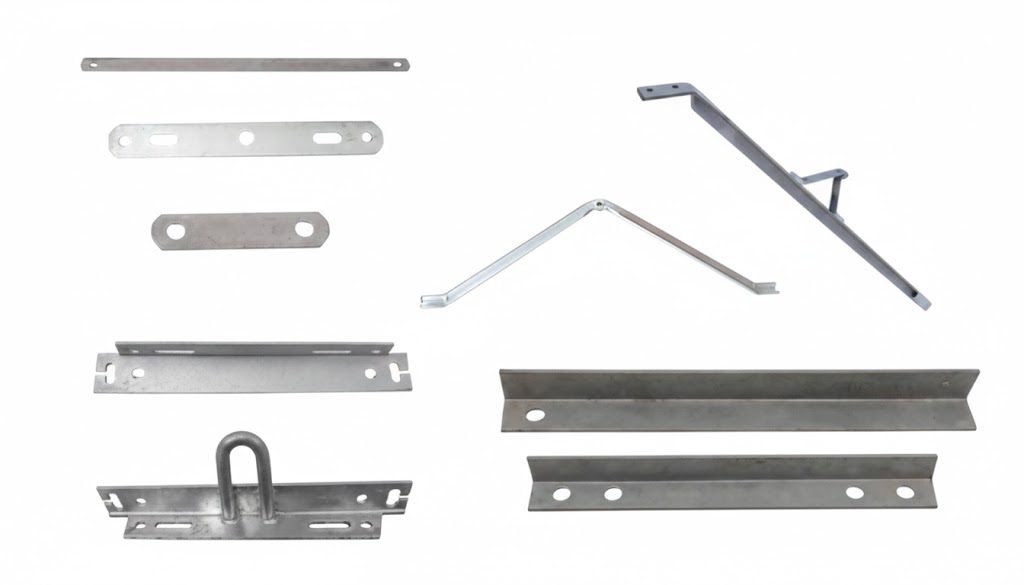
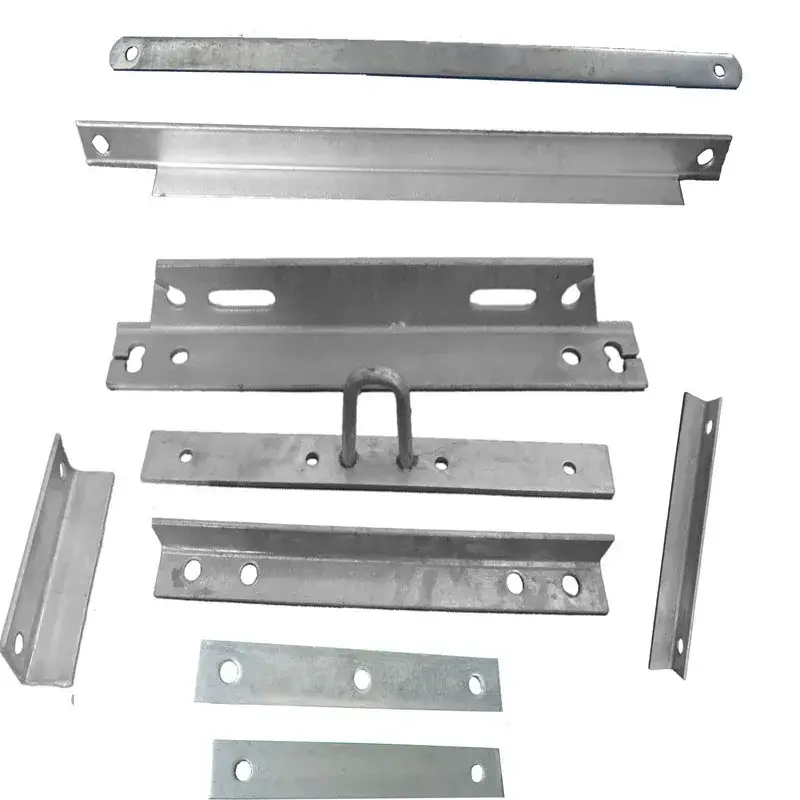
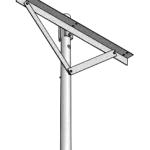
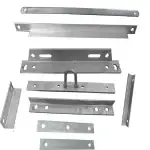
Description
The Arm That Carries the Line Out From the Pole
Every pole needs its conductors held out and apart, clear of the pole, clear of each other, at the spacing the design requires. The cross arm is what does it: the horizontal member bolted to the pole that carries the insulators and, through them, the line.
It’s a component that has to be strong (it holds the conductors’ weight and load), stable (it can’t sag, warp, or twist and change the spacing), and durable (it lives outdoors for the life of the pole). Wood has done the job for a century, but it rots, warps, splits, and burns. Steel cross arms answer all four, and this page covers them: why steel, which type for your line, and the sections we make.
Why Steel Over Wood or Composite?
The crossarm material is the first decision, and steel makes a strong case:
- Strength and consistency: A hot-dip galvanized steel angle carries its rated load without the variability of a timber baulk every arm is the same, and none has a hidden knot or shake waiting to fail.
- No rot, no warp, no split: Steel doesn’t absorb water, host insects, warp in the sun, or split at a bolt hole the failure modes that age a wooden crossarm and shift its conductor spacing over time.
- Fire resistance: In wildfire-exposed corridors a growing concern across many of your markets a steel crossarm doesn’t burn, a genuine and increasingly specified advantage over wood.
- Long service life, matched to the hardware: Galvanized to the same class as the bolts and fittings it carries, so the whole assembly ages together rather than the arm outliving or under-living its hardware.
Composite/fiberglass crossarms have their place (weight, dielectric properties), but steel remains the workhorse for strength, cost, and durability across distribution and sub-transmission. Tell us the application and we’ll be honest about where each fits.
Which Cross Arm Type Do You Need?
The type follows the structure and the job:
| Cross arm type | What it’s for |
|---|---|
| Power pole cross arm | Standard straight arm for distribution/sub-transmission poles |
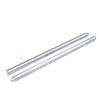
| Electrical cross arm | Angle-steel arm for conductor support (EC series) |
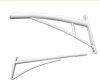
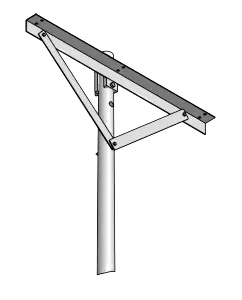
| V-type cross arm | V/braced configuration for added strength at angles and heavier loads |
| Alley arm | Offset arm where the line runs along a property line or alley |
| Street light arm | Arm/bracket carrying a luminaire |
| Flat crossarm brace | The brace that stiffens the arm to the pole |
Tell us the structure (straight run, angle, dead-end, alley, lighting) and the conductors it carries, and we’ll route you to the type the sections below cover the main ones.
Steel Sections We Make
Electrical cross arm (EC series):
| Type | Angle section (mm) |
|---|---|
| EC01 | 40 × 40 × 4 |
| EC02 | 50 × 50 × 5 |
| EC03 | 60 × 60 × 6 |
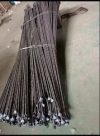
Steel angle crossarm (SA series):
| Type | Length (mm) | Angle section (mm) |
|---|---|---|
| SA11 | 508 | 65 × 65 × 6 |
| SA12 | 965 | 65 × 65 × 6 |
| SA13 | 508 | 50 × 50 × 4 |
| SA14 | 965 | 50 × 50 × 4 |
(V-type and alley-arm brackets are made in their own VA/AA series see the V-type and alley arm pages. Lengths and sections outside these are made to your drawing.)
Reading the sections: the angle size (e.g. 60×60×6) sets the arm’s strength larger and thicker angle carries more load over a longer arm. Match the section to your conductors’ weight, the arm length, and the loads at your structure; send those and we confirm the section, or build to your drawing.
Why Buyers Choose DAPENG Steel Cross Arms
- Hot-dip galvanized, made to your section: Galvanized to ISO 1461 class coatings, in the angle section your span and load need EC and SA series above, or to your drawing.
- Drilled to your hole pattern: Bolt holes for the insulator pins, brackets, and mounting your design specifies so the arm arrives ready to fit, not needing field drilling.
- Braced and complete: Supplied with the flat crossarm braces, double arming bolts, and mounting hardware that fit it a complete arm assembly, not just the angle.
- The whole structure from one factory: Cross arms with the pins, insulators, brackets, pole bands, and bolts they carry matched and kitted per structure.
Use-Case Deep Dive
How do I choose the crossarm section and length?
By the load and the geometry. The length is set by how far apart the conductors must sit (the spacing your design and voltage require) a wider line needs a longer arm. The section (angle size) is set by the load the arm carries: the conductors’ weight, wind and ice loading, and any unbalanced tension at angles. A short distribution arm carrying light conductors uses a modest section (the EC01/40×40×4 end); a longer arm or heavier load steps up to 50×50 or 60×60 and beyond. Send the conductor spacing, the conductors, and the structure type, and we confirm the length and section or build to your utility’s standard drawing.
Straight arm, V-type, or alley arm which?
By the structure. Straight arms (power pole / electrical) for standard poles on straight runs and light angles. V-type arms where the added bracing carries heavier loads or angle forces. Alley arms where the line must offset to one side along a property boundary, a road, or an alley rather than sit symmetric on the pole. At heavy angles and dead-ends, double-arm construction (two arms bolted through with a double arming bolt) is used. Tell us the structure and we route you.
Do steel crossarms come drilled and braced, or plain?
To your specification. We supply arms drilled to your hole pattern for the insulator pins, brackets, and mounting your design uses and with the braces and bolts that complete the assembly, so the arm fits on site without field drilling or sourcing braces separately. If you prefer plain stock to drill yourself, we supply that too; most buyers want the arm ready to bolt up.
Specifications and What They Mean for You
| Specification | What we supply | What it means for the buyer |
|---|---|---|
| Material | Hot-dip galvanized steel angle | No rot, warp, split, or fire risk; consistent strength |
| Sections | EC 40×40 to 60×60; SA 50×50 to 65×65 | Matched to your span and load |
| Lengths | SA 508–965mm; custom to drawing | The conductor spacing your design needs |
| Coating | HDG to ISO 1461 class | Ages with the hardware it carries |
| Drilling | To your hole pattern | Fits on site; no field drilling |
| Bracing | Braces and bolts supplied | Complete arm assembly |
Straight Answers to Common Buyer Concerns
“Why steel instead of the wood crossarms we’ve always used?” Three reasons buyers switch: steel doesn’t rot, warp, or split (so conductor spacing stays put and there’s no mid-life replacement cycle), it’s consistent (every arm carries its rated load, with no timber variability), and it’s fire-resistant (increasingly decisive in wildfire-exposed corridors). Wood is cheaper up front; steel usually wins on service life and reliability. Where you want the lightest or a dielectric arm, composite is worth discussing we’ll be honest about the trade-off rather than push one material.
“Can you drill and brace to our standard?” Yes send the hole pattern, section, and length (or the standard drawing), and the arms arrive drilled and braced to fit, so a crew bolts them up without field work. Matching a utility’s crossarm standard is routine export work, confirmed before production.
“Can you supply the arm complete with pins, insulators, and bolts?” That’s the advantage of one line-hardware source. The crossarm, its braces, the insulator pins and insulators, the brackets, and the mounting bolts come matched and kitted per structure one order, one delivery, everything fits.
Explore the Cross Arm Range
- Power pole cross arms and electrical cross arms straight arms
- V-type cross arms braced, for heavier loads and angles
- Alley arms offset arms
- Street light arms luminaire arms
- Flat crossarm braces the braces that stiffen the arm
Complete the Structure
- Insulator pins, pole top pins, insulators, insulator ties what the arm carries
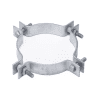
- D brackets, post insulator brackets, pole bands mounting hardware
- Square head machine bolts, double arming bolts, square washers the bolts that fix the arm
- Browse all pole line hardware and overhead line fittings
Get a Structure-Matched Quote Within 24 Hours
Send your conductor spacing, the conductors and loads, the structure type (straight, angle, dead-end, alley), and quantities or the crossarm standard drawing. Our engineers confirm the type, section, length, and drilling, and quote the arm complete with braces, pins, and mounting hardware, typically within one working day.
After You Order
Section, length, and drilling confirmation before production, galvanizing certificates with shipment, arms drilled and braced to fit and kitted with their pins and mounting hardware per structure, and an engineering contact who answers precisely because the crossarm sets the conductor geometry, and getting it right is what keeps the line where the design put it.