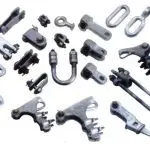
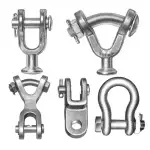
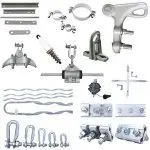
Description
Which Overhead Line Fittings Does Your Project Actually Need?
If you are preparing a bill of materials for a transmission or distribution line, you are probably staring at a drawing full of clamps, clevises, links, and plates, and asking the question every procurement engineer asks: which overhead line fittings do I need, in which combination, to which standard?
It is the right question, because overhead line fittings are never bought one piece at a time. They work as assemblies: a suspension clamp is only as reliable as the ball eye, socket clevis, and yoke plate it hangs from. Order them mismatched, wrong socket size, wrong standard, wrong galvanizing spec, and the delivery that arrives is a container of expensive rework.
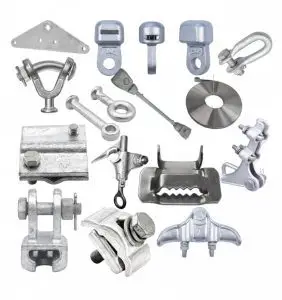
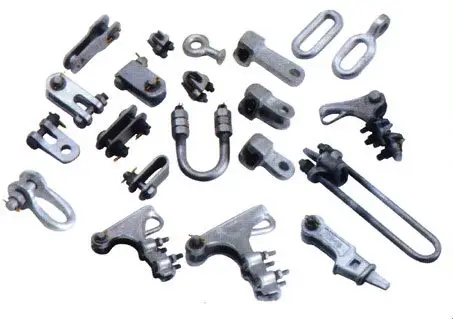
DAPENG Power manufactures the complete range of overhead line fittings, also called power line fittings, electric power fittings, or overhead line hardware, under one roof in Handan, China, and has supplied them to utility, EPC, and distributor customers across more than 30 countries. This page is both our catalog and your selection guide: what each fitting does, how the assemblies go together, and what to check before you order.
Why Buyers Choose DAPENG Overhead Line Fittings
- Strength you can put a number on. Every fitting is rated by breaking load and production batches are load-tested, because “high strength” means nothing on a datasheet until it becomes a tested figure on a test report you can show your client.
- Hot-dip galvanizing that outlives the project loan. Fittings are galvanized to international practice (ISO 1461 / ASTM A153 class coatings), giving the thick, metallurgically bonded zinc layer that survives decades of rain, salt air, and UV, not the thin flash of electro-plating that fails in a few seasons.
- Dimensional accuracy that shows up at installation. Forged and machined to drawing tolerances, so a socket clevis mates with its ball eye the first time, at the top of a pole, in the wind, where a linesman has no patience for filing parts to fit.
- Standards flexibility for export markets. Ball-and-socket couplings to IEC 60120 sizes, assemblies aligned with IEC 61284 type-test practice, and OEM manufacturing to your national standard or your own drawings.
- Factory-direct economics. No trading-company margin between your RFQ and our production line, and one supplier for the whole assembly, so nothing arrives mismatched.
The Complete Range, Organized by Function
Engineers do not think in alphabetical lists; they think in jobs. Here is the catalog the way your line design actually uses it.
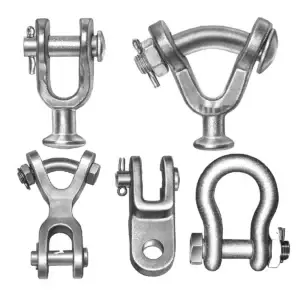
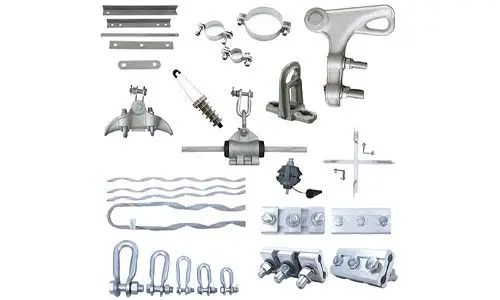
To suspend conductors (tangent structures): Suspension clamps cradle the conductor at every straight-line tower, holding it vertically while letting tension run through. They hang from insulator strings built with ball clevises, ball eyes, socket clevises, and socket eyes.
To terminate and tension conductors (angle and dead-end structures): Strain clamps and bolt type tension clamps anchor the conductor at dead ends and heavy angles, carrying the full line tension into the structure through the insulator assembly.
To connect and distribute loads: Yoke plates split one attachment into multiple insulator strings or conductor bundles; U shackles and clevis links complete the chain between tower, insulators, and clamps. Every coupling in the chain must match in size and rating, which is exactly why buying the chain from one manufacturer matters.
To make electrical connections: Parallel groove clamps join conductors and taps; hot line clamps provide connections that crews can make and break with live-line tools; crossover clamps manage conductor crossings and jumpers.
To protect the line: Spacer dampers hold bundled conductors apart while absorbing wind-induced vibration; Stockbridge vibration dampers and spiral vibration dampers protect conductors, earth wires, and cables from Aeolian vibration fatigue at the clamps.
To band and mount on poles: Stainless steel banding straps and banding buckles fix equipment, signs, and hardware to poles of any diameter without drilling.
Ball hooks, additional clevis patterns, and guy attachment clips are also manufactured to order as part of complete assembly sets.
Use-Case Deep Dive: Three Projects, Three Fitting Strategies
Which overhead line fittings do I need for a distribution line project?
For a typical 11-33 kV pole line: suspension clamps at tangent poles, strain or bolt-type tension clamps at dead ends and angles, parallel groove and hot line clamps for taps and connections, banding straps for pole-mounted equipment, and vibration dampers on exposed spans. Distribution projects live or die on delivery completeness, a missing box of clevises stops a whole crew, so we ship fittings kitted per your structure schedule when requested, not just per product line.
What fittings make up a complete insulator string assembly?
A standard suspension assembly runs: tower attachment (U shackle or strap) → ball eye → insulator string → socket clevis → suspension clamp → conductor. A tension assembly replaces the suspension clamp with a strain clamp and often adds a yoke plate where multiple strings or bundled conductors share the load. The critical check is coupling compatibility: ball-and-socket sizes to IEC 60120 (16 mm and 20 mm being the common sizes) must match between the insulator and the metal fittings. Send us your insulator datasheet and we match every coupling before production, this single check prevents the most common assembly error in imported hardware.
Can DAPENG supply overhead line fittings to my country’s standards?
Yes, this is our core export business. We manufacture to international practice (IEC 61284 for fittings requirements and tests, IEC 60120 couplings, hot-dip galvanizing to ISO 1461/ASTM A153) and to national variants across Africa, Latin America, the Middle East, and Southeast Asia. If your utility works to its own specification or legacy drawings, our engineering team manufactures OEM to your documents, dimensions, markings, packing lists, and test documentation included. Projects we have supplied in South Africa, Chile, the Philippines, Saudi Arabia, and Mexico each shipped to different standards; that flexibility is the product as much as the steel is.
Materials & Specifications – and What They Mean for You
| Specification | What we do | What it means for the buyer |
|---|---|---|
| Body materials | Forged carbon steel, malleable/ductile iron, aluminum alloy per product | The right material for each load path, forged steel where tension lives, aluminum where conductor contact matters |
| Corrosion protection | Hot-dip galvanized, ISO 1461 / ASTM A153 class coating thickness | Decades of outdoor service; coating thickness verifiable with a gauge at your incoming inspection |
| Mechanical rating | Rated breaking load marked per product; batch load testing | Your safety factors are calculated on tested numbers, not catalog optimism |
| Couplings | Ball-and-socket to IEC 60120 sizes; clevis-pin to drawing | Fittings mate with your insulators, first time |
| Testing & documentation | Batch test reports; type-test alignment with IEC 61284 practice; certificates supplied with shipment | Paperwork that satisfies your client’s inspector, not just your warehouse |
| Packing | Seaworthy export packing, marked per your PO; kitting available | Clears port handling intact and arrives sorted the way your site needs it |
Straight Answers to the Three Questions Every Importer Asks
“How do I know the quality is real before the container arrives?” You inspect it, and we make that easy. Batch test reports ship with every order, third-party inspection (SGS/BV or your nominated agency) is welcome at our factory before dispatch, and samples are available before you commit to production quantities. We would rather pass your inspection at the factory gate than argue about it at yours.
“Is a factory-direct order actually cheaper once freight and risk are counted?” For container-quantity orders, yes, removing the trading-company margin typically outweighs freight, and single-source assemblies eliminate the hidden cost that hurts most: mismatched components from multiple vendors. For smaller trial orders, we quote honestly, including the freight math, so you can compare landed cost line by line.
“What if something is wrong when it arrives?” Then we fix it. Claims supported by photos and the packing list are resolved with replacement parts or credit, and because every batch is traceable to its test report, disputes are short. Our repeat customers in 30+ countries are repeat customers for exactly this reason.
Related Resources
- Browse the complete pole line hardware range for pole-mounted construction hardware
- Building fiber on your network? See our ADSS/OPGW fittings for optical cable hardware
- Match your assemblies with compatible insulators pin, post, suspension, and stay types
Get Your Quotation Within 24 Hours
Send us your bill of materials, drawings, or even a photo of the fittings you need replaced. Our engineering team will confirm specifications, flag any compatibility issues in your assembly list, and return a factory-direct quotation, typically within one working day. Production slots for container orders are scheduled on confirmation, so early inquiries secure earlier delivery.
After You Order
Confirmation drawings before production, progress updates during manufacturing, pre-shipment inspection access, complete export documentation (invoice, packing list, certificates, test reports), and support that stays reachable after the container lands, because the goal isn’t one shipment, it’s being the fittings supplier your projects stop worrying about.