
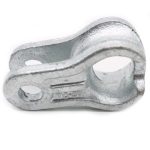
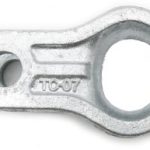
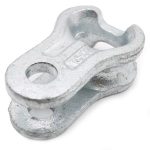
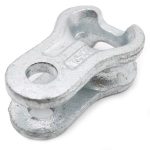
Description
What Connects a Guy Wire Loop to the Hardware Without Destroying It?
Here is a failure mode every experienced lineman has seen: a wire loop bent tight over a plain pin or sharp-edged fitting. Under tension and vibration, the strand kinks at the bend, individual wires work-harden and crack, and a connection rated for tonnes quietly loses strength season after season, invisible until it lets go.
The fix costs almost nothing and has a name: the thimble clevis. If you are specifying stay assemblies, guy dead-ends, or insulator string hardware and asking how do I terminate a wire loop safely at a clevis connection, this is the fitting your drawing is pointing at.
What a Thimble Clevis Is, Precisely
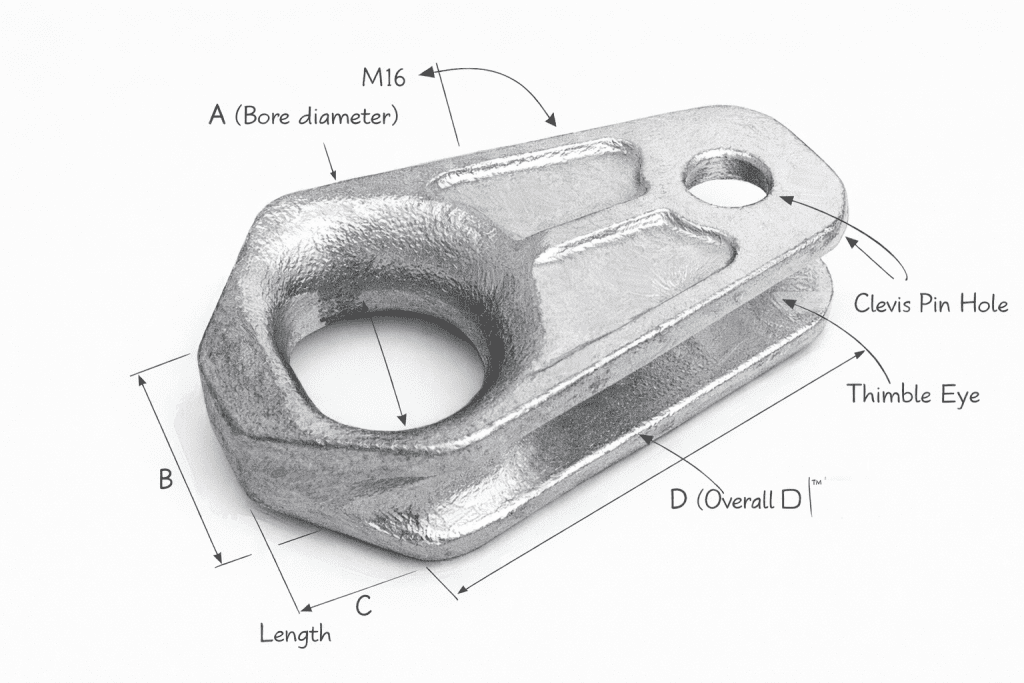
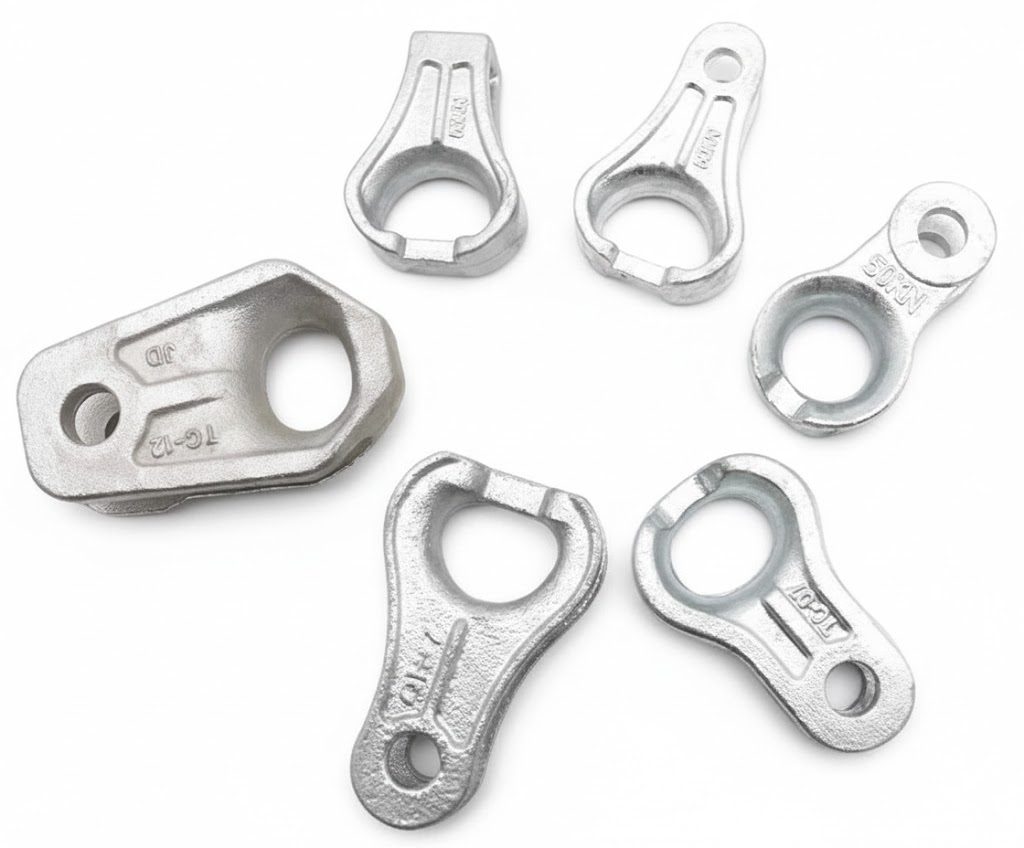
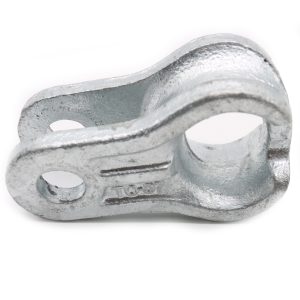
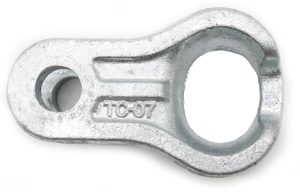
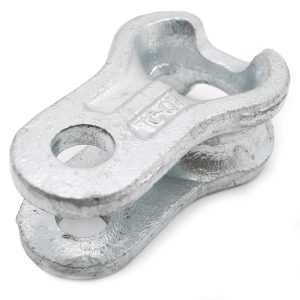
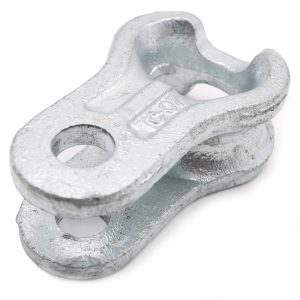
A thimble clevis is a forged connecting fitting with two working ends:
- A clevis coupling, the U-shaped jaw closed by a removable bolt or pin, which connects to tongue-type fittings, eye fittings, yoke plates, or structure attachments.
- A thimble seat, a smoothly grooved, teardrop-profile saddle over which a wire or strand loop lies. The groove supports the loop across a broad, gentle radius instead of a sharp bend, spreading contact stress and protecting every individual wire in the strand.
That grooved seat is the whole point. It does the same job as a separate galvanized thimble dropped into a wire eye, but built into the clevis body as one forged piece: one component fewer to order, stock, and assemble, and no loose thimble to fall from a linesman’s hand at the top of a pole.
Why Buyers Choose DAPENG Thimble Clevises
- Forged, not fabricated. One-piece forged steel bodies with no welds in the load path, the strength is in the grain of the steel, not in a seam.
- A groove that actually fits the wire. The thimble radius is sized to the strand it will carry; a groove too small pinches the loop, too large lets it flatten. Tell us the wire size and the seat arrives matched.
- Galvanizing you can measure. Hot-dip galvanized to ISO 1461 / ASTM A153 class coatings, decades of outdoor service, verifiable with a coating gauge at your incoming inspection.
- Pins that fit the rest of your chain. Clevis jaw openings and pin diameters manufactured to match your existing tongue fittings and standards, so the coupling closes without site modification.
- Rated loads on paper, not in adjectives. Every size carries its rated breaking load, and batches are load-tested with reports supplied, your safety factor calculates from a tested number.
Where the Thimble Clevis Works: Two Assemblies
How is a thimble clevis used in a guy or stay assembly?
This is its most common home. In a typical stay dead-end: the guy wire is terminated with a preformed guy grip, and the grip’s loop seats over the thimble groove of the clevis; the clevis pin then couples to the stay rod eye at the ground end, or to the pole attachment at the top. The thimble seat protects the grip loop, the assembly’s most vulnerable point, from the sharp-radius bending that fatigues strand. The same logic applies with conductor dead end grips on light constructions.
Can I use a thimble clevis in an insulator string assembly?
Yes, wherever a string built on clevis-tongue couplings must receive a wire or strand loop. It appears in stay insulator assemblies (connecting guy strain insulators into the stay), in light suspension arrangements, and in jumper and downlead terminations. Note the coupling families: clevis-tongue systems (this fitting) and ball-and-socket systems (ball clevis, socket clevis, ball eye, socket eye) are different, non-interchangeable standards, your insulator’s end fittings decide which family the drawing needs. Send the insulator datasheet with your RFQ and we confirm the match before production.
How do I select the right thimble clevis size?
Three checks, in order:
- Wire/loop size, the thimble groove must match the strand diameter (or the grip loop that will seat on it).
- Pin diameter and jaw opening, must mate with the tongue or eye fitting on the other side of the coupling.
- Rated load, the clevis rating must meet or exceed the rated strength of the wire it terminates, with your standard’s safety factor. The fitting should never be the weakest link, especially not at a stay dead-end you will not inspect again for years.
If any of the three is unknown, send what you have (even a photo of the fitting being replaced); matching legacy hardware is routine work for our engineering team.
Specifications and What They Mean for You
| Specification | What we do | What it means for the buyer |
|---|---|---|
| Body | One-piece forged carbon steel | Full-section strength; no welds to open under tension |
| Coating | Hot-dip galvanized, ISO 1461 / ASTM A153 class | Decades outdoors; coating thickness checkable on arrival |
| Thimble seat | Grooved radius sized to strand/loop diameter | Protects the loop from kinking, the failure the fitting exists to prevent |
| Coupling | Clevis jaw + bolt/pin to standard or drawing dimensions | Mates with your existing tongue fittings, first time |
| Ratings | Marked rated load per size; batch load testing | Safety factors on tested numbers, with reports supplied |
| Customization | OEM to utility drawings; imperial and metric sizes | Passes your inspector’s dimension check, not just ours |
Straight Answers to Common Buyer Concerns
“It’s a small fitting, does the quality really matter?” More than on almost any other component, because of where it sits: at dead-ends and stay terminations that carry full design tension and get inspected least. A failed suspension clamp announces itself; a fatigued stay connection fails in a storm. Small fitting, structural consequence, which is why ours are forged, batch-tested, and galvanized to a measurable class.
“How do I know it will fit my existing hardware?” Because matching is part of the quotation, not your risk. Pin diameters, jaw openings, and groove sizes are confirmed against your drawings or samples before production. If your network runs a legacy or national-standard pattern, we manufacture to it, that is the majority of our export work, not the exception.
“Minimum order too high for a fitting this small?” Thimble clevises usually ship as part of complete stay or string assemblies, with the grips, thimbles, rods, and shackles of the same order, where quantities take care of themselves. For standalone or trial quantities, tell us the project size and we quote honestly, including the freight math.
Complete the Connection
- Galvanized thimbles – the separate-thimble alternative for eye terminations
- Guy grips and guy wire – the loop the thimble seat protects
- Stay rods – the anchor end of the same assembly
- Browse all overhead line fittings – clevises, eyes, links, and clamps from one factory
Get a Matched Quote Within 24 Hours
Send your assembly drawing, wire sizes, or a photo of the hardware you are replacing. Our engineers confirm groove, pin, and rating compatibility and return a factory-direct quotation, typically within one working day. Fittings ship kitted with their assemblies on request, sorted the way your stores and crews need them.
After You Order
Dimension-confirmation before production, batch load-test reports and galvanizing certificates with shipment, export packing marked to your PO, and an engineering inbox that stays open afterward, because the next pole schedule always comes, and suppliers who answered last time get the RFQ first.