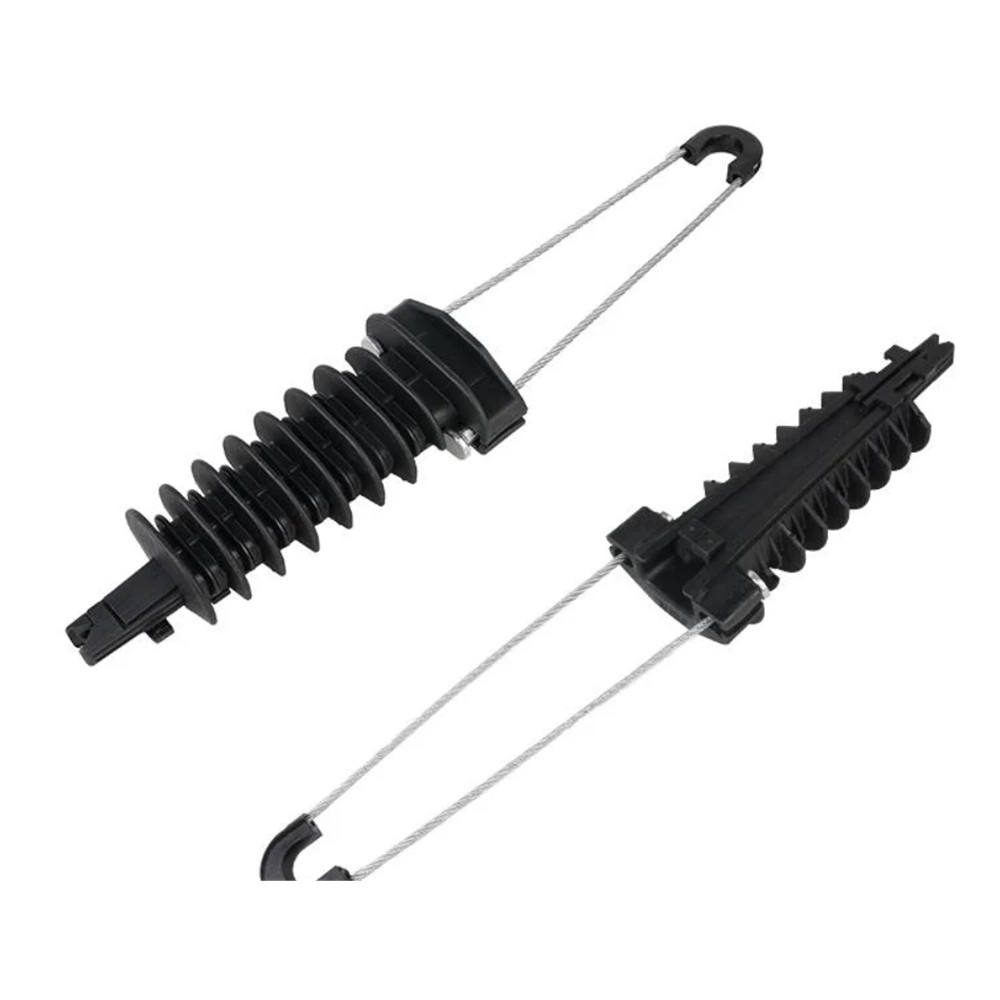
Description
Which Anchoring Clamp Matches Your Cable, and Will It Hold the Span?
An anchoring clamp does the least forgiving job on any aerial network: it takes the entire tension of a span and hands it to a structure. Everything else on the route- the suspensions, the spacers, the drops- deals with a fraction of the load. The anchor deals with all of it, in wind, at temperature extremes, for the life of the plant.
Which makes the specification question sharper than it looks. Which clamp fits this cable, and is its breaking load actually above my span tension with the safety factor my standard demands? Most supplier pages answer the first half and hide the second in a PDF.
Below is the full selection data, cross-sections, messenger diameters, cable diameters, and breaking loads, published openly, plus the mechanism that lets a small clamp hold a span for decades without damaging what it grips.
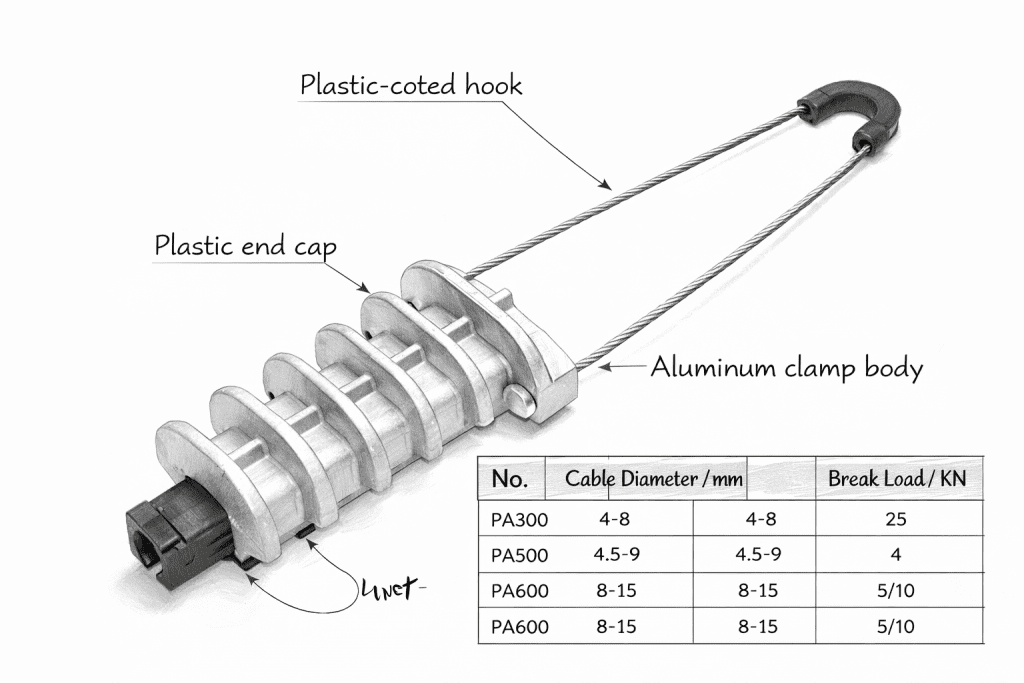
How a Wedge Anchoring Clamp Works
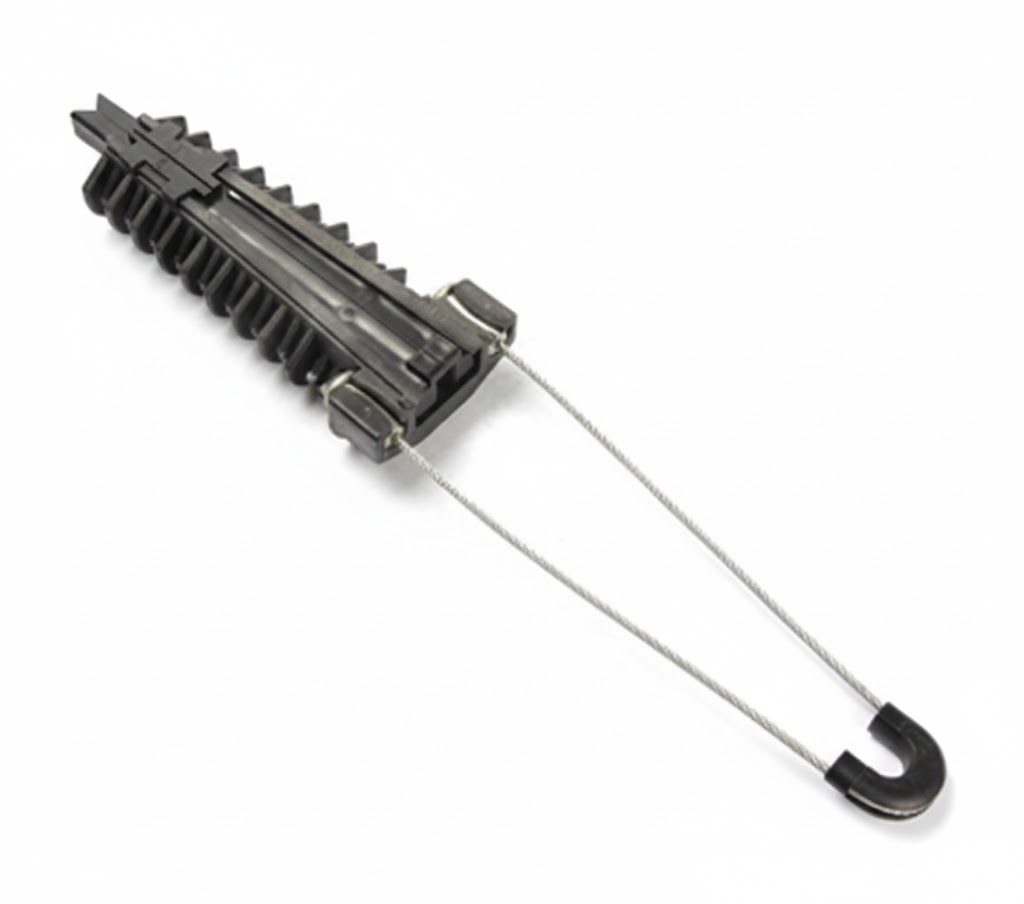
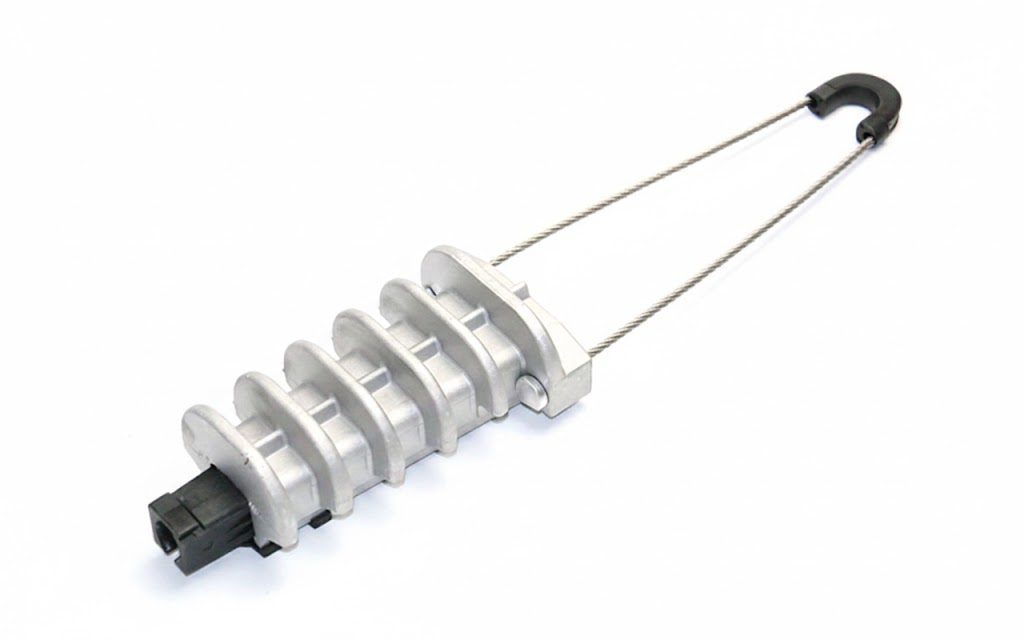
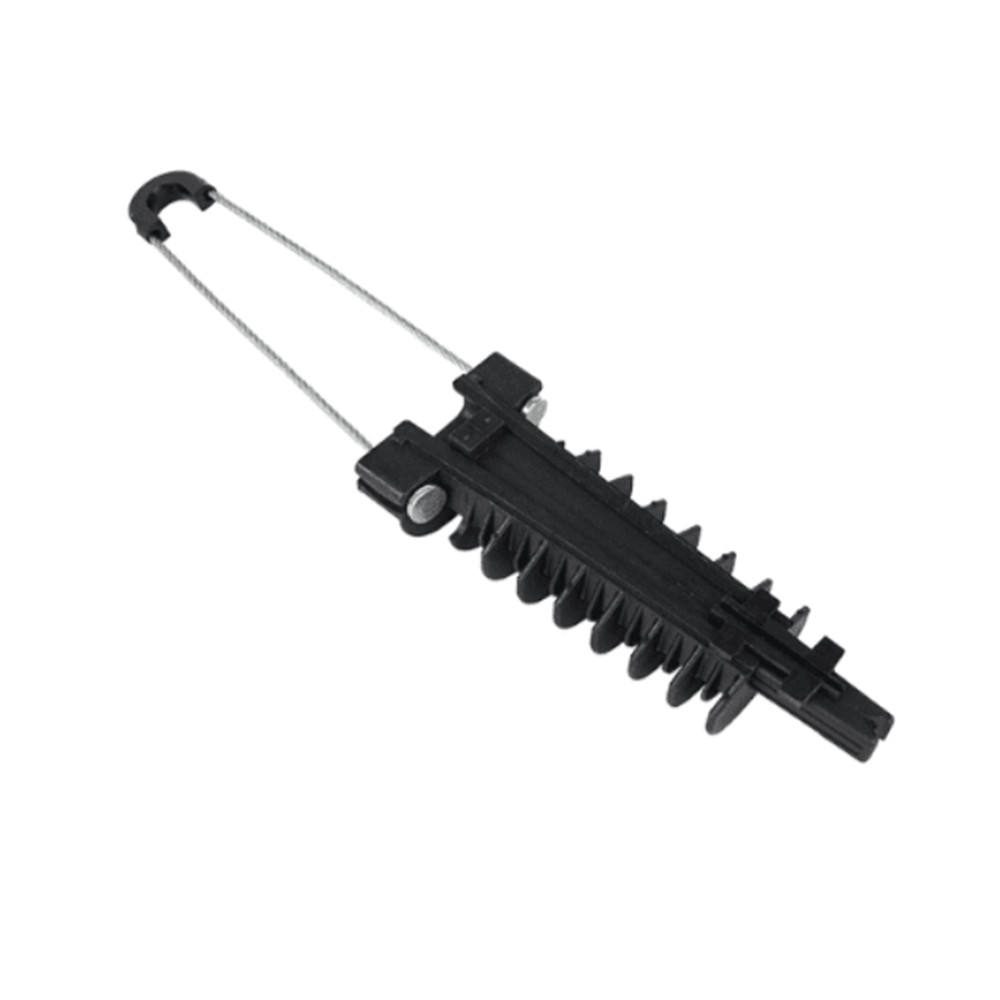
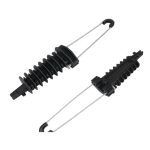
Inside the clamp body, the cable is held between shaped wedges seated in a tapered channel. The bail, the loop or hook that attaches to the pole bracket, wall anchor, or structure fitting, pulls on the wedge system rather than on the body.
When the span pulls, it draws the wedges deeper into the taper. The taper converts that pull into clamping force, distributed across the wedges’ full contact length. Three consequences that matter on site:
- More tension produces more grip. A gale tightens the hold instead of testing it.
- Force is spread, never concentrated. The sheath sees moderate pressure over a length, critical on dielectric ADSS jackets and on insulated ABC bundles, where a point clamp starts a failure that shows up years later.
- Correct installation is geometric, not procedural. No torque wrench, no spec for a tired crew to miss at the fortieth pole: seat the cable, load the wedge, hang the bail. The physics finishes the job.
It is the same design logic as the shear-head bolt on our insulation piercing connectors and the wedge grip on our drop wire clamps: on hardware installed thousands of times by many hands, correctness has to live in the product.
Selection Tables
PAL Series, Bundled Cable with Messenger
(Selection by conductor cross-section and messenger/bearer diameter.)
| Type | Cross-section (mm²) | Messenger diameter (mm) | Breaking load (kN) |
|---|---|---|---|
| PAL 1000A | 10 – 35 | 5 – 9.8 | 10 |
| PAL 1000 | 16 – 50 | 7 – 12 | 12 |
| PAL 1500 | 50 – 70 | 11 – 13 | 15 |
| PAL 2000 | 70 – 150 | 13 – 18 | 15 |
PA Series Fiber and Drop Cable
(Selection by overall cable diameter.)
| Type | Cable diameter (mm) | Breaking load (kN) |
|---|---|---|
| PA300 | 4 – 8 | 2.5 |
| PA500 | 4.5 – 9 | 4 |
| PA600 | 8 – 15 | 5 / 10 |
How to read these tables properly. Cable size gets you to the row; breaking load gets you to the right answer. Your span tension, multiplied by your standard’s safety factor, must sit below the clamp’s breaking load, and span tension rises with span length, sag specification, and ice loading, not with cable diameter alone. A 12 mm cable on a short courtyard span and the same cable on a 60-metre exposed crossing are two different selections. Send the span schedule with the cable spec and we confirm both dimensions of the choice in writing.
Why Buyers Choose DAPENG Anchoring Clamps
- Published data, not “contact us for details.” The tables above are our actual range. You can specify from this page without an email round-trip, and when you do write, you are confirming a choice rather than starting one.
- Sheath-safe by geometry. Wedge profiles and channel radii matched to the cable so that dielectric jackets and insulated bundles are held, not crushed, the difference between a span that lasts and an attenuation fault at year six.
- Built for the weather, not the warehouse. Aluminum alloy and corrosion-resistant metalwork with UV-stabilized polymer components, specified for permanent outdoor service on poles and building faces.
- Rollout-scale supply. Network builds consume anchoring clamps by the thousand: batch load testing with reports supplied, cartons counted and marked for crew-level stock draws, production batched to your activation calendar.
- The whole terminal structure, one factory. Anchoring clamps ship with the pole bands, banding straps and buckles that mount them, the suspension hardware of the tangent poles, and the connectors or closures at the same structure, one order, one compatibility review, one container.
Use-Case Deep Dive
Should I use a wedge anchoring clamp, a preformed dead end, or a bolted tension clamp?
Three families, three jobs, and the distinction is worth two minutes because getting it wrong is expensive.
Wedge anchoring clamps (this page) are the standard for terminating insulated and jacketed aerial cable, ABC bundles, ADSS, drop and figure-8 cable, at poles, walls, and section points. Fast, tool-free, sheath-safe, and self-tightening.
Preformed tension clamps are the standard for OPGW and bare stranded cable at transmission strain structures, where helical rods develop the cable’s rated strength across meters of contact.
Bolted tension clamps and strain clamps are the standard for bare conductors on distribution and transmission dead ends, our pistol-grip NLL range covers conductors from 5.0 mm to 23.0 mm with rated failure loads from 40 kN to 90 kN.
Mixed networks order from more than one family; send the route description and the split comes back with the quotation.
Which anchoring clamp do I need for an ADSS span?
Start with the PA table above for standard fiber and drop cable, matching overall cable diameter, then check the breaking load against your span tension. Longer or more exposed ADSS spans move you up the range, and past a certain tension the route wants preformed tension clamps at terminals instead, a judgement we make from your span data, not from the cable diameter alone.
Specify the rest of the span with it: armor grip or suspension hardware at tangent poles, spiral vibration dampers on exposed spans, down lead clamps at splice structures, and a junction box or closure where the fiber terminates.
Can the same clamp anchor a bundle at both the pole and the building?
Yes, anchoring at both ends of a span is the standard arrangement, with the clamp bailed to whatever the structure offers: a pole bracket or band at the network end, a wall hook or eye at the building end. Where service drops leave the span rather than terminating it, the hardware changes: span clamps grip the messenger mid-span and drop wire clamps anchor the drop itself. Order the mix by structure type and the cartons arrive marked accordingly.
Specifications and What They Mean for You
| Specification | What we supply | What it means for the buyer |
|---|---|---|
| Mechanism | Self-tightening wedge, bail-loaded | Grip grows with span tension; no torque spec to get wrong |
| Range | PAL 10-150 mm² / 5-18 mm messenger; PA 4-15 mm cable | Published above, specify from the page, confirm at RFQ |
| Breaking loads | 2.5, 4, 5/10, 10, 12, 15 kN across the range | Match to span tension × your safety factor, not to cable size |
| Materials | Aluminum alloy and corrosion-resistant metalwork; UV-stable polymer components | Permanent outdoor service on poles and building faces |
| Cable protection | Wedge profiles matched to jacket and bundle types | Held, not crushed, sheath integrity for the plant’s life |
| Verification | Batch load testing, reports supplied | Safety factors calculated on tested numbers |
Straight Answers to Common Buyer Concerns
“The breaking loads look modest. Will they really hold my spans?” Compare them to your actual span tension rather than to intuition: aerial distribution and fiber spans commonly run tensions well within these ratings, which is exactly why the range is built this way. What matters is doing the arithmetic, tension × safety factor against the clamp’s breaking load, and that is a calculation we will run with you from the span schedule. Where the numbers say a heavier family is needed, we quote the heavier family.
“How do we QC an order of tens of thousands of clamps?” Batch by batch, and sample by sample: load testing per production batch with reports supplied, material verification, third-party pre-shipment inspection (SGS/BV or your nominated agency) welcome at the factory, and samples for your own pull-testing before the programmed order. Fifty units on your test bench are worth more than any assurance in an email.
“Our network runs several cable types from different eras. Can one supplier cover them all?” That is a table lookup, not a problem. Send the cable datasheets, or sample lengths of the legacy ones, and the quotation returns with a clamp type per cable, distinctly marked cartons, and a one-page crew card showing which clamp belongs on which cable. Mixed plant is normal; mismatched hardware is optional.
Complete the Structure
- Suspension clamps and armor grip suspension – tangent-pole support between anchors
- Preformed tension clamps, bolt type tension clamps, strain clamps – the other dead-end families
- Span clamps and drop wire clamps – service drops off the anchored span
- Pole bands, banding straps and buckles – mounting to any pole
- Browse all ADSS/OPGW fittings and overhead line fittings
Get a Span-Matched Quote Within 24 Hours
Send your cable datasheets, span lengths, and structure counts, or simply the network standard you build to. Our engineers confirm the clamp type per cable, check the breaking load against your span tensions, and return a factory-direct quotation, typically within one working day, with the mounting and drop hardware quoted alongside if you want the structure as one kit.
After You Order
Type-confirmation sheet before production, batch load-test reports with every shipment, cartons marked by cable type for error-free store issue, and an engineering contact who answers while the crew is still on the pole, because network builds are measured in structures per day, and a hardware question shouldn’t cost an afternoon.