

Description
The Fitting at the Top of the String Carries Everything Below It
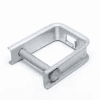
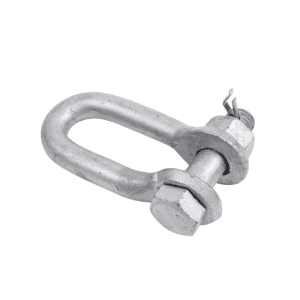
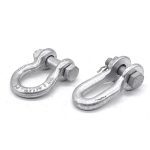
An insulator string is a chain, and chains have a rule: the assembly is only as strong as its weakest component. On a suspension or tension string, the U shackle is usually the topmost link, bolted through the crossarm plate, the tower attachment, or the yoke, with the whole string hanging beneath it: the insulators, the coupling fittings, the clamp, and the conductor’s share of the span.
Which makes an easy and expensive mistake possible. Specify 120 kN insulators, 120 kN coupling hardware, and a 70 kN shackle at the top, and you have not built a 120 kN string. You have built a 70 kN string with expensive components below it, and the limiting part is the one at the top of a tower, where nobody will notice until something proves it.
This page publishes the complete size and load data so the shackle is never the accidental weak link, and explains how to match it to both your string and your structure steel.
U Shackle Selection Table
(Hot dip galvanized. Dimensions in mm; rated failure load in kN. All figures from the Dapeng catalog – see the designation note in the pre-publish block above.)
| Type | C (mm) | M (mm) | d (mm) | h (mm) | R (mm) | Rated failure load (kN) | Weight (kg) |
|---|---|---|---|---|---|---|---|
| U-7 | 20 | 16 | 16 | 80 | 10 | 70 | 0.44 |
| U-10 | 22 | 18 | 18 | 85 | 11 | 100 | 0.54 |
| U-12 | 24 | 22 | 20 | 90 | 12 | 120 | 0.96 |
| U-16 | 26 | 24 | 22 | 95 | 13 | 130 | 1.47 |
| U-20 | 30 | 27 | 24 | 100 | 15 | 150 | 2.20 |
| U-25 | 34 | 30 | 26 | 110 | 17 | 170 | 2.79 |
Sizes outside this table are forged to your drawings – dimensions, pin type, and marking to your utility’s specification, with confirmation drawings issued before production.
How to Select a U Shackle in Three Checks
1. Rated failure load – match the string, don’t undercut it. The shackle’s rating must equal or exceed the rating of every other component in the string. Our coupling and link fittings run in matched load classes, so a coherent string is straightforward to build:
- Ball eyes – 70 kN to 420 kN, in designated coupling sizes 16, 20, 24 and 28 mm
- Socket clevises and socket eyes – 70 kN to 300 kN
- Yoke plates – 100 kN to 600 kN across the L-series
- Thimble clevises – for wire and strand terminations within the assembly
Quote the string’s design rating with your RFQ and every fitting comes back in the same class.
2. Jaw opening and pin diameter – match the structure and the fitting below. The C dimension is the jaw opening: it must clear the crossarm plate, tower attachment lug, or yoke it bolts through. The d dimension is the pin: it must pass the hole in that steel and accept the fitting hanging below. This is the check that stops installations, a shackle rated correctly but too narrow for a 20 mm gusset plate is a shackle that goes back in the box. Send the attachment detail or a dimensioned sketch and we confirm the fit before production.
3. Coupling compatibility below the shackle. Whatever hangs beneath, a ball eye into a ball-and-socket insulator string, a clevis-tongue fitting, or a yoke plate splitting the load into two strings, must mate with the shackle’s pin arrangement. Ball-and-socket and clevis-tongue are separate, non-interchangeable coupling families; your insulator’s end fittings decide which one the drawing needs. Send the insulator datasheet and we match the whole chain.
Why Buyers Choose DAPENG U Shackles
- Forged, with the strength in the grain. Hot-forged carbon steel bodies, no welds in the load path on a fitting where the whole string’s load passes through one bend of steel.
- Galvanizing you can measure. Hot-dip galvanized to ISO 1461 / ASTM A153 class coatings, so the coating on the fitting at the top of the tower is as verifiable as everything else on the order, check it with a gauge on arrival.
- Rated loads that are tested, not asserted. Batch load testing with reports supplied, so your safety factors are calculated from real numbers and your client’s inspector has paper to review.
- Pin security specified, not improvised. Bolt, nut and locking arrangement per your standard, because the one place you never want a fastener working loose is the point the entire string hangs from.
- The whole string from one factory. Shackles ship with the ball eyes, ball clevises, socket fittings, yoke plates, insulators and terminal clamps of the same assembly, matched in load class, kitted per structure, documented together.
Use-Case Deep Dive
Where exactly does the U shackle sit in a suspension assembly?
Top of the chain. A standard suspension string runs: tower attachment → U shackle → ball eye → insulator string → socket clevis → suspension clamp → conductor. On a tension assembly the terminal fitting changes to a strain clamp, bolt type tension clamp, or preformed tension clamp depending on the conductor. Where two strings or a bundled conductor share one attachment, a yoke plate sits between shackle and strings, and its 100–600 kN range becomes the component to match.
Send us the string drawing and every coupling in it is checked against the ones next to it before anything is manufactured.
Can I use a U shackle for guy and stay assemblies?
Yes, shackles serve wherever a load path needs a bolted, openable connection between structure steel and a fitting. In stay work they connect pole attachments and anchor hardware, usually alongside a thimble clevis where a wire loop enters the assembly, so the strand bears on a proper thimble radius rather than on a pin. The same three checks apply: rating above the stay’s rated strength, jaw clearing the steel, pin matching the fitting below.
What if my utility’s standard specifies a shackle we don’t see in the table?
Then we forge it to the standard. National utilities specify shackle geometry precisely, jaw, pin, bolt type, marking, and sometimes proof-load documentation, and manufacturing to a customer’s drawing is the majority of our export work rather than an exception. Send the specification page or a sample of the existing fitting, and you receive confirmation drawings before production begins. Matching legacy hardware on a network mid-life is routine; guessing at it is not.
Specifications and What They Mean for You
| Specification | What we supply | What it means for the buyer |
|---|---|---|
| Body | Hot-forged carbon steel, one piece | No weld in the load path at the string’s highest-stressed link |
| Coating | Hot-dip galvanized, ISO 1461 / ASTM A153 class | Decades at the top of the tower; thickness checkable on arrival |
| Sizes | U-7 to U-25 standard; custom to drawing | Published dimensions above, specify from this page |
| Rated failure loads | 70, 100, 120, 130, 150, 170 kN | Match or exceed every other fitting in the string |
| Pin and bolt | To standard or your drawing, with locking provision | The fastener at the top of the string stays where it was torqued |
| Verification | Batch load testing, reports with shipment | Safety factors calculated on tested numbers |
Straight Answers to Common Buyer Concerns
“How do we know a small forged fitting is really rated as marked?” By testing it before it ships and checking it when it lands: batch load-test reports accompany every order, coating thickness is measurable with a gauge at your goods-in, and third-party pre-shipment inspection (SGS/BV or your nominated agency) is welcome at the factory. On load-bearing string hardware we would rather your inspector confirmed the rating at our gate than your incident report questioned it later.
“Our string mixes fittings from several suppliers. Can you match into it?” Yes, and it’s worth doing carefully. Send the ratings and coupling details of the fittings the shackle will sit between, or samples, and we confirm the mating and the load class in writing. Mixed-supplier strings are common on networks built over decades; the risk isn’t the mixing, it’s the unchecked assumption that everything in the chain shares a rating.
“Is there a minimum order for a fitting this size?” Shackles normally ship as part of complete string assemblies, where quantities take care of themselves. For standalone or trial quantities, tell us the project size and we quote honestly, including the freight arithmetic, so you can compare landed cost line by line rather than guessing at it.
Complete the String
- Ball eyes, ball clevises, socket clevises, socket eyes – coupling fittings, 70-420 kN
- Yoke plates – 100-600 kN, where one attachment feeds multiple strings
- Thimble clevises – where wire or strand enters the assembly
- Insulators – pin, post, suspension and stay types
- Suspension clamps, strain clamps, bolt type tension clamps – terminal fittings
- Browse all overhead line fittings and pole line hardware
Get a String-Matched Quote Within 24 Hours
Send your string drawing, design rating, insulator datasheet, and attachment steel details, or simply a photo of the fitting you’re replacing with a tape measure in frame. Our engineers confirm the size, the rating class, and the fit to your structure, then return a factory-direct quotation, typically within one working day.
After You Order
Confirmation drawings before production, batch load-test reports and galvanizing certificates with shipment, fittings kitted per string so stores issue complete assemblies rather than loose parts, and engineering support that stays reachable afterwards, because the next tower schedule always comes, and the supplier who answered last time gets the RFQ first.