


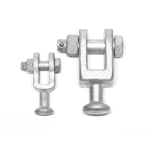
Description
The Ball Clevis Starts the String Where the Structure Offers a Tongue
An insulator string begins at the structure, and the fitting that starts it has to match two things at once: the structure’s attachment on one side, and the first insulator’s socket on the other.
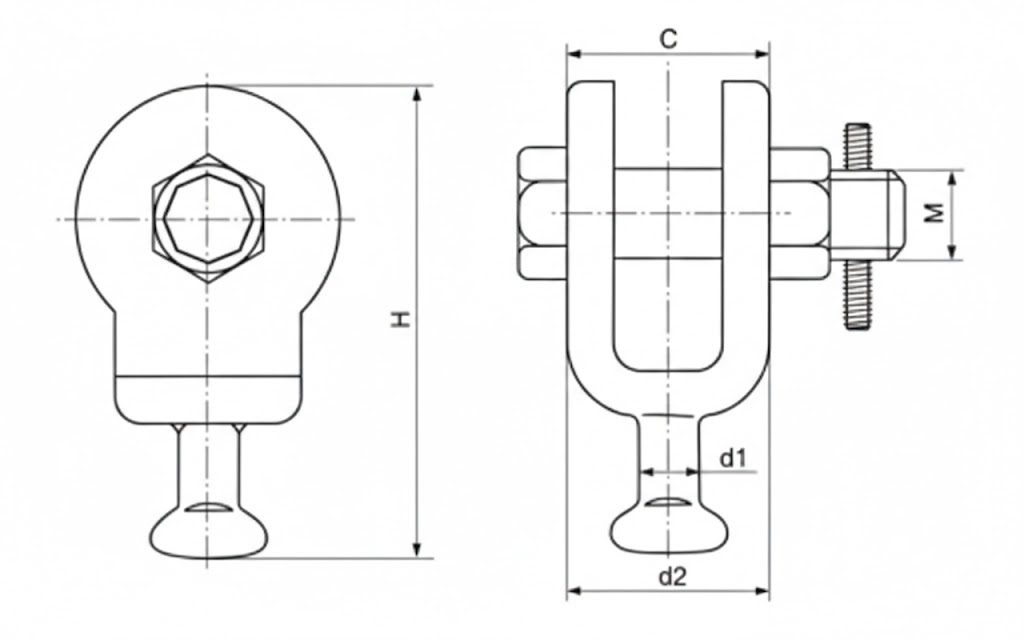
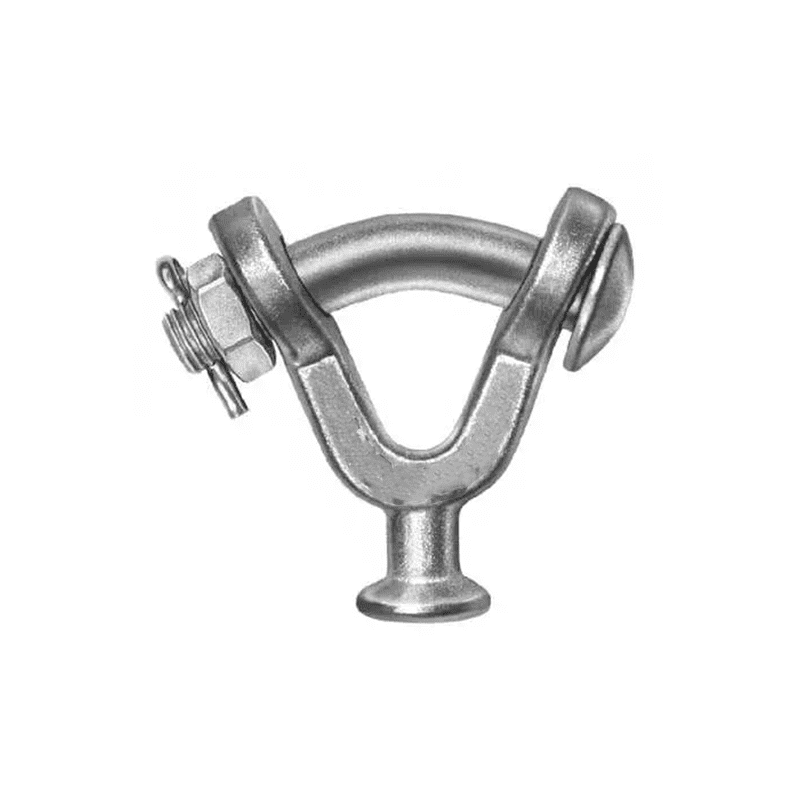
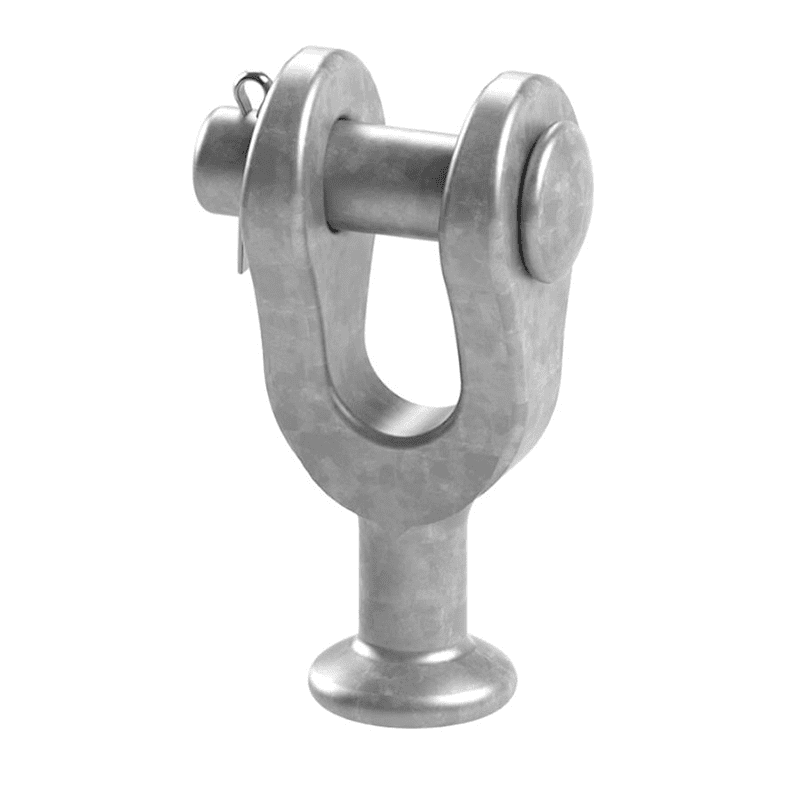
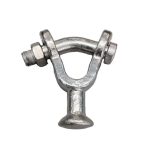
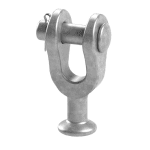
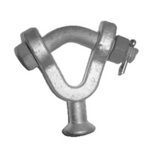
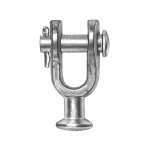
When the structure attachment is a tongue, a flat blade with a pin hole, as many crossarm plates, yoke plates, and tower fittings are, the fitting you need is the ball clevis: a clevis jaw and pin at the structure end to receive that tongue, and a ball at the other end to drop into the first insulator’s socket.
It is the tongue-attachment sibling of the ball eye, which does the same job where the structure offers an eye or pin instead. Same position in the string, same ball coupling to the insulator, different attachment, because the structure decides.
This page publishes the coupling sizes and rated loads, and settles the four-way “which fitting” question from the ball-and-clevis corner.
Ball Clevis, Ball Eye, Socket Clevis, Socket Eye – Which Fitting?
Four fittings, one logic. Each has a coupling end (ball or socket) and an attachment end (eye or clevis):
| Fitting | Coupling end | Attachment end | Use when |
|---|---|---|---|
| Ball clevis (this page) | Ball enters the insulator socket | Clevis jaw + pin | Structure end, attachment is tongue-type |
| Ball eye | Ball enters the insulator socket | Closed eye | Structure end, attachment is eye/pin-type |
| Socket clevis | Socket receives the insulator ball | Clevis jaw + pin | Conductor end, hardware below is tongue-type |
| Socket eye | Socket receives the insulator ball | Closed eye | Conductor end, hardware below is eye-type |
The rule: at the structure end you need a ball fitting (the first insulator presents a socket to receive it); choose clevis vs eye by whether the structure offers a tongue (→ clevis) or an eye/pin (→ eye). Read the ball/socket from the insulator, the eye/clevis from the hardware, and the fitting is decided. The two coupling families ball-and-socket and clevis-tongue never interchange, which is exactly why these adapter fittings exist.
Ball Clevis Selection Table
(Z-type, hot dip galvanized. Type, rated failure load and weight are catalog-verified; dimensions pending PDF verification – see note above.)
| Type | Rated failure load (kN) | Weight (kg) |
|---|---|---|
| Z-7 | 70 | 0.56 |
| Z-10 | 100 | 0.87 |
| Z-12 | 100 | 1.16 |
| Z-16 | 160 | 2.38 |
| Z-20 | 200 | 3.8 |
| Z-25 | 250 | 5.0 |
| Z-30 | 300 | 5.8 |
(Dimensional columns C1, C2, M, h to be published once verified against the original catalog PDF. Coupling designation to be confirmed per type. Sizes outside this range are forged to your drawings.)
Reading the table: the type number tracks the rated failure load class (Z-7 ≈ 70 kN, Z-30 ≈ 300 kN). As with every coupling fitting, two specifications must both be right: the ball’s coupling designation must match your insulator’s socket, and the rated load must meet your string’s design class. Specify both.
How to Select a Ball Clevis in Three Checks
1. Coupling designation from the insulator: The ball must match the socket on your insulator, to the IEC 60120 designation (16 mm and 20 mm the most common). Read it off the insulator datasheet; a ball a size out will not seat.
2. Rated failing load match the string, never undercut it: The string is rated at its weakest component, and this fitting sits at the top carrying all of it. Our matched-class range makes a coherent string straightforward:
- Ball clevis (Z-type) – 70 to 300 kN (table above)
- Ball eye -70 to 420 kN
- Socket eye / socket clevis – 70 to 300 kN
- U shackles – 70 to 170 kN
- Yoke plates – 100 to 600 kN
3. Clevis jaw and pin against the tongue it receives: The jaw opening must clear the structure tongue (or yoke plate blade), and the pin must pass the tongue’s hole. A ball clevis correctly rated but dimensioned for a thinner tongue is a fitting that won’t close on the steel it’s meant to grip, check it against the yoke plate or attachment it meets.
The Ball Clevis Has Two Retention Systems Specify Both
Like the socket clevis, a ball clevis carries two independent retention systems, and both must be right:
- The ball’s retaining clip the split pin or W-clip locking the ball into the first insulator’s socket. Fitted by hand at height; its correct seating is the same discipline covered on our socket eye page. Push the ball fully home, seat the clip, check every one, never improvise.
- The clevis pin the bolt or pin closing the jaw around the structure tongue, with its nut, cotter, or locking arrangement. It carries the full string load in shear at the top of the string. Specify the pin type and its locking provision, and order spares dropped pins and cotters are a routine field loss, and a few cents’ spares beats a crew idled for a missing part.
We supply the clip and the pin with the fitting, so the coupling arrives complete and nothing is improvised on the tower.
Why Buyers Choose DAPENG Ball Clevises
- Forged in one piece: Hot-forged carbon steel, no welds in the load path the whole string’s load passes through the ball neck and the clevis jaw.
- Ball and jaw machined to standard: The ball seats and articulates in the insulator socket; the jaw and pin mate cleanly with the structure tongue both confirmed against your drawing before production.
- Galvanizing you can measure: Hot-dip galvanized to ISO 1461 / ASTM A153 class, checkable with a gauge at goods-in, ball neck and jaw included.
- Rated loads that are tested: RFL marked per type, batch load-tested, reports supplied.
- The whole string from one factory: Ball clevises ship with the ball eyes, socket eyes, socket clevises, U shackles, yoke plates, insulators and terminal clamps of the same assembly matched in class, kitted per structure.
Use-Case Deep Dive
Where does a ball clevis sit in a suspension string?
At the top, when the structure attachment is tongue-type. A suspension assembly then runs: structure tongue → ball clevis → insulator string → socket clevis or socket eye → suspension clamp → conductor. The clevis jaw grips the tongue; the ball starts the insulator string. Where the structure offers an eye instead of a tongue, a ball eye does the same job. On twin-string arrangements, a yoke plate presents tongues to two ball clevises.
When do I choose a ball clevis over a ball eye?
Purely by the structure attachment. Both present a ball to the insulator; they differ only at the top. Tongue-type attachment (a blade with a pin hole common on yoke plates and many tower fittings) → ball clevis. Eye or pin attachment → ball eye. It is not a strength or preference choice; it is dictated by what the structure offers. Send the attachment detail and we confirm which and supply whichever your structures actually present, mixed across a line if needed.
Can you match a ball clevis into an existing string?
Yes, with the checks in writing: the ball coupling designation, the rated load class, and the tongue thickness and pin size of the structure attachment as figures, samples, or clear photographs with a rule in frame. We confirm mating and class before production. Mixed-supplier strings are normal; the unchecked coupling-size or rating assumption is the only real risk.
Specifications and What They Mean for You
| Specification | What we supply | What it means for the buyer |
|---|---|---|
| Body | Hot-forged carbon steel, one piece | No weld in the load path at the string’s top link |
| Coating | Hot-dip galvanized, ISO 1461 / ASTM A153 class | Decades outdoors; thickness checkable, ball neck and jaw included |
| Coupling sizes | To IEC 60120 designation | Matches your insulator’s socket exactly |
| Rated failing loads | 70 to 300 kN (Z-7 to Z-30) | Match or exceed every other fitting in the string |
| Retention | Ball clip + clevis pin, both supplied | Two retention systems, both complete on arrival |
| Verification | Batch load testing, reports with shipment | Safety factors calculated from tested numbers |
Straight Answers to Common Buyer Concerns
“How do we verify a forged coupling is rated as marked?” Test reports before it ships, a gauge check when it lands, and third-party pre-shipment inspection (SGS/BV or your nominated agency) welcome at the factory. On the top link of a string we would rather your inspector confirmed the rating at our gate than your outage report questioned it later.
“Our structure uses an unusual tongue thickness.” Send the dimension or a sample. The clevis jaw and pin are made to receive your tongue jaw opening and pin diameter to your drawing as routine OEM work, with confirmation drawings before production. A yoke plate or tower fitting built to a national standard deserves a clevis that fits it exactly.
“Can we order maintenance quantities?” Coupling fittings usually ship within complete string assemblies, but spares orders are welcome and the clips and pins especially, since those are what a maintenance crew runs short of. Tell us the quantity; we quote honestly, freight included.
Complete the String
- Ball eyes – the eye-attachment alternative at the structure end
- Socket eyes and socket clevises – the coupling fittings at the conductor end
- U shackles (70–170 kN) and yoke plates (100–600 kN) – attachment and multi-string arrangements
- Insulators – the ball-and-socket units this fitting couples
- Suspension clamps, strain clamps, bolt type tension clamps – terminal hardware
- Browse all overhead line fittings and pole line hardware
Get a String-Matched Quote Within 24 Hours
Send your insulator datasheet, string drawing and design rating, and the structure attachment detail (tongue thickness and pin size) or a photograph of the fitting you’re replacing with a rule in frame. Our engineers confirm the coupling designation, load class, and jaw/pin fit, flag any mismatch, and return a factory-direct quotation, typically within one working day.
After You Order
Confirmation drawings before production, batch load-test reports and galvanizing certificates with shipment, clips and pins packed with the fittings, and assemblies kitted per string so stores issue complete sets rather than loose parts with engineering support that stays reachable through stringing and beyond.